Tuesday, September 6, 2022

Scalak - Thoughts


It's hard to imagine anyone playing through Scalak and feeling as though they've wasted their time. In the subgenre of brief, minimalist, non-numerical puzzle games, you can run into a lot of unfulfilling titles that either fail to reach their potential (Naboki) or are annoyingly obtuse (Understand)—but Scalak is neither of those things. What you'll get is an interesting, colorful, varied puzzle game, one that appears to be about matching similar shapes but is really about object manipulation. If you like the idea of having to flip, twist, and turn blocks in order to get them to satisfyingly "click" together, then Scalak might just be for you.


What helps make Scalak stand out compared to other manipulation games like The Room and PUSH is that there's very little experimentation required. You won't find any hidden compartments or secret switches; brute forcing your way to a solution via trial & error is not an option here. The only unknown you'll have to contend with is what the opposite side of an object might look like—a problem that's easily solved with Scalak's intuitive rotation controls. The main challenge of the game comes from deducing what the solution should look, and then arranging the pieces before you to match that image. It sounds simple in theory but gets pretty perplexing as the number of pieces increase.


Of course, this comes with the stipulation that you can handle rotating 3D images in your head. I was reminded of Organic Chemistry while playing it, specifically picturing how organic compounds would interact with outside elements. While the technique came was natural for me, I know other folks struggled with it—and perhaps Scalak would similarly drive them up the wall. But it's not nearly as fraught with complexity as its molecular kith, at most giving you three rectangular prisms to deal with at a time. That's not to say that there isn't a surprising amount of complexity in its later puzzles (there is), but Scalak never gets to the point that you'll want to pull your hair out. It knows to keep things calm, the ambiance warm, and new mechanics flowing like good wine at a wedding reception.


I'm not as head over heels for Scalak as I was with Linelight, but I find it as equally deserving of a recommendation. There are a lot of cool bits and head-scratching puzzles, all promising a rush of relief if you can get the pieces to fall perfectly into place with one another. But there's no pressure; Scalak is calm, clean, and simple without ever feeling effortless, boring, or like it's stalling for time. Think of it like a good meal at an affordable restaurant: you'll be done with it in two hours and it'll be worth every penny you spend.

Wednesday, August 31, 2022

Fallout: New Vegas - Thoughts


For nearly a decade now, I've heard nothing but praise for Fallout: New Vegas. Fans online crown not only the best Fallout game, but one of the best written narratives in video games period. I had always planned to jump into the old Interplay games first, curious how loyal New Vegas stayed to the classic formula, but years had gone by while I waited, with both Fallout 4 76 getting released while I twiddled my thumbs playing other games. One excuse or another always kept me from it, like other recent releases, or I wasn't in an open world mood, or it was just too damn long to start right now. So this year I finally said "screw it", booting up my Xbox 360 to sit down and finally play one of the best games of the last decade. And you know I found?

That it was a huge mistake to play it on the 360.


... And that the game is good, of course. But wow was this a buggy, busted experience from start to end, even with the newest patch installed. Enemies fell into the terrain, VATS would seize up, pivotal quest lines were unfinishable, and I suffered more crashes than I did radiation sickness. Worse yet is that nearly every crash wound up corrupting my autosave—of which I only had one of—so I lost progress constantly until I ingrained manually saving as a response to seeing the loading screen. I remember encountering some issues playing Fallout 3 on the 360, but New Vegas was an entirely new brand of buggy hell; either play it on PC or turn down the difficulty to blaze through the game. As for me, I'm never going to touch this game on the 360 again. Seriously, it was a miserable experience!

So, with that big asterisk out of the way, does Fallout: New Vegas still hold up? And the answer to that is a waffling, nasally kiiindaaa. The biggest problem (surprise surprise) is that it's rooted in Fallout 3—that is to say an ugly world with terrible gunplay. Had I played New Vegas back in 2010 (or on PC with mods) I'm sure I'd be singing a different tune, but Fallout 4 was a categorical improvement on the formula, so it's a little hard to go back. Not that it's "unplayable" or "trash" or anything so hyperbolic, but all the old issues are still present: spongy enemies, lackluster weapons, clumsy UI, stiff animations, shameless room reuse, and a drunk AI with pinpoint accuracy. Part of it is my fault for playing on Hardcore Hard (which only accentuated these issues), but I prefer survival RPGs with some bite to them, forcing me to be smart about stocking supplies.

And to Obsidian's credit, the changes made to Fallout 3's base are quite impressive. There's a huge amount of weapon mods, ammo types, and consumables to pour over while you're playing, along with a massive crafting system that gives a purpose to all the junk you've collected beyond just caps. Hardcore mode also establishes itself as the best way to experience the post-apocalypse, turning the game's purified water and floor mattresses into some of the best goods to come across. And giving ammo a weight ensures you can't just sit on a metric ton of mini nukes—you have to be wise about what you're bringing along and much more open to using the armaments weighing you down.


All of these are really cool additions—except for the crafting. It's great idea in theory, but there's no way to check what items you need out in the wild until you find a workbench or campfire. And given how easy it is to get over-encumbered on your journey, the last thing you're going to do is carry around weighty conductors and scorpion glands you can't use. Your only choice is to memorize what you need or collect junk like a hoarder, both of which require more work than simply ignoring crafting altogether. If you could simply look at the rubbish strewn about and see a quick list of what items could be crafted, then I'd toss all these complaints out the window. Again, it's something I'm sure PC mods easily fix—hammering home how obsolete the 360 version of the game is.

Lastly, New Vegas is an unbelievably swingy game, especially when fighting cazadors and deathclaws. Again, playing on Hard with low endurance did me no favors here, but no matter how many drugs I ingested and how heavy my armor was, I was always a few hits from death. But if I could face an enemy one on one (without them getting the drop on me), then it was a completely different story. With a number of valuable perks and a boat-load of VATS points at my finger tips, nearly every major enemy and boss melted before me, their heads dissolving into a fine and ruddy gas. It's just that as soon as VATS ended I was at the mercy of my next opponent. This problem only became worse in the DLC, as enemies became unbelievably tanky and could decimate me if left un-crippled. Fights felt neither strategic nor rewarding; battles were solely determined by who got the drop on who first, which gets pretty boring by hour 20, let alone 100.


I've blathered on for long enough that it's time to cover what makes New Vegas so truly special: its story. Despite my copious whinging, the plot of New Vegas alone makes it a must-play for RPG fans, as the amount of detail and factions is staggering. I thought Fallout 4 was pretty cool for having four different clans to ally with at the end, but it doesn't even hold a torch to the ideological divisions inside of New Vegas. Groups here are multidimensional, complete with sycophants, dissidents, skeptics, leaders, cooks, and a whole mess of internal organizational issues. There are no moral binaries in the world of New Vegas—your enemies are human, split only by ideals and circumstance, often making decisions similar to your own faction. That's not to say there's no moral compass in the world—Caesar's Legion rightfully sucks—but that you can never be confident that you're on the right side of history.

But it's not just the depth and granularity with which the world of New Vegas is portrayed (though they're nevertheless laudable)—it's how you can move through it. Besides the four main factions in the game, there's a host of other minor factions that you can befriend, decimate, or ignore altogether. And it's not the content that's surprising as much as it's the amount of outcomes. There are almost always violent and non-violent solutions to your problems, provoked by both inside and outside forces. This flow chart illustrates my point perfectly: you can stumble upon the quest in different ways, solve it through talking with different NPCs, go on a fetch quest, succeed through speech checks, or just kill the people involved. New Vegas not only understand that the world is filled with people of all different stripes, but that solutions to their problems can't be binary either, instead existing in multiple points on the spectrum between diplomacy and brute force.

There's less futuristic conundrums, less abstract debates about whether replicants are human or the krogan deserved the genophage. New Vegas asks a profoundly simple, yet unanswerable, question: who deserves to hold power? Do you support a war wherein the troops aren't fighting for their homeland? Is imperialisms justified if it's enacted to uplift the locals? Are all of our ambitious ideals doomed to failure, repeating the mistakes of our forefathers under a different name, a different brand? New Vegas pushes you to question authority without making it feel anarchic, acknowledging that lines have to be drawn but the issue is with where. It has a smart, deft script to support its messaging too.


Fallout: New Vegas is a piss-colored game that's a minor improvement over Fallout 3 gameplay-wise, but is on a whole 'nother level with its world.  is great if you want to know the history of an area. Just... y'know, make sure you play it on PC.

---------------------

Images obtained from: microsoft.com, gog.com

Tuesday, August 30, 2022

Chasm - Thoughts


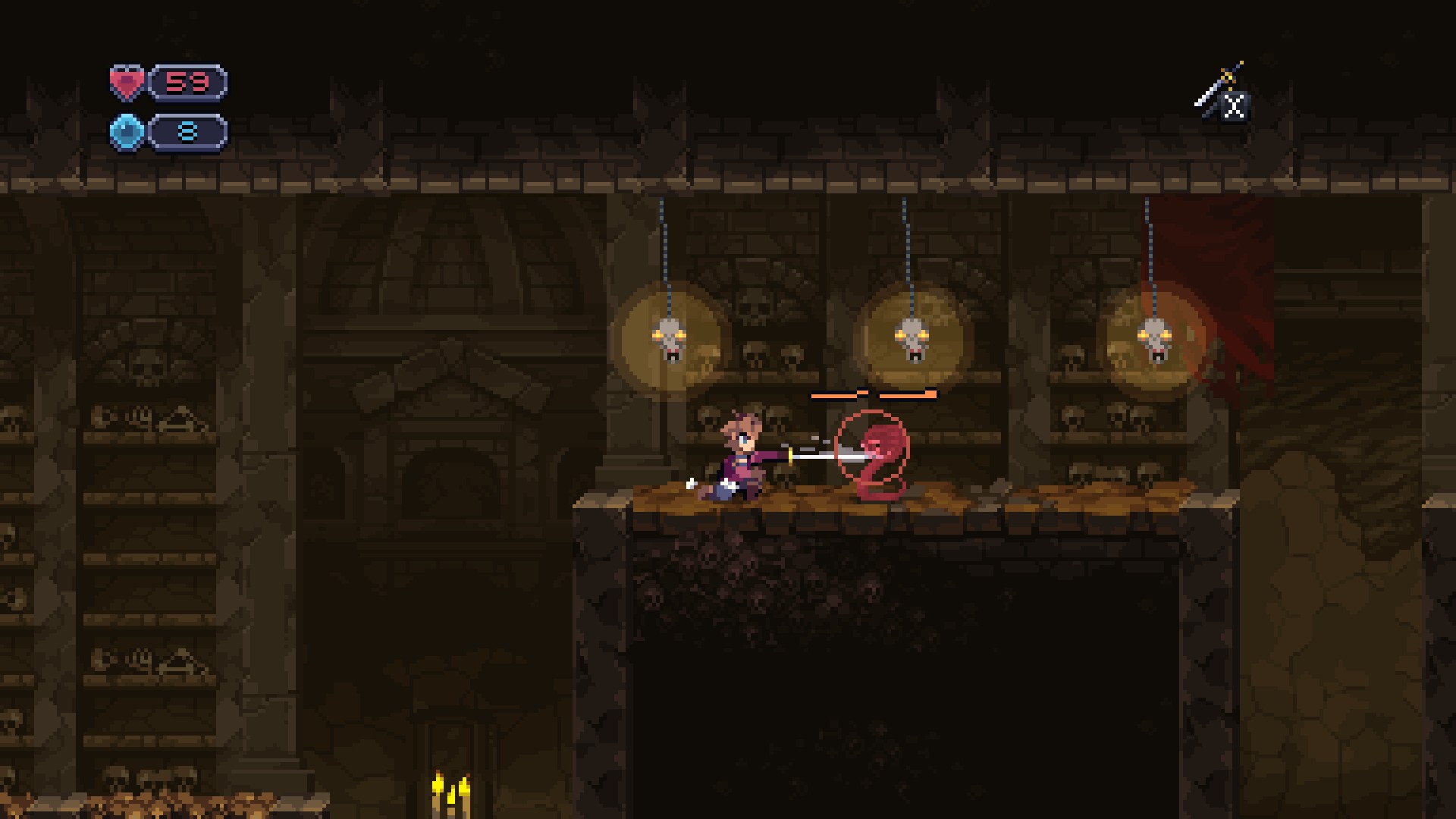
Hearing the descriptors "Metroidvania" and "Roguelite" tend to perk up my ears, so imagine how alluring Chasm appeared when it promised to combine both. Although I didn't back the game on kickstarter it was always on my radar, inevitably worming its way into my bustling backlog. Ironically, what got me to finally dive in was seeing the number of mixed reviews for it on steam—could a game that looks this good miss the mark that badly? After delving through a lot of good games recently, I figured it was time to plumb some supposedly mediocre mines. And you know what? For a game made by such a small team, Chasm isn't all that bad!...

... buuut I'm still going to talk about a bunch of things it bungles.


The first bit to note is that while Chasm pegs itself as a roguelite-Metroidvania, it's considerably more of the latter than it is the former. I played through the game twice (once on normal, once on hard) and the only major difference between the two worlds were a handful of new rooms. Everything else is lightly shuffled around; expect to run into the same enemies, items, power-ups, bosses—you name it. Even the general map structure is identical, with save points and warp zones located in roughly the same spots. Venturing through Chasm a second time will dispel the charm of its seeded worlds, revealing a single blueprint hiding behind a maze of mirrors. Honestly, you'll find more variety in a replay of Mass Effect.

Another one of Chasm's issues is that it has a bit of an identity crisis. Castlevania: Symphony of the Night isn't just an inspiration for the indie title—it's the very foundation that Chasm is built on. Numerous fundamentals have been carefully replicated, from attack animations to the UI, to relics, to backdashing, weapons, subweapons, items, pets, afterimage sprites, and even Symphony's peculiar jump canceling. Hell, they preserved the annoying "boot back to title screen after death" too! Rather than refine any of these systems or add a unique twist, Chasm is content to simply ape them... which is a disappointment for anyone hoping for an evolution of the Metroidvania formula.

A weird quirk that demonstrates Chasm's penchant for playing it safe is found in its lore—specifically, that there isn't any. The plot is fairly bare bones, teasing a cliché, soon-to-wake evil that only you can defeat... and that's about it. Chasm could've fleshed out its world using the flavor text of the items you come across, but just like with Symphony of the Night, any text is entirely descriptive. Food, weapons, armor, gems, spells—all of them have dry descriptors and zero history. Worse yet is that the bestiary lacks flavor text entirely! It's a bare-bones concept that even Symophony of the Night included! If gameplay is all that matters to you then you can easily ignore these oversights, but considering how much attention is paid to Chasm's aesthetics, it's strange that they lack any kind of substance.


The benefit of copying Symphony of the Night is that it's admittedly a good game to imitate—and Chasm does this impressively well. Your character handles smoothly, hitboxes make sense, and your arsenal is decently varied, ranging from speedy daggers to powerful clubs. It also helps that Chasm is an unbelievably gorgeous game, packed with fluid animations and some truly impeccable background art. The visuals are hands-down Chasm's best quality, but the enemies and bosses you'll face offer a ferocious runner-up. One of the things I came to appreciate most about Chasm is that it has a fantastic difficulty curve, one that ramps up quite harshly towards the end. I personally enjoy Metroidvanias where the consumables you amass become pivotal to your success (unlike Symphony of the Night, which gives up early on and plateaus in difficulty.)

Design-wise, Chasm also has a smart blend of platforming and combat, frequently testing you on both in a number of ways (and occasionally at the same time.) Unfortunately, due to the roguelite aspect, you'll run into repeating rooms and enemy arrangements, with the worst being the monsterless vertical climbs that offer no challenge whatsoever. The game is generally well-paced though, with warps and saves placed a good distance apart and in much-needed locations. You'll often have to fight tooth and nail to make it to the next save, especially on Hard where enemies can destroy you in a scant four hits. However, I do wish there was a warp that took the player straight to town; the two screen buffer between the town and the warp hub feels like an unnecessary tax on your time, a problem that's exacerbated by how often the game wants you to check up on rescued villagers.

Lastly, Chasm's major power-ups are a real mixed bag. Most of them are your typical Metroidvania mobility upgrades (ledge grab, double jump, sliding), but a handful wind up being used a total of two to four times total. The diving gear and translation book could've had some cool uses, but they're effectively single-use keys that are hardly worth including. The lantern also feels like a missed opportunity, having only one side area dedicated to it—and considering that you can only stumble upon that zone after already acquiring the item, it feels less like you're consciously using your lantern to plumb new depths and more like the next mandatory trek is merely... darker than normal. Similar to the flavor text, this isn't a hugely detrimental oversight, but rather just another example of how Chasm fails to capitalize on its good ideas.


There's plenty of worse Metroidvanias to spend your time on than Chasm—which isn't exactly the most glowing of praise. It's undoubtedly a well-made title that hews closely to the modern Castlevania formula, potentially making it worth a play for Igarashi fans salivating for another dose of his particular blend. But in taking from both metroidvanias and roguelites, Chasm sadly fails to do justice to either. It's competent but unremarkable; clever but repetitive; sharp but safe. Chasm is a decent game for a small studio, but as a "roguevania", it's...

... well, it could've been better.

Monday, August 29, 2022

Celeste - Thoughts


[contains minor spoilers]

Behind Celeste's cartoonish art style and vivid color palette is a story about struggle. The struggle of trusting others, the struggle of accepting oneself, and most pointedly, the struggle with failure. Few games are as honest and forthcoming about their themes as Celeste, which opens by telling you that your goal is to climb a mountain. It's a daunting task that weighs on every character in the story, growing heavier and heavier as the air continues to thin. Yet there's a beautiful brutality to it in hindsight, like catching the sunset glimmering over a lake during a marathon. The catch is—like with any fulfilling activity in life—that to get the most out of it, you have to struggle.

And if you're interested in the postgame, that means struggling a lot.


Not since Super Meat Boy have I faced such an oppressive wall of difficulty in a platformer. But the good news is that if you're only interested in the main story, Celeste isn't all that bad. That's not to say it isn't frustrating at times, but if you stick with it you can clear the game in under 1000 deaths. Compare that to the postgame, where there's a chance the tally will skyrocket up to 10x that amount. If that number appears dispiriting, what helps take the edge off is that Celeste has lightning quick restarts to keep the action rolling. It's a minor but crucial touch, one that keeps the player invested in maintaining their groove even in the most absurd situations (like at the start of stage 3's C-side).

What also helps is that your next checkpoint is always close by, as individual sections in Celeste are pretty short (besides the damn C-sides). Stages usually consist of 1-2 screens littered with obstacles and spikes, with checkpoints doled at every screen transition. This keeps its individual challenges brief and surmountable—which is ironic, given that Celeste's levels on the whole are lengthy and grueling. The shortest stage takes around twenty minutes to complete, with the rest of the levels gradually adding to this time until it culminates in the one hour endurance test that is the final level (which will feel like a joke after Farewell). Stages in Celeste are more like entire worlds from Super Meat Boy—but even then, the latter title at least lets you skip its hardest levels. Meanwhile Celeste... well, it is a game anchored in struggle after all.

Thankfully, similar to many of the best platformers, unique mechanics are frequently interjected to spice up gameplay. While you can expect genre staples like springs, wind, and falling platforms, what surprised me were some of the mechanics not seen in many (any?) platformers before: permeable star blocks, dash-activated blocks (both varieties!), gold feathers, and the entire hot/cold mechanic of the core (as well as its clever dash limitations). You won't ever find Celeste at a want for ingenuity... although there definitely are moments where it indulges in its design a little too long (specifically, the end of stage six). Still, it's impressive just how many mechanics Celeste crams into its relatively short run time.


Even more impressive than that, however, is that the game continues to teach you new things long after the credits have rolled. Within Celeste's bonus levels (cutely labeled B-sides and C-sides), you'll discover new ways to interact with old mechanics, as well as uncover two more dash maneuvers. Like with Super Metroid, what's nifty about these hidden abilities is that they've been available to you from the very start, opening up the ways you can interact with the game on a replay. But be forewarned that they're not for the faint of heart; wavedashing in particular is a fickle beast, something I could barely get to work properly half of the time. You don't need it for the majority of the game, but the spots where it is required will definitely test your resolve.

I maintain that the gameplay in Celeste is its greatest asset, but it's no slouch in the narrative department either. The story here is simple yet potent, opting to avoid the granularity of mountain climbing for a more introspective look at its characters. You won't find an in-depth discussions as to the lore of the mountain or how its magic operates either; Celeste keeps its eye squarely on the future, less concerned with the "why" and more with the "what are you going to do about it?" It has a great message about coming to terms with who you are, conveying its emotion not just through the writing but its wonderful art, music, and even sound effects. Plus thanks to Celeste's brilliant assist mode, nearly everyone can make it to the top to see how the story concludes.

Don't be surprised however, if you're initially drawn in to the story but wind up staying for the gameplay.


While climbing Celeste, expect your palms to sweat, your joints to ache, and even your fingers to callus over. Despite its lighthearted exterior, Celeste is a hardcore experience that can give even the most hardened platform-savants a run for their money. But it's never flagrantly cruel or purposefully pernicious; Celeste is about keeping calm and finding a surgical solution to your problems. And more important than that, it's about knowing your limits—do you want to get all the strawberries? Finish the merciless B-Sides? The punishingly precise C-Sides? Endure the bottomless abyss of the golden fruits? To play Celeste is confront your limits, understand your capabilities, and not beat yourself up if it gets too hard. Through play you'll struggle, and in struggling, you'll cultivate the chance to succeed.

And few things are as tremendously satisfying as finally besting a challenge that had once seemed all but impossible.


Celeste is a really cool game that deserves all the praise it gets.

Sunday, July 31, 2022

20 Minutes Till Dawn - Thoughts


[This is an Early Access Review, July 2022]

Despite the low price point, I was never compelled to pick up Vampire Survivors. From its silly, totally-not-Castlevania art style to its annoyingly long lootbox animation, I never felt like I was missing out on anything special. The player characters were as slow as molasses, enemy mobs behaved too similarly, and thirty minutes just seemed a bit too long for such basic gameplay. Of course the game has evolved plenty since release—a cursory search on youtube will reveal a kaleidoscope of psychedelic colors and yellow numbers—but Vampire Survivors always felt like it was missing something to me...

... something like a gun.


Well that's not totally true—20 Minutes Till Dawn also looks tremendously better than its spiritual predecessor. The 4-bit aesthetic is sleek as hell, using salmon pink (of all colors!) to wisely convey danger. That small touch allows players to read the battlefield, even amidst a violent storm of chaos. Rest assured, 20 Minutes Till Dawn will always get hectic, especially when you're new and unaccustomed to the visual effects of your numerous upgrades. But as long as you've developed an eye for shmupping, the game never gets too noisy—well, just make sure you avoid taking the Splinter upgrade with the grenade launcher (a mistake you definitely won't repeat again).

Speaking of upgrades, 20 Minutes Till Dawn offers a buffet of useful abilities, each of them important to at least one viable build. Of course you'll quickly latch onto some obvious favorites (I take Run & Gun, Kill Clip, and Frost Mage on nearly every run) while others may only find themselves considered in the most niche or desperate scenarios (Focal Point, Watch & Learn, Giant, and the entire Ghost Friend tree). But unless you're playing with the same character and weapon every time, you'll inevitably come across a tough decision to agonize over—especially since one wrong upgrade could cost you the entire run on harder difficulties.


More and more, I'm becoming convinced that granular difficulties à la Slay the Spire are the best fit for roguelites. Not only do they acclimate you to the game's changes one minutae at a time, but they naturally encourage multiple runs, ensuring you can't stumble your way into a lucky victory on "hard" and call it a day. 20 Minutes Till Dawn starts off fairly easy but really ratchets up the intensity, especially when standard enemies are given a minor speed boost. Darkness 15—the (current) final difficulty—forces you to experiment with different runes and upgrade pathways, which can be frustrating when you're missing that one powerup you really need, but invigorating once it all finally comes together. It's a good blend of RNG and skill, though some characters/gun combos will be notably easier to win with than others.

If there's something to criticize about 20 Minutes Till Dawn (besides elemental builds being the best and summon builds the worst), it's that each run always has the same peaks and valleys. Specifically, the second and fourth bosses will be your biggest obstacles, both of them a tense encounter that can drop your health in the blink of an eye. It's a cool challenge you have to consciously spec for... but nearly every other boss is a simpleton in comparison. In fact, the final three minutes are more or less a victory lap; if you can survive being caged in with the spinning laser blob, then there really isn't anything that can stop you outside of closing your eyes and letting go of your controller. Hell, in some rare cases you might win anyway (ah, the beauty of triple Glare)! It's just a shame that over the course of a twenty minute non-stop brawl, there's only a few memorable bits—and they're the same ones every run.


20 Minutes Till Dawn is a great game that offers considerable bang for your buck. It requires a decent blend of deft dodging and smart upgrading, promising a fireworks-like spectacle if you make it to the end. No doubt the game can be vexing when you aren't offered a pivotal powerup—speed upgrades are essential for Darkness 15—but it's thrilling to know that success isn't always a guarantee (again, at least on Darkness 15). While I look forward to seeing how 20 Minutes Till Dawn develops, I've probably had my fill for now, content to leave its banquet of bullets with my stomach stuffed and satisfied.

(Oh, and avoid Endless Mode—at least for now. It's a repetitive snoozefest that lasts over two hours, which is waaaaaaay too long for a game this bite-sized.)

Wednesday, July 27, 2022

The Room - Thoughts


When I started The Room, I didn't expect there to be quite so much... clicking. A cursory glance suggested perplexing riddles or logic puzzles, but the entire experience is leagues simpler than that: The Room is a linear series of fidget cubes. Well, elaborate fidget cubes—which at least require some semblance of logic to puzzle out. For those tickled by antique wooden boxes hiding a plethora of compartments, The Room is a cool game... but venture into it understanding that it values a curious mind more than a sharp one.


About an hour in, I understood why the series is buzzing with positive reviews—there's not really anything like it out there. Sure, you get an occasional puzzle box in Resident Evil and Uncharted, but a whole game based off pulling out miniature drawers to discover bizarre keys? That's an untapped (digital) market! And thankfully, Fireproof Games knows how to design a game around prodding and poking an ornate box full of secrets...

... for the most part.

In order to investigate a particular section of the puzzle box, you first have to zoom in by double clicking nearby. But you can't zoom in anywhere you want; sections are delineated, forcing you to click around frantically to see what is and isn't interactable. Sometimes you'll zoom in on completely innocuous bits that don't have a use (yet) and other times the camera will send you right beside the thing you actually want to investigate. And since clicking can also manipulate objects, you'll be frequently mashing your mouse pointer against anything and everything, in the hopes of uncovering a secret pressure plate or hidden dial. It never gets as bad as pixel hunting in adventure games, but trying to find every interactable object does evoke a similar confusion—if not frustration.


This isn't a minor inconvenience either, as aimless clicking composes most of The Room's playtime. But if you can put up with it, there are some cool animations and nifty perspective puzzles to behold, along with some really gorgeous puzzle boxes. Seriously, if any screenshots from The Room capture your interest, it's worth the price of entry just to explore each chapter's convoluted wooden contraption. There is an undeniable delight in watching a latch or spindle slide away to reveal a new piece of the puzzle, all while staying (mostly) consistent with the internal dimensions of each box. The way hinges creak and gears click is impeccable too—if there's something Fireproof Games got right, it's making the boxes the star of the show.

The last gripe I have with The Room is that it's ultimately... directionless. When you start the game, both the setting and narrative seem to indicate you're on the verge of discovering something far beyond your imagination. And while I liked the occult flavoring, the experience doesn't really lead anywhere conclusive—at least for the first entry in the franchise. There's some cool art and non-Euclidean trickery in the latter half, but at no point does it feel like you're building to the final puzzle or an unspeakable treasure. In fact, you don't really fulfill your main objective at all; the game kind of just ends and goes "hope you're ready for more some day!"


You can blast through The Room in a handful afternoons, and that's honestly the perfect length of time for the game. There are some neat bits and bobs here but nothing that will really stick with you once the experience is over, besides a feeling of "I guess that was cool." Yet conversely, you won't ever get stuck in it for too long, as you know the path forward has to be located somewhere on the exterior of the object before you. While I would've liked more meat to the game (1/3rd of the puzzles have you making the same shape over and over), I'm glad The Room exists for puzzle box enthusiasts—and I'm curious how the series expands from here.

Friday, July 22, 2022

Neon Abyss - Thoughts


[contains minor spoilers]

Three runs deep, I had a troubling realization: Neon Abyss wasn't winning me over. There are other roguelites I dropped faster than it (Legend of Dungeon, Sublevel Zero), but I wasn't itching to plumb its depths the same way I had with Spelunky, Dead Cells, or Crypt of the Necrodancer. On one hand it's unfair to compare it to the genre's greatest, but on the other hand Neon Abyss has the chops to contend with the best: it's smooth, flashy, meaty, and has a sardonic charm that helps it stand out. But even after besting its managers (both regular and cursed), I still find it... lacking in a lot of ways. Succinctly put: Neon Abyss is a fun game, but I don't think it's a good game.


Or perhaps I should specify that it's not a good roguelite, as my issues mainly stem from Neon Abyss's poor balance run to run. As a game it can be quite captivating, handing you quirky weapon and item combinations that will bathe your monitor in bouncing lasers and cascading explosions. If there's something you can expect from Neon Abyss, it's bang for your buck: there's a staggering amount of enemies, items, characters, oddities, and unlockables here, ensuring there's something new to contend with each run. Despite my playtime clocking in at over twenty hours, I've only laid eyes on 75% of the power-ups available—and what I've currently seen is more than enough to check a box labeled "variety" multiple times over.

But the byproduct of having a mountainous heap of options is that a certain portion of it is destined to be junk. And the garbage isn't on the periphery either: there's a myriad of common power-ups that range from mediocre to detrimental. Even items that could be useful under certain conditions (like spite-producing power-ups) are all but useless unless you can proc them consistently (so pray Animosity falls into your lap). I think a big part of the issue is that while certain guns or items are fine to run into, the really good ones (Lipstick, Forbidden Mask, Most Wanted List, Howard Reactor, Divinity) are so invaluable that it's frustrating when you're deprived of them, instead offered rubbish like Matchbox and Black Rum. The worst is the entire subset of melee power-ups—melee is a risky, impractical, and sloppy alternative to simply shooting your problems away from across the room. I mean come on, a huge amount of enemies and bosses are airborne!

Weapons sadly fall prey to this disparity too, although you'll have a better chance of encountering at least one decent one in a shop. Unfortunately, your starting weapon will always suck with no exceptions—which makes finding a new firearm a top priority. Gun upgrades can help transform an anemic firearm into a capable one, but some weapons (Phantom, Thunder, Noise, Deathray, New Type) will always stink compared to their kin. Meanwhile armaments like Famine, Animosity, and Vortex are so devastating that you can stand still and decimate encounters—including some of the toughest boss battles! 


Anyone that's played The Binding of Isaac knows that imbalance is sown into the roguelite turf, but player skill usually helps buffer that annoyance. Namely, that Isaac (and Gungeon and dozens of others) are played as a twin-stick shooter, where good positioning and sharp reflexes can counterbalance some of the worst loot drops. But Neon Abyss is more in line with a run'n'gun, cutting the second dimension out of your movement. This makes it notably harder to dodge enemy attacks, especially when they warp in right above you like in arenas. And there's no floaty ScourgeBringer physics or Dead Cells dodge mechanic to assist in avoiding attacks either—the best way to dodge is to kill your enemy ASAP, or pray you find a rare flight-granting item (which then trivializes the rest of the game!)

You'll learn quickly that there are very few comfortable middle grounds in Neon Abyss—victory will either come easily or feel impossible. Nothing embodies this better than the arena fights, a trio of tight encounters you're encouraged to beat without taking damage. Victory will reward you with a much-needed gun upgrade—but if you've brushed against a single bullet, you'll receive a consolatory bomb/key/nickel instead. Fights don't really scale past the second level either, meaning that if you can best your first few arenas you'll basically snowball your way to victory. Yet on occasion you'll encounter an arena where you simply need to dodge a predictable laser, a task so straightforward that your weapon upgrade is guaranteed upon entry.

And stuff like that is pricks me about Neon Abyss: it leans into randomness too hard. Sure, thematically the game gels with chaos like chocolate does with marshmallow, but so much of the game is RNG stacked atop RNG. There are so many sources of randomness: shops, eggs, crates, chests, bricks, arcade rooms, Smirk counters, roulette machines, roulette doors, roulette boxes, roulette rooms, roulette stages... hell, even the gun upgrades that drop from bosses will randomly cycle between 1-3 random powerups! I know RNG is the lifeblood of roguelites, but Neon Abyss fixates on gambling to the point that it stacks random rewards inside of its random rewards, like a self-propagating matryoshka doll. Anyone that's gone through a room full of chests, tried fishing, or suffered through a clown room will know exactly what I'm talking about.


I know I've been relentlessly trashing on Neon Abyss, so let me at least clarify that there are definitely some cool things about it. One of the most appreciable touches is how much the player can customize their experience; beyond difficulty and character selection, you can choose from a handful of items to start with and remove upgrades, items, and even enemies you don't like! Plus the power trip Neon Abyss sends you on can be as fulfilling as it is ludicrous, with entire rooms melting under your gigantic, wall-piercing quintuple laser. And considering how there's two items per treasure room, wisdom & violence rewards, and a shop on every floor, it's pretty hard not to cobble together a winning build (at least on Normal.) The game is fairly laid-back once you get used to its eccentricities.

The problem, however, is that even with these eccentricities accounted for, Neon Abyss continues to feels unbelievably sloppy. Every run devolves into a landslide of visual chaos, making it impossible to tell where attacks are coming from or what's happening most of the time. Endgame fights like Hal, Zeus, and Athena are a collage of colors that will not only obscure incoming attacks but are guaranteed to obliterate most of your pets (RIP pet builds.) Yet what's weird is you don't really need to know what's happening either; should a Basketball Jersey, The Towel, or a decent weapon be in your possession, you can tank those bosses like nobody's business. It was only on my fourth Prometheus kill that I finally understood what the hell was happening during phase 2!

What really put the nail in the coffin for me and Neon Abyss were the damn wisdom chests. To reach the true final boss, you have to traverse either the path of wisdom or violence—which just means opening up a bunch of their respective chests. But a major problem is that wisdom chests that take damage turn into violence chest—and not the other way around. So on more than one occasion I failed to reach Cursed Athena due to a wisdom chest taking unavoidable damage from an enemy on the other side of the room, with no way to prevent it! Hard mode bafflingly compounds this issue too, occasionally making it impossible to reach Cursed Athena/Ares due to not enough chests spawning. Why? Why allow me to make it so far through the game just to shrug and go, "Oops, try again!"


In some ways, one can argue that Neon Abyss succeeds with flying colors—brilliant, blinding, and absurd flying colors. But for me it's just too sloppy, noisy, and undignified to warrant returning to. Team 17 feels more concerned with content than balance, addicted to designing new roulette wheels for the player to waste their time on. Again, I can't deny that I already played a ton of the game and had a lot of fun doing so, but boy howdy was I wrong in assuring myself that its peculiarities would become palatable if only I stuck with it.

At the end of the day, perhaps it's just a difference of opinion. Whereas Enter the Gungeon sought to make Binding of Isaac more serious, Neon Abyss zips off in the opposite direction at full speed. Neither is the "right" or "wrong" approach—I just find Gungeon to have more of a substantive and balanced game to it compared to Abyss. If a zanier, less coherent Binding of Isaac sounds like your jam, then Neon Abyss might be right down your alley. Just be wary that the flashing lights of this neon alley might be all there is to it.