Showing posts with label Metroid. Show all posts

Monday, September 21, 2020

Metroid Super Zero Mission - Thoughts


Metroid Super Zero Mission is a hack of staggering ambition. Crafting a unique rom hack out of Super Metroid's mold is difficult enough, but to throw Metroid: Zero Mission's blueprint in there as well—a game which itself is a reinterpretation of the original Metroid—is a mind-boggling task. The original Zero Mission acts as a sort-of interquel between the two Metroid titles, so I wasn't sure what Super Zero Mission was going to bring to the table. Plus most Super Metroid rom hacks are already "remixes" of the base game (aptly deemed "halfhacks"), and those are typically so lazily cobbled together that I prefer a hack that's wildly new and fresh (like Super Metroid Phazon). But SBniconico's take on the formula blew me away; Super Zero Mission is not only a stunning game in its own right, but its old school design is so meticulous that it becomes downright terrifying at times.


I would be hard-pressed to say that Metroid Super Zero Mission feels like a proper Nintendo title. It's as refined as Another Metroid 2 Remake, but AM2R frequently exhibits a soft, careful touch, so as not to drive off newcomers. Super Zero Mission, by comparison, is very much a game made by a Super Metroid expert for Super Metroid experts. It could theoretically be beaten by someone that has casually finished Super Metroid, but it would be an arduous and frequently punishing endeavor, requiring tight maneuvers like the midair horizontal shinespark. God only knows what is demanded of the player in the hard mode of the hack!

While Super Zero Mission is unarguably tricky, it never becomes insurmountable or cruel—not once did I need to revert to save states or backtrack to find e-tanks and missiles. But Super Zero Mission relentlessly tests your dexterity, observation skills, and memory of the older games. Even the bosses have undergone meaningful changes, their room layout altered and health buffed. There are two noticeable difficulty spikes in the game (Pirate Ship & Chozodia), but as long as you keep your wits about you and press on, you won't be stymied beyond a couple of painful deaths. I'd personally label the game "beatable" in the same way that I would tell anyone that Dark Souls or Contra is "beatable"; those unable to rise to Super Zero Mission's expectations will find it unfair, confusing, and ultimately frustrating.

Though the game is nowhere near impossible to finish, 100%ing it is a different matter. A couple power-ups are tucked away in such mystifying, nonsensical spots that finding out how to access them is akin to reverse-engineering a programming puzzle. For instance, speed booster blocks will taunt the player in a location far from flat land, and there's a constant use of foreground tiles that hide tiny morphball-sized paths. The presence of these ultra-hard power-ups don't ruin the game—I was definitely comfortable with my arsenal by the end—but it will be extremely vexing to completionists. Don't be surprised if Super Zero Mission reveals just how little of Super Metroid you truly understand.


Besides the maddening items that will linger just out of reach, the design of Metroid Super Zero Mission is also... pretty maddening. But it's a good kind of maddening, something that turns level designers green with envy. One of the biggest examples of this is that SBniconico has made hack super speedrun-friendly. This manifests itself in minor ways while you're playing; occasionally you'll stumble across a crumble-block cul-de-sac that tips you off to the presence of a shortcut. The concept is ripped directly from Zero Mission's speedrun-friendly layout, and like that game you're not likely to utilize any sequence breaks until you read about how you're supposed to access them.

What makes this feat more impressive than Zero Mission's is that the hack is massive, littered with plentiful opportunities for the player to get themselves into an area they're not prepared for. Yet SBniconico's design is so precise that it's not likely to happen, even when you think you've stumbled upon a secret path. In fact, Super Zero Mission depends on you sniffing out obscure tunnels in order to progress normally, especially towards the end when the game explodes into a maze of optional paths. This keeps you feeling like an intrepid explorer while hiding the fact that you're barely scratching the surface of the game's mysteries.

You would think that dull rooms and getting lost would be an inevitable byproduct of a hack of this size, but Super Zero Mission is almost always on point. Every room serves some kind of purpose and acquiring a power-up has you organically funneled towards your next destination. Even vets of Super Metroid will find themselves surprised by some of the twists and turns here; Tourian in particular is an awe-inspiring section that kept me on edge. If I had to describe Super Zero Mission in one word, it'd probably be "brilliant"—but it's a niche brilliancy, one that works due to the Metroid framework, cleverly juggling the known with the unknown.


Metroid Super Zero Mission's excellence is undeniable. Every area has been properly changed and feels perfectly tuned, incorporating an adroit blend of the base game with Zero Mission's philosophy—while still managing to exhibit SBniconico's unique, personal flavor. It's a great game!... but it's not for everyone. For Metroid experts, Super Zero Mission is a satisfying (and occasionally challenging) meal. For regular fans however, I fear it'll be an arduous climb that'll either make you hungry for more or turn you off of romhacking forever. I wouldn't stop anyone from trying the game out—it is great after all—I just wouldn't be surprised if their takeaway is that it's "too much."

Saturday, August 8, 2020

Super Metroid Phazon - Thoughts


It is nearly impossible to re-capture what made the original Super Metroid so special. So much of the game is immersed in nostalgia, and what isn't is difficult to quantify and explain. There's a je ne sais quoi to its world and atmosphere—familiarity and alienation are masterfully blended together, forming a curious stew that you can never quite identify the ingredients of. And for the most part, a lot of Super Metroid rom hacks approach this untouchable recipe with strict reverence: weapon progression is similar, zones feel roughly the same, and your journey will always end with the player blasting Mother Brain to bits. But Super Metroid Phazon eschews with the formal, seeking to hone in on something that Metroid fans love but don't frequently emulate:

Weirdness.


Now, of course there's a lot of ugly, oddball hacks out there, but what those fail to understand is that Metroid has always had a sort of... dignified weirdness. The fauna is unnatural (if not a bit quirky) and the zones are colorful, but nothing is mismatched, nonsensical, or garish; a bright pink mossy almost makes sense coexisting next to a ruddy stone shaft. Metroid unnerves but never repels, and Super Metroid Phazon respectfully understands this concept. Not only does it shake up the typical Super Metroid item and boss progression, but it tugs at player expectations with its eerie alien ambition.

First, you'll awake as Dark Samus inside of a malfunctioning capsule, mere steps away from a free energy tank and an empty red door on the ceiling. Rather than run across the surface of an alien planet in search of the morph ball, you'll dive through underwater passageways, climb frozen cliffsides, and dart past a boss for your first missile pack. Soon you'll uncover a big room that displays a picture of all the areas in the game, your next destination indicated by a small flashing dot. You won't find maps to download, a ship to recharge at, or item hints on the minimap. And as you collect beam powerups, you'll find your arm cannon gets slower—rather than stronger—when the beams are stacked. While Super Metroid Phazon may look familiar, it doesn't feel familiar in the slightest.


What really helps differentiate it from a lot of other Metroid hacks is the visual presentation. Super Metroid Phazon brings with it a massive graphical overhaul, changing nearly every enemy, every zone, and even the UI itself. Caverns, phazon groves, and underwater trenches look realistic and beautiful at times, while the massive complexes of Tetrafuse are unsettling and inexplicable. The entire world of SR217 is infested with snakelike piping, protected by strange machinery that rarely resembles anything humanoid. The bosses themselves have really excellent sprites (Kraid in particular), their attack patterns the only indicator of what they once were. In fact, if there's one thing from Phazon I'm likely to remember, it's how bizarrely rectangular most of its enemies were.

Besides the new coat of paint, the most memorable aspect of Super Metroid Phazon is how massive the world is. My run-time clocked in at a total of 7:24 with only 77% of the items obtained, and (at least I thought) I was pretty thorough. A good chunk of time was spent hunting down the Prime-esque collectibles required to reach the final area (an interesting addition), as well as traversing the land since the screens themselves are also gargantuan. The Tetrafuse towers are mechanical mountains to explore, and the lower depths of the Sewers is one of the coolest journeys: it goes on forever and is mostly empty. "Vacancy" may not sound like much of a compliment, but plunging down to its dark, aquatic depths will make you feel insignificant and alone, eager to find signs of life (or missiles!) amidst the coral.

There's really not much criticism I have to offer for Super Metroid Phazon, as I really dug its aesthetic and direction. If anything, I feel the first half of the game where you're brilliantly strung along from powerup to powerup is the strongest, and sniffing out the Prime-collectibles in the second half not only lacks difficulty but is a bit too aimless (I accidentally missed the final beam powerup). I wouldn't say Phazon overstayed its welcome, but for as cool as the long trek through cavernous rooms are the first time, they're plainly exhausting on revisit. Warp points thankfully mitigate this issue, but you should still prepare your legs for a hefty workout.


If Super Metroid is one of your favorite games, I implore you to give Super Metroid Phazon a try. It's not a major overhaul that retools enemy AI or adds cool new items, but it deftly transcends the typical "second quest" trope a lot of hacks fall into. From the great new visuals to the completely new world, Phazon feels like an alternate dimension parallel to Super Metroid—or maybe more aptly, a third party stand alone sequel. It plays around with the Metroid formula and succeeds, creating a tantalizing soup to Super Metroid's special stew.

Thursday, November 30, 2017

Metroid: Samus Returns - Thoughts


I feel bad for developer MercurySteam.

It's not hard to surpass Metroid II: Return of Samus—the Game Boy entry is claustrophobic, confusing, and very repetitive. Applying typical Metroid tropes to it would work wonders, which is what Another Metroid 2 Remake did... almost a full year before Metroid: Samus Returns was even announced. Nintendo hitting AM2R with a DMCA notice only made Samus Returns look like a big bully in comparison too, even through MercurySteam had little to do with it. Add in a trailer full of zoom-ins, sprites swapped out for polygons, and a developer ludography that—while great—leaves fans with plenty of reservations, and you're left with the sinking feeling that Samus Returns is going to be the final nail in the blonde bounty hunter's coffin.

Thankfully, this is not the case; Metroid: Samus Returns is an excellent, modern companion piece that works with AM2R, not against it.


Part of the reason why I sympathize with MercurySteam is that for many fans, Samus Returns is inevitably going to be compared to AM2R instead of (the far inferior) Metroid II. Luckily Samus Returns sidesteps this issue by being retaining an identity that's unique to the other two titles. While AM2R looks to Metroid II as a wizened master it must study the blueprints of, Samus Returns treats the Game Boy original more as a reference than a template. Sure, you'll have to hunt 50 metroids in one-on-one duels, and the number of demarcated areas remain the same, but besides that there's not much connective tissue between the titles. Samus Returns has a slew of new mechanics, new enemies to wrangle, and most notably—a massive new world.

Metroid: Samus Returns is unarguably the largest 2D Metroid game to date. It took me nearly ten hours to 100% it, and that was without getting stuck or lost; the amount of land you'll have to traverse is staggering. MercurySteam knew this, so they tweaked Samus to move at a swift pace, but it nevertheless remains a gargantuan game to explore... which is cool! It's nice getting such a huge Metroid experience to sink your teeth into, especially since uncovering the map manually turns you into a one-woman deep-delving pioneer. The problem that comes from this however, is that a lot of the areas feel... samey.

There's not a lot besides background decorations that separate one setting from another. The most interesting "room" I can think of is the one with the crystal structure deep in Area 3; nearly all of the foreground architecture follows strictly to this gray concrete/stone theme. Each area has their own specific color hue, but that's not enough of a differentiator—the geometry and structural design between levels is essentially interchangeable. This is a huge bummer for someone that loves how distinct Maridia feels from Norfair, whereas with Samus Returns it'd be tough to look at a snapshot of a room and determine if it's from Area 2, 3, 4, etc.


The silver lining in the "sameyness between levels" is that it's probably the game's largest fault—everything else is handled with care and precision. Animations are smooth, Samus feels great to control, the parry mechanic is a blast to execute, and the Aeion abilities are fairly good additions. Missile expansions are sneakily hidden away in cramped, snake-like passages, which makes running around looking for secret entrances highly rewarding when you find them. The game is also really combat heavy, forcing you to stop every now and then to parry or dispatch a foe with a beam burst, but if there's one Metroid game you want the developer to nail the combat for, it's Metroid II.

Unlike AM2R, where the fights with the metroids became exhausting and drawn-out, there's a number of ways to subdue a metroid here. The manual aiming allows you to sneak in a couple of missiles on a their vulnerable underbelly, and it's invigorating to stare that energy sucker down right before you parry their ferocious bite. The zeta metroid in particular is an awesome enemy to engage with, having a wide variety of attacks while also not being as obnoxiously protective of its weak-point as the gamma mutation. The larger bosses are few and far between but they're also hell of a lot of fun to fight, really pushing you to be as accurate and responsive as possible. Perhaps what helps tip the game from "good" to "great" for me is that Samus Returns puts up a fight—you feel well-rewarded for finding every upgrade, since you'll routinely expend your energy tanks and missiles trying to survive the nightmarish depths of SR-388.


The core distinction between Metroid: Samus Returns and AM2R is showcased by how each game handles its final area: the latter retains the unsettling, monsterless jaunt to the final facility, while the former pumps that stretch full of enemies and power-ups. The difference here is in the influence of the original, as well as explosiveness—Samus Returns will happily discard the design of Metroid II if it can find a way to entice the play with intense combat or labyrinthine passageways. This may not sound like a design shift that honors the original, but it doesn't need to; AM2R is the devout successor to Metroid II, while Metroid: Samus Returns is its advanced contemporary. Both are directions I appreciate, and both are games worthy of the Metroid moniker.

Kudos on shattering expectations, MercurySteam.
---------------------

Images obtained from: PureNintendo.com, Nintendojo.com, gamesreviews.com, heypoorplayer.com

Monday, November 27, 2017

Metroid Prime 3: Corruption - Thoughts


[contains minor spoilers]

I couldn't never put my finger on why Metroid Prime 3: Corruption was so... odd to me. I don't think it's because of the shift to Wii-pointer controls, since I think the new control scheme suits the series better than the restrictive Gamecube setup (don't get me wrong—it was great for the time, but it wasn't really satisfying). I don't believe it was the greater emphasis on plot nor the focus on bounty hunters besides Samus either. Something about Corruption just didn't... capture me, despite the game being fairly engrossing and fun, maintaining the longstanding tradition of excellent art, music, and design that the series is known for. Whatever reason there was for Corruption sticking out like a sore thumb eluded me...

... but now, I think I understand why.


The Metroid franchise has always been about exploring strange alien worlds, but nothing feels quite so foreign as the start to Metroid Prime 3: Corruption. Listen to how crazy this is: your ship drops you off on a sci-fi military cruiser and you're greeted by two guards that tell you the captain wants to see you! Was the tutorial guest-designed by Bungie? Not only does the opening to the game feel strange due to the amount of dialogue and friendly NPCs you encounter, but there's a whole second half to the tutorial that's completely linear and profusely combat heavy. Suddenly, Metroid's penchant for loneliness and exploration has vanished, leaving behind an FPS shell that pretends combat and plot are core pillars of the series. In trying to appeal to newcomers, Metroid Prime 3 had succumbed to what fans feared most.

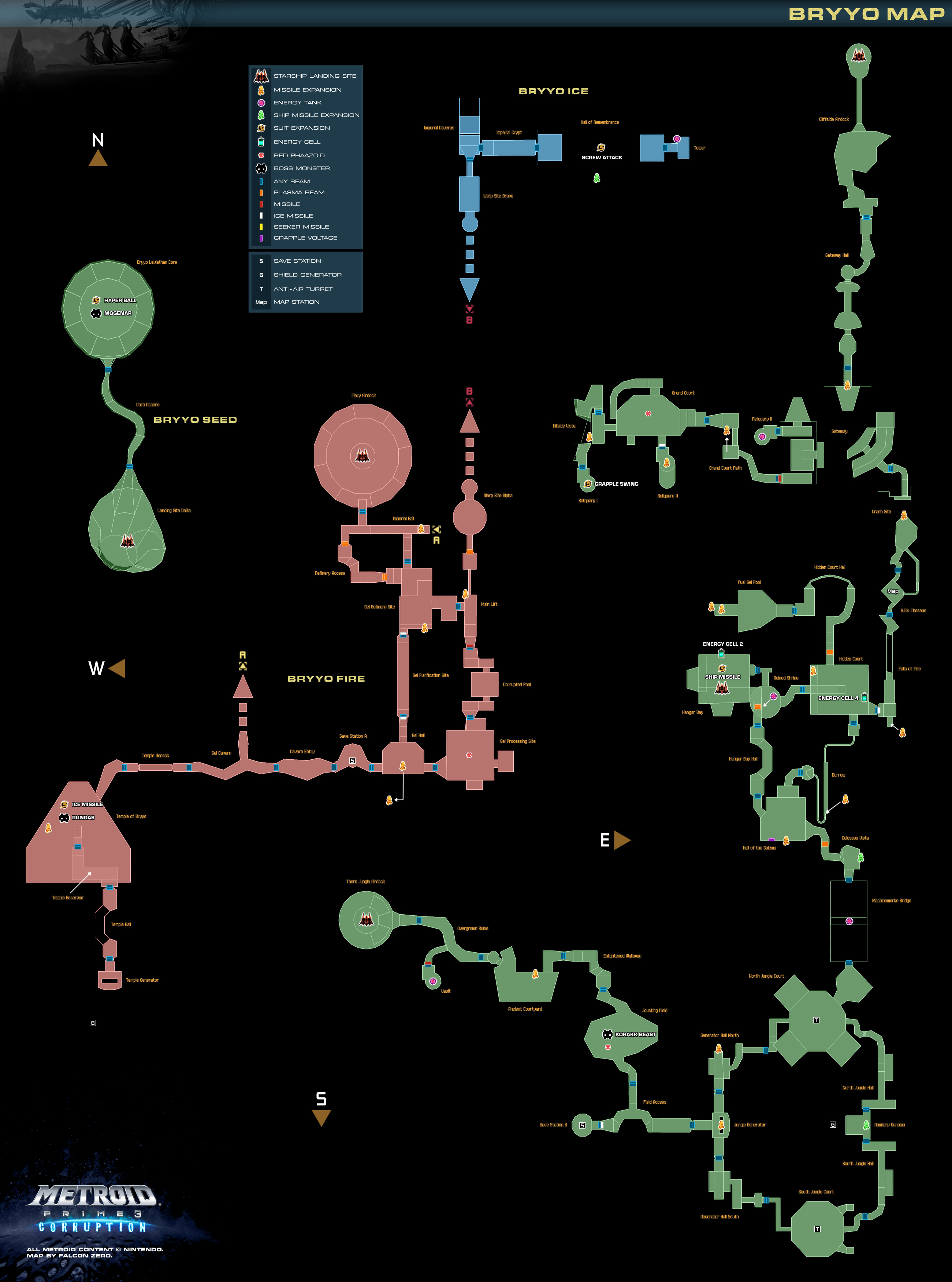
... But then you arrive on Bryyo, and suddenly everything feels normal again. Before you lies a bizarre landscape riddled with ancient machinery and aggressive fauna—distinctly Metroidian traits! Prime 3 only goes up from here, offering the player the jaw-dropping wonder of SkyTown, and later the gloomy Pirate Homeworld. The former is one of the most gorgeous areas in the entire series (rivaling Sanctuary Fortress), and the latter has this oppressive infiltration feeling to it, similar to exploring the Phazon Mines—except this time you're delving into a mechanized alien hell. Both areas have a really distinct feel to them whereas Bryyo is just kinda... there? It has some cool lore and differently themed zones, but everything kinda feels like a "been there, done that", while the worlds toward the end of the game—especially the final level in particular—really flex the creative muscles of the art team.

Metroid Prime 3 undoubtedly maintains the great enemy design and architecture of the series—so how the combat hold up? The most accurate way to surmise it is that the actions shifts from combat depth to combat proficiency. No longer are you equipped with multiple beams and missile combos; the brunt of the action is knowing when and where to activate Phazon Mode in order to salvage your energy tanks—even at their partial cost. Instead of having to decide between your ammo and your health like in Prime 2, here your ammo is your health, and I feel it's a step forward as you no longer feel powerless against the bigger foes in the game. This keeps the action at a brisk pace, even on the hardest difficulty.

Unfortunately, this comes at a great cost: triggering Phazon Mode is often the best combat decision to make in almost every encounter. Missiles continue to do pitiful damage, and the Seeker Missile is a poor replacement for the missile combo attacks, due to its long charge time. Combine this with the fact that enemies have the ability to go into a hypermode (and do so often on hard), and the simplest solution becomes pumping them full of phazon, especially since you can reap health from their defeat. This isn't a categorical step down however; there's plenty of smaller enemies to blast with your standard beam cannon, and your foes are far more nimble and engaging than in the previous Prime entries, thanks to being designed for the Wii controls. The bosses provide excellent battles by and large—my only qualm being that Mogenar's shielded weakpoints make the fight an abominable chore.


Okay, so the worlds are great, the combat has its pros and cons, and I'll mention now that the sound, music, and lore roughly retain the same quality. So why would Metroid Prime 3 leave me with such ambivalent feelings the first two times I played through it? The answer to this, as I've discovered, is deceptively simple—so much so, that it feels unfair to fault the game for this one addition.

It's because of Samus's ship.

And it's not because it's often used to justify the backtracking (though that does bother me), nor is it because there are a lot of "Wii gimmicks" in the cockpit (which I actually don't mind). Where the ship and I part ways is that's it's used to ferry you from place to place, thereby breaking up the world into quarantined parts. Bryyo is the worst offender of this, having three distinct areas that are mostly inaccessible from one another, forcing you to return to your vessel and hop around. The ship doubling as a warp-point causes the design to be far more linear too; Bryyo is chock full of straight paths that only serve to connect two rooms, rarely giving you alternate options when you go to backtrack through the game. Elevator loading times were also a necessary evil in the previous entries, but they're nearly tripled here thanks to the amount of traveling you'll do.

This aspect doesn't make or break the game though—all it really does is make Metroid Prime 3 feel... different. To be honest, I'm not entirely sure how any developer would go about making a Metroid title feel cohesive when it's spread over half a dozen different planets. I suspect a single terrestrial setting is something that's core to Metroid's DNA in the same way that wildly diverse lands are core to Mario's. But in any case, it makes the experience feel more artificially segregated, thereby dealing a huge blow to the "isolated immersion" that I love the franchise for. It's easy to become numb to it after a while, but you still spend roughly half the game playing something that just feels... uncomfortably weird. It's almost like Metroid: Streamlined Edition.

The last thing I need to cover is something absolutely worthy of praise: the endgame fetch-quest is optional! Well... not really—you still need to collect 5 of the 9 energy cells to reach the final level, but the fact that you don't need to gather them all is fantastic. Additionally, you can pick all five up without doing any backtracking, which is a huge boon for replays of the game. The GFS Valhalla is also really cool: it's an eerie wreckage infested with phazon monstrosities, where the majority of things to scan are chilling descriptions of how its crewmates died. It was an impressive level when I first played the game, and my adoration for it has only grown since then.


No matter how many times I tried to analyze what Metroid Prime 3 had done "wrong", there was little I could criticize that wasn't also present in other entries. There are exceptions of course—the atypical opening leaves a terrible first impression on Metroid vets, and missiles are not only useless but you can stumble upon their upgrades without looking—but nothing sticks out to me more than the physically separated worlds. It's a complaint I admit holds little weight if one doesn't care for it (I feel the intrusive plot could probably be more nettlesome to certain players), but it deprived Metroid Prime 3 of one of Metroid's cornerstones. Besides that, Prime 3 is a rather fitting closer to the trilogy, offering up a decent challenge along with some of the coolest worlds seen yet (did I mention how much I love the final level?) Retro not only handled the franchise with respect and admiration, but built further upon its foundation and style, leaving an proud, enduring mark that many now see as inextricably tied to the series—including myself.

Well done folks!
---------------------

Images obtained from: metroid.retropixel.net

Wednesday, November 8, 2017

Metroid Prime 2: Echoes - Thoughts


[contains minor spoilers]

The main reason why I don't consider Metroid Prime 2: Echoes superior to the first Prime game is evident from its gimmick: you have to explore every area twice. I find that very few video games justify the use of this mechanic, as it tends to come across more as lackluster padding than a necessary expansion to "original" world (the Silent Hill series being the notable exception). That's not to say any game that uses this concept is automatically bad, but exploring two identical environments makes a playthrough feel significantly longer. Even though Metroid Prime 2 features more interesting abilities, puzzles, and settings than the first, it does not escape the detriment of the "dual worlds", especially considering that it's placed into a franchise teeming with backtracking segments as-is.


It's difficult deciding whether or not to air my complaints or compliments first, since a lot of them are inextricably tied together. For instance: the ammo system. Attaching ammunition to opposite beam types strengthens the combat, since you're forced to decide whether you want to endure a long battle at the potential cost of your health, or fight a short battle that quickly depletes your ammunition. Missiles had always served this purpose, but every enemy was weak to them in equal measure; the Dark and Light beams are primarily world specific, forcing you to weight your options before jumping into a trans-dimensional warp-gate. Add in the missile combos for each weapon and you're suddenly looking at a Metroid that's surprisingly resource intensive, and therefore a lot more engaging on the survival front.

Buuuut ammo in Metroid Prime 2 is scarce and unreliable. Beam recharge centers are only available in the dark worlds, and there's a number of bulky enemies that drain your munitions should you choose to fight them. This leads to my second point—foes are too durable. This was a complaint from the first game (and similarly, I'm judging it based off the game's hard mode), but the problem is greatly exasperated here. The Ing are shockingly resilient to the Light Beam and since the missile combos cost so much ammo (it really should've been about 20 missiles & 20 ammo), you're frankly better off skipping a majority of the encounters. The Dark Pirate Commandos are the worst offenders, as without the Dark Beam (which they shouldn't be weak to?), fights against them take so long that the brigands just up and leave after a certain amount of time elapses—but the doors are locked until they decide to do so.

This is a shame since the enemies you'll encounter in Echoes are more diverse and fun than in the original Prime. A number of familiar critters return but there's also plenty of new fauna to interact with, the most interesting of which is saved for the final area of the game. Bosses are also more engaging, utilizing your own power-ups against you in creative ways (the Spider Ball Guardian being my favorite sub-boss). But outside of these titanic tussles, there's not much of a point to challenging the Ing forces. Had larger foes dropped more bountiful caches of ammo & health, maybe I'd be singing a different tune. Luckily, puzzles are much more challenging and extensive in Echoes, so I have no qualms in that department. I also appreciate that the game isn't too taxing to 100% without a guide.


If my entry thus far seems fairly negative, I don't intend it to be; following up on Metroid Prime was going to be a difficult task for Retro Studios, no matter how hard they tried. In a way, I'm kind of glad they aimed to go "bigger and better", as the ambition on display here is commendable. Power-ups like the Echo Visor and Screw Attack are excellent additions—the timing on the shift from first person to third for the Screw Attack is remarkably fluid. Each major area loops around itself quite nicely, allowing the player multiple paths to reach their destination during backtracking. Each setting is simultaneously gorgeous and lonely; Sanctuary Fortress in particular is a breathtaking sight to behold, really drilling home how utterly amazing the art team is. Lastly, the Ing have a menacing and grotesque design, perfectly befitting of their monstrous nature. The aesthetics of the game alone make it worth playing.

Lore-wise, I'm satisfied with what's presented here, though nothing in particular really blew me away. I think part of the problem is that there isn't much of a distinction between entries of the Light and Dark versions of each creature—it would've been interesting to read about how the Ing repurpose certain animals and technology for more than just warfare. I mean, their emphasis on battle accurately conveys the priorities of the Ing, but their civilization has a hierarchical structure that barely gets touched upon, and I feel like more entries could've been written around that. Perhaps I'm a little disappointed because the Ing aren't nearly as fascinating and flawed as the space pirates are... at least uncovering the various ways the Luminoth honorably stood against their hordes was intriguing (as well as tragic). Oh, and I quite like the area names given on the map of the Dark World—what's not to love about "Bitter Well", "Profane Path", or "Doomed Entry"?

Finally, I need to harp on the return of my lest favorite Prime aspect: mandatory endgame item collection. Echoes is ~50% longer than Metroid Prime due to repeated visits you'll undergo to the Dark World, an aspect that gets amplified when you're forced to find the nine Sky Temple keys. You spend enough time in each locale that the requirement to go through them all again just feels like a waste of time, especially considering you've essentially traveled through them twice as is. It doesn't help that the structure of the overworld requires repeated visits to the Great Temple (until the end of the game), and that returning power to each of the energy controllers is dull and uneventful (taking the energy is all that should've been required). The interlocking layout cuts down on the tedium, but just barely.


Metroid Prime 2: Echoes is a sturdy sequel that expands on the Prime name in interesting ways. It's unfortunate that the "interesting ways" make the game a mixed bag; none of Echoes' concepts are bad, it's just that the execution leaves a lot to be desired. Nevertheless, I greatly enjoyed my replay of Echoes; sadly, there was just no way to turn off my inner-critic while playing it. If you enjoyed Metroid Prime I see no reason why you won't value and cherish Echoes as well, but prepare to feel fatigued once the journey is over.
---------------------

Images obtained from: metroid.retropixels.net, Giantbomb.com

Friday, October 20, 2017

Metroid Prime - Thoughts


[contains minor spoilers]

Back in 2001, I thought it was impossible to render Super Metroid properly into the 3D world. Super Mario 64 & Ocarina of Time turned out to be superb games—don't get me wrong—but they faced inherently different hurdles than those intended for Nintendo's shoulder pad-clad bounty hunter. Super Metroid was fast, fluid, and moody, placing a massive emphasis on exploration and atmosphere, featuring both fantastical creatures and labyrinthine locations. When Metroid Prime was described as a "First Person Adventure Game", I imagine that I must've guffawed heartily at reading that, confident that the developers behind Turok were on the verge of ruining one of my favorite franchises.

Evidently, that was probably the most wrong I've been regarding a video game in my entire life. Not only is Metroid Prime a masterpiece of video game design, but it is the perfect rendition of Super Metroid into the third dimension. It takes an appropriate amount of nods from its predecessors while simultaneously carving its own bold path, framing the world of Metroid through an immersive first person perspective. Retro Studios understood what made the world of Super Metroid tick: they nailed the combat, scaled gaining power through items appropriately, and captured the feeling of being isolated on a gorgeous alien planet—even the music and sound effects were on point! Against all odds, Metroid Prime became the best single player experience you can have on the Gamecube, bar none.


I feel bad for constantly comparing Metroid Prime to Super Metroid, but the way Prime directly honors its forebearer without copying it is worth inspection. Both games open the same way, thrusting Samus onto a derelict space station that closes out with a timed escape section. But the experiences are largely dissimilar—Super's vessel is a brief sprint and faux-boss fight, while Prime's frigate is significantly larger and alludes to the story to come. Aboard the desolate space pirate facility you'll learn the fundamentals of both combat and scanning, the latter of which is the most inventive addition Prime contributes to the Metroid universe.

I heap massive amounts of praise on the Souls series for its environmental storytelling, but Metroid Prime is one of the earliest 3D pioneers of the style (to my knowledge). The plot in Prime aims to be so unobtrusive that it's practically tucked away—hell, you'll only encounter 2-3 lore entries regarding its titular antagonist. But if you seek this information out, you'll be well-rewarded with a fairly interesting story that's more about the methodology of the space pirates than the history of Phazon. There's so many quirky details that help to distinguish the pirates apart from other intergalactic menaces, from the way they meticulously log the successes of their brutal Phazon experiments, to the human-like errors they constantly make (eg keeping the local fauna as pets and teasing captive metroids). They're both alarmingly competent and hilariously buffoonish, being able to replicate Samus's weaponry in one experiment but fatally crushing their Morph Ball test subjects in another. The way they blatantly disregard life all for the sake of research and progress is a fascinating quality to add to a group of enemies that previously had no traits besides being "evil".

The scanning system is the most novel idea in Metroid Prime because it allows the player to dive into the lore and biology of the world according to their whim. You can scan the local flora to discover that some of it has evolved to produce a volatile chemical in order to ward off animals, or you can just shoot the glowing sac and observe it exploding without ever understand why it does that. Metroid Prime provides plenty of reasons for its silly and archaic game design (like that most technology is manually activated in order to avoid the dangers of a network-wide security hack), a touch I personally love. Being able to research the wildlife and uncover the lore of the Chozo without having the game relay this information in a mandatory cutscene places the power of discovery into the hands of the player, which is what Metroid has always been about.

This is primarily why I say that Metroid Prime understands what made Super Metroid special: Retro Studios knew to put exploration front and center, relegating combat off to the side. The combat (and challenge) of the game is still important—and there's some pretty fun fights to be had—but the priority was on immersing the player in a living, breathing world with its own culture, identity, and history. Most of the non-space pirate foes aren't all that dangerous, but they're far more unique and interesting—creatures like the Plazmite, Triclops, and Jelzap are creative in a way that humanoid enemies can't be. Of course, a huge reason for why the world of Tallon IV is so compelling is that the art direction is impeccable; I'd contest that the visual style of Metroid Prime is just as memorable as its highly lauded soundtrack. Seriously, go check out the concept art for some really stellar sketches.


Returning to the Super Metroid comparison, Prime adheres to its basic world structure (five large interlocking areas) but mixes up the general theming, discarding the underwater and vegetative zones for some wasteland ruins and a frozen canyon. There are similar beats here and there but for the most part Metroid Prime operates according to its own rule book; one of my favorite sections in the game is the underwater journey through the crashed frigate from the opening act, harkening back to the Wrecked Ship in Super Metroid but replacing "dread" with "tranquility". There are moments that are meant to invoke Super Metroid (the Lower Norfair melody, power bombing the cracked tunnel, using the grapple beam on a Glider), but they act more like classic call-backs rather than aped design tropes. For instance, power bombing the tunnel rewards you with a completely new ice+missile combo attack rather than allowing you to traverse into a new area. Likewise, you only need to use the grapple beam on a Glider for an optional missile expansion—never to complete the game.

For all the merits I could heap onto Metroid Prime's design (trust me, I could go on for a while), I have to discuss the three shortcomings I feel the game has. The first is that most missile expansion & energy tank puzzles are relatively simplistic, but this complaint is somewhat excusable considering Metroid Prime is the franchise's first foray into 3D. My second grievance is a bit more particular: enemies on Hard have too much health. I appreciate the amount of damage they deal to Samus, but the tankiness of the later foes and bosses reveal the weaknesses of the combat, namely that there's not a lot of variety—all of the beam troopers act the same way and most of the endgame bosses prefer to spam the "expanding ground ring" attack (which is a cinch to jump over). This isn't an egregious problem on Normal, but Metroidvanias thrive in their Hard modes, forcing you to scavenge for every little pick-up in order to gain an edge in combat.

My third point of contention—and the most serious one—is that collecting the Chozo Artifacts is a bore. They might be interesting to sniff out on a first playthrough but there's no optimal path to acquiring all of them outside of abusing glitches. The biggest offender is Phendrana Drifts: all three of its Chozo Artifacts are scattered in entirely different locations, each requiring the final beam in order to obtain. Had the player been given the opportunity to nab them over the course of the main adventure (like the Chozo Artifacts in Magmoor Caverns) I would rescind my complaint, but this backtracking unnecessarily pads out the length of the game, especially considering that you do enough backtracking as-is to get the regular power-ups. Artifact collecting a boring endeavor that shouldn't be compulsory—leave the repetitive backtracking for the completionists.

This comes as such a major disappointment to me because—similar to Wind Waker—some of the game's strongest moments come at the end. The final area is unnerving in that special way only Metroid can be, and the final boss is my favorite in the entire series (the first form specifically—the second has twice as much health as it should have). Gating such a spectacular climax behind a ho-hum scavenger hunt is nothing less than tragic, but I suppose a silver lining is that exploring the world is rarely boring. Part of this is due to how every room feels necessary and purposeful, but I think an even better reason is that Samus is just plain fun to control. Her speed and jump height feel perfectly tailored for the Tallon IV sojourn, and the platforming and morph ball sections rarely become annoying. The sublime quality of the controls really caps off what a fantastic game Metroid Prime is; every aspect has been expertly honed in order to craft a truly unforgettable adventure.


As I was replaying Metroid Prime, I found myself repeatedly exclaiming, "this is a really cool idea!" It's a game that continued to surprise me even on my sixth playthrough, new details and clever design decisions awaiting around every corner. Had obtaining the Chozo Artifacts been more streamlined (or made so you only needed 3/4ths of them), the case could be made that this is the definitive Metroid experience. Unfortunately, Super Metroid is a high bar to pass (did I mention it's my favorite game of all time?) so Metroid Prime has to settle for being the "astoundingly good with exceptional design" runner-up. I have my doubts that the Metroid franchise can reach these astronomical heights again, but hey—I've been wrong before.
---------------------

Images obtained from: metroid.retropixels.net, Giantbomb.com

Friday, September 9, 2016

Another Metroid 2 Remake - Thoughts


Back in my Stardew Valley entry, I mentioned how we're in an era where the torches of stale Japenese IPs are being passed onto Western indie devs. Nested in this claim are also hundreds of passion projects based off of the framework of an already existing franchise. Whereas a game like Stardew Valley seeks to leave its own unique mark on the world, there are plenty of fan-made games that aim to honor their predecessors by using an existing engine or creating a new—but unmistakably similar—one. Entries like Streets of Rage Remake, Mega Man Unlimited, and a veritable ocean of Doom wads both honor and expand off of their source material, rivaling (and sometimes surpassing) their elders in quality. Joining this pantheon of fan-crafted greatness is Another Metroid 2 Remake (AM2R), a game that masterfully melds Metroid 2 and Metroid: Zero Mission together.


As a diehard Metroid fan that regards Super Metroid as his favorite game of all time, I'm reasonably skeptical of anything that has Samus' Varia-clad sprite attached to it. The series has a special look and style to it that's not easy to imitate; though dozens of Metroidvanias are released each year, only Axiom Verge has come close to capturing the energy and tonality of the original NES Metroid. Delving into a fan-made project can also be a bit of a gamble, since you're unsure of the level of quality you're likely to get... or if the project leader even likes said game for the same reasons you do. An example of something I was kinda looking forward to was Super Mario Fusion for its clever twist on classic Mario gameplay, before it eventually devolved into an orgy of nonsense. Not every project suffers its fate of course, but I'd argue it's more likely for fan games to dive off the deep end due to a lack of guidance than your run-of-the-mill retail product (er, before the advent of Steam Greenlight I suppose).

Thankfully, Another Metroid 2 Remake suffers no such fate. Samus' old-new adventure remains loyal to its predecessor's design while updating it with the modern hallmarks of a 2D Metroid. You'll find familiar items scattered around slightly-familiar locations (Speed Booster, Power Bombs, stacking beams, etc.), and besides a handful of boss battles and one new area, AM2R follows the Game Boy version's structure quite religiously. There's ruins to plunder, dens to be smoked out, and boiling lava to be drained once you've eradicated enough metroids. Despite the Metroid 2 skin, it looks and handles mostly like Zero Mission (with a handful of tweaks you can apply to make it closer to Super Metroid), which is a blessing since the diminutive Game Boy screen didn't allow Samus much flexibility in the older title. Oh, and the soundtrack takes an inspirational nod from the Metroid Prime series, which fits surprisingly well here.


I cannot stress enough how successful AM2R is in both revering and expanding off of Metroid 2's core design philosophy. If you've never played it before, Metroid 2 is kind of a weird game that doesn't quite feel like the other entries in the series: you're never required to backtrack to previous areas for power ups and a significant amount of your time is spent fighting the ~50 metroids in their various evolutionary stages. It's one part spelunker and another part boss rush; Metroid 2 is the one Metroid game that feels truly oppressive, since you're always descending ever-deeper into the vile metroid nest (plus, the soundtrack and the 2-bit color palette contributed greatly in making SR388 feel dark and lifeless).

AM2R successfully takes these aspects and presents them to the player in a prettier bundle, managing to retain what made the original game feel so unique. There's still a sense of unease to encountering a metroid den or traveling too deep into a facility with no save point in sight. Metroid fights are tense, long, and arduous like they were in the original game, though significantly less dependent on spamming missiles and more about studying/absuing AI patterns, especially in the exhausting Zeta and Omega battles. The game is still centered around the bite-sized areas branching off of the main path, though they're thankfully far more original and less repetitive this time around. And lastly, there's plenty of slow, plodding spider ball portions where you'll travel along the ceilings of vast caverns looking for goodies.

These things may not sound too appealing to you—the metroid fights can definitely feel like a chore due to their high HP pool—but I feel that above all else, AM2R respects its forebearer. The project doesn't look upon the Game Boy entry as a failure that needed refinement, but as an under-appreciated gem that would flourish with a new coat of paint and some classic power-ups added. AM2R treats Metroid 2's enemies and layout with reverence, wanting to do more with them by envisioning what a SNES/GBA port of the game might be like. What conveyed this message best wasn't in the opening moments or all the subtle variations I noticed throughout the game—it was the quiet, ambient jaunt the player takes before reaching the final save point. This monsterless vignette is an extremely odd (and slightly uncomfortable) section in the original Metroid 2 that felt a little out of place considering you're already in narrow corridors for the final fifth of the game, but rather than ax the segment, AM2R's philosophy was to showcase—not replace. I still find that portion a bit strange, but it's cool to see that it's been kept.


Like Metroid: Zero Mission long before it, AM2R practically renders its precursor obsolete. For better or worse, it manages to keep the peculiar design decisions that made Metroid 2 feel so divisive whilst wrapping them inside of a more palatable skin, and each of the new tweaks, sounds, and fights it adds feel right at home. Sadly there are still some things that disappointed me—the final fight in particular is nowhere near as insanely nerve-wracking as its original incarnation (dull might be a good word for it)—but I felt that this entry should be about praising DoctorM64 for accomplishing something I'm sure many were doubting would ever even see the light of day. Honestly, it feels damn good to play a great, new 2D Metroid game in 2016...

... though it's unfortunate that Nintendo doesn't feel the same way about the project.