Wednesday, August 26, 2020

Terraria - Thoughts

[contains minor spoilers]

With Re-Logic having finished their last major update for Terraria, my brother and I figured it was time to jump back in. We had previously gotten about halfway through it several years ago, but this time we were in it for the long haul, determined to start fresh with mediumcore characters and really sink our teeth into this cute, 2D Minecraftian adventure. It took a while—a lengthy 44 hours to be exact—but our journey was fun and thrilling, containing some really wild ups and downs. The critical thing I did not expect (and really should've in retrospect) was that the Terraria wiki would be an essential contributor in our victory over the game.

I suppose you could finish Terraria with nothing more than experimental mindset and some elbow grease, but hardmode will undoubtedly test that theory. For those that don't know, after descending into a literal hell to slay a fleshy monstrosity, new monsters, items, and features are added to the world to bring this once-explored land back to life—lovingly called "hardmode". I'm fairly certain I stopped here the last time I played because I definitely would've remembered the ass-whooping Terraria handed me had I tried to continue. Resilient enemies prowled the landscape, safe houses were frequently invaded, and the number of corpse runs I undertook had more than quadrupled.

Terraria does a decent job at directing you where to go by suggesting what your next achievement should be, but its mostly a breadcrumb of bosses to kill rather than gear to acquire. And once in hardmode you'll find your gear woefully underleveled, especially if you try to tackle one of the nasty mechanical bosses that can assault your base at night. Looking up how to spawn better ore, what enemies drop what components, and how to acquire wings and/or mounts are the first steps toward surviving—and the game does an abysmal job at telling you this. Hell, I'm not even sure if it tells you how to properly build a house that villagers can live in, let alone what triggers NPCs to finally sell pylons (which are the best way to travel across the overworld for like 90% of the game).

I sympathize a bit with Re-Logic on this issue; nearly every crafting-oriented game becomes so bloated with information and options that it's irresponsible to add a text box simply suggesting, "Player should make X armor and Y weapon". But this diminishes your sense of discovery since you're forced to stumble across most of the secrets on a wiki, instead of experiencing them yourself within the game's world. If you stubbornly refuse to do outside research, you'll find yourself staring slack-jawed at your inventory, oblivious that "soul of light" can be crafted into a boss-summoning totem at an anvil made from mythril, the second ore generated from every triplicate of altars destroyed. For the record, the first NPC that arrives does share a crafting list when you show him an item, but good luck learning where how to locate the other reagents (ah yes, to get an avenger emblem I have to farm an earlier boss I previously had zero reason to fight! Of course!)

There are definitely worse aspects in Terraria than having to do some wiki siftinglike its occasionally abysmal drop rate and the unwieldy UI that gets exponentially more cumbersome with mediumcore deaths. But at no point are any these bad enough to dissuade you from further playing. One of the coolest things that Terraria possesses that other games like Minecraft don't is an urge to evolve. You'll start the game deceptively humble, happy to craft an iron sword to replace your old copper one. But by the end your final state will be practically unrecognizable from how you started, a whirlwind of rockets and magic and spears and yo-yos flinging from your fingertips. Terraria explodes outwards in options as you progress through it, showering you in items that are as cool as they are delightfully stupid. The lack of self-seriousness gives the game a lot of charm, reminiscent of media melting pots that middle-schoolers often brew together. So what if you have orcs, martians, pirates, pixies, and disembodied lovecraftian eyes existing alongside one another? They're all cool! Bring on the pirate jacket and eyeball helmet!

I never really minded hardmode's dramatic ramp in difficulty, mainly because the sense of getting stronger is so well done in Terraria. Every play session starts and ends with you ruminating on your next objective. Slowly you'll work from point A to B to C, crafting a new armor set, grabbing extra health crystals, and discovering new equipment that makes you audibly "ooooh!" Blood moon events that once left you shaking in your boots become minor nuisances, and when the final boss falls you'll feel practically immortal, able to fend off literal armies while bathing in lava. If anything, the game will probably get a little too crazy by the end, transforming into a nonsensical shmup that's tremendously hard to parse. But you don't come to Terraria for its finely-tuned combat—you play it to learn its secrets and then slowly conquer it, biome by biome, boss by boss.

Similar to Destiny 2, another obfuscated game I adore, your experience will be significantly smoother playing with someone that knows what they're doing. When you're first stepping out into the unknown forests of Terraria's wilds, it can be a truly captivating journey—until you run into a wall and have no idea how to proceed. But check out the wiki and stick with it, because Terraria is about the ascension from a simple lumberjack to a gaudy deity capable of summoning unicorns, dragons, and UFOs to their aid, armed with Excalibur in one hand and a gun that shoots bees in the other. It's ludicrous, but reaching that level of absurdity is absurdly fun.

(Also there's a ton of mods and they look pretty cool.)

Thursday, August 20, 2020

Destiny 2 - Thoughts


I barely spent any time with Destiny 2 when it was first released. I mean, I played enough to finish the main campaign, but what does that mean for a massively-multiplayer video game? I had no idea what reputation was used for, attached no mods, finished no exotic quests, and was nowhere near being raid-ready. I bounced off of it as quickly as I had for the first Destiny, finding the story pointlessly convoluted and the gameplay good... but not addicting. The only conclusion I could surmise is that the series just wasn't for me—and that was fine. There were plenty of other MMO/GaaS games in the sea.

... But when Destiny 2: New Light was released on Steam (for free), I jumped back in and got hooked. I put in a whopping 100 hours, purchasing both Forsaken and Shadowkeep. I finally got around to exploring all the missing bits of content I missed: Crucible, Gambit, Nightfall, Menagerie, dungeons (but not raids yet—it's been tough trying to organize them with friends). My vault is packed with exotics, my weapons and armor pieces kitted with mods, and I experienced the pain of grinding for Pinnacle Engrams firsthand. Yet despite knowing more about the game than I ever thought I would, the true nature of Destiny 2 continued to allude me.

What the hell was this game that I had sunk so much time into?


I mean, I get it—but I don't. And it's not a hard sentiment to understand if you've spent any time with Destiny 2. When you jump into New Light you're allowed to go wherever you want and play any mission you like, which makes the game more confusing than freeing. Like what should you do? What do you even want to do? The quality of your gear determines your level, so it's probably best to search for higher level equipment... but you can find it almost anywhere. Plus why are you trying to get better gear in the first place? Campaigns, adventures, and strikes are level-independent activities, and most PvP modes ignore level advantage altogether. The most obvious thing you'd need it for is the newest raid, but that requires five other players to group up without a matchmaking function, meaning it's probably not a priority for the amateur player. True, the raid is an objective, but so is killing Onyxia in World of Warcraft—and that game at least guides you towards that destination, whereas Destiny shows you a pamphlet on swimming and then flings you into the deep end.

This cavalier aimlessness is the central reason why Destiny had so much trouble getting its claws in me—and the lack of a strong narrative only made it worse. There are clever plot threads and diverse races interwoven throughout Destiny 2's tapestry, but Bungie purposely keeps its fabric vague and insubstantial. You're told you're a Guardian that owes its life to the Traveler thanks to the Light bequeathed to you, but none of those terms are well defined. There's some robots trying to rewrite reality and the remnants of an inter-dimensional king's army faffing about, but you never get a firm grasp on their motivation beyond "let's rule the universe." Ironically the plot in Destiny 2 is relayed in a much more considerate way than the first game (I honestly still have no idea what that one was about), but it's a far cry from the epic space fantasy the series wants to be. Characters will bark orders at you with resolve and urgency, but you won't really comprehend anything beyond "dark is bad."

So Destiny 2 is a hard game to get into. But it's also, without a doubt, the most aesthetically pleasing FPS I've ever played. From the satisfying "thunk" of a grenade launcher to the gorgeous skyboxes full of interstellar anomalies, Destiny 2 is covered in fine, sensuous details. Even the UI—as clunky as it may be—looks and feels unique, the sounds of swapping mods and popping engrams embedding themselves into the pleasure zone of your brain. The armor design is considerably varied so that you can look like anything from a pirate king to a long-forgotten astronaut, and I really like the shader system too, allowing your grossly mismatched gear to blend together effortlessly


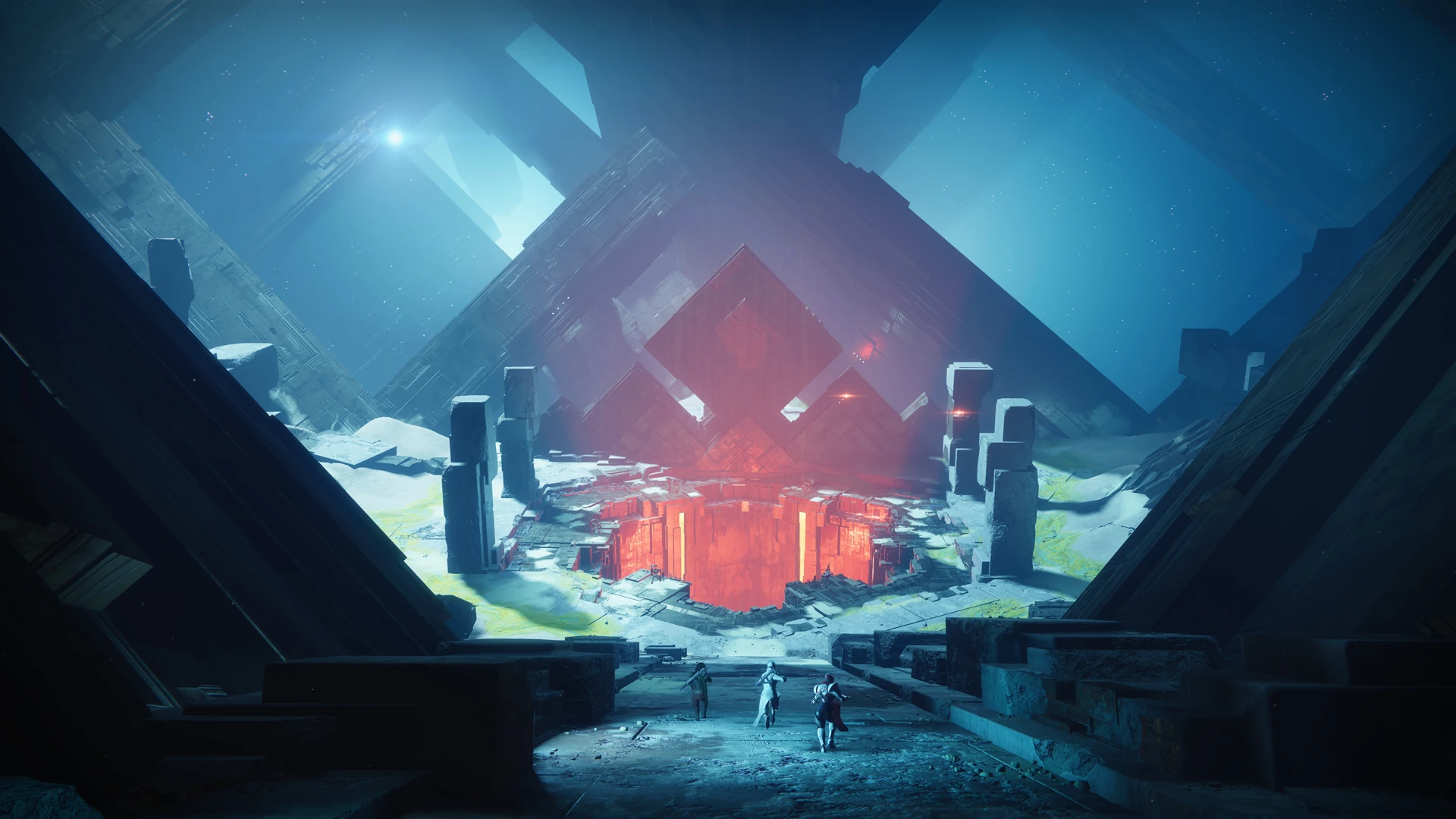
Speaking of, the colors—the colorsDestiny 2's visuals are cohesive despite every planet wielding its own vibrant palette, like the oppressive orange sandstorms of Mars, the crushing green tidal waves of Titan, and the resplendent gold of the mighty Leviathan. The architecture is just as memorable, utilizing a lot of simple geometric shapes for Vex shrines and rigid, mucus-y metal for the Hive dens. The Earth and Cabal stuff are good too, but they're extremely mundane compared to zones like The Dreaming City and its ghostly capital. The aesthetics of Destiny 2 are so captivating that my main motivator for playing was to witness more of its world. That's not to say the gameplay is bad either—shooting stays captivating for hours on end—it's just that there's not really any FPS that captures the scope and grandeur of an alien world quite like Destiny.

Even if you enjoy being a tourist in Destiny 2's gorgeous universe, eventually you're going to want a goal to strive towards. The game is loaded with repeatable bounties and adventures, but the most structure is derived from trying to complete its various Exotic (ie rare weapon) quests. But here is where you'll run into one of the most novel-yet-frustrating aspects about Destiny: it's esotericism. Questlines are plentiful, disorganized, and stupidly vague, often just pointing you in a random direction with a single riddle to guide your way. Some of the bigger, more impressive quests (like the Whisper of the Worm) you'll have to research how to access, and quests with unique level designs are unfortunately few and far between. Plus due to the fact that you'll be playing several seasons of content simultaneously, you're bound to get a stack of quests that'll be impossible to parse the value of—do you even want the gun that's at the end of this quest line? Do you know what to do to get its catalyst (ie final upgrade)? Do you know what the objective on the catalyst is?

Like a lot of MMOs, you'll spend a chunk of time outside of the game researching things: build guides, how power level specifically affects you, and the frequent "how the hell do I get this quest/item/heroic event?" Eventually the annoyance will fade and you'll come to accept that this is simply what Destiny 2 is. Don't get me wrong—it can still feel vexing—but having to dig in order to uncover the game's cooler aspects can be... kind of neat? At least for me it was; the unorthodox design extends all the way into its level structure, going as far as to incorporate confounding oddities like a secret NES-style password system in one of the raids. The PvP Crucible is probably the best mode since it's the most straightforward one (plus it's actually endlessly replayable), but uncovering the game's weird secrets is personally the most rewarding activity available. Even Destiny's strange reliance on platforming and shortcuts in some of their quests (like Outbreak Perfected) has tickled my curiosity more than most games have in years.


No matter what you're playing the game for, the core loop of Destiny 2 distills down into three things: gathering Exotic (and sometimes Legendary) weapons, gradually raising your power level, and hoping to find better stats on your favorite gear drops. The game is still wildly aimless—how you accomplish each of these is largely up to you—but you'll come to define all your actions in one of these three ways. And it's... weird, personally, to play a game where the ultimate objective is to keep you on a treadmill running forward, hoping you're hungry enough to savor every crumb of progression that's doled out. I realize most games utilize this kind of incremental-power engine, but here it's so naked and disappointing that I can't look past it. I mean, am I really going to play this for 100 more hours in the hopes of finding something as meaningless as boots with high Discipline and Recovery? Because it feels like that's my only choice.

Destiny 2 operates on a seasonal model where new content and story developments are rotated in every ten weeks, which should give you new reasons to play. But even if you pay for the ridiculous seasonal pass ($10 for access to a temporary event and bounties?!), it doesn't provide you with better endgame material—it just makes the treadmill run a tiny bit easier. The juicy PvE content I thirst for (Master Ordeals, new dungeons) come out at a grossly infrequent rate and lack matchmaking, turning them into a greater challenge than I bargained for. And since the game doesn't accommodate for solo or duo teams, I end up having to wait until I can blast through them at vastly higher light levels (like the Pit of Heresy). What's crazy to me too is that Destiny 2 includes a item modifier the player can use to adjust the difficulty level and special conditions of PvE events, but it only works for Nightfalls! Why Bungie? Why must you do this to me?


Whenever I think about Destiny 2, a thousand thoughts zoom through my mind and collide like a turbulent asteroid belt: It's cool! Annnd it's weird! And some of the design choices are really baffling! But it's so beautiful! Wait, do I really have to keep playing the same content over and over? At least the enemies are diverse. A shame that the bosses are just bigger regular enemies though. How the hell do I get this "Recluse" everyone talks about? Woah, the Darkness is coming in these dope pyramids! Or the pyramids... are the Darkness? Hold up, what is the Darkness? Et cetera, et cetera.

This colliding jumble of impressions and questions keeps me from reaching a consensus on Destiny 2... but they also urge me to return every now and then. I'm not sure that's a good thing—I inevitably find myself left speechless at how confusing and uncommunicative its content is—but the best thing I can say about Destiny is that it is wholly unique. Despite coming from a big, well-loved studio, there's not really another game you can compare it to. Nowhere will you find a more peculiar blend of majestic artistry, convoluted storytelling, excellent gunplay, divisive platforming, and repetitive content than in Destiny 2. Again, I'm not sure this is a good thing, but Bungie will always have my attention when it comes to this franchise—for better or worse.

Saturday, August 8, 2020

Super Metroid Phazon - Thoughts


It is nearly impossible to re-capture what made the original Super Metroid so special. So much of the game is immersed in nostalgia, and what isn't is difficult to quantify and explain. There's a je ne sais quoi to its world and atmosphere—familiarity and alienation are masterfully blended together, forming a curious stew that you can never quite identify the ingredients of. And for the most part, a lot of Super Metroid rom hacks approach this untouchable recipe with strict reverence: weapon progression is similar, zones feel roughly the same, and your journey will always end with the player blasting Mother Brain to bits. But Super Metroid Phazon eschews with the formal, seeking to hone in on something that Metroid fans love but don't frequently emulate:

Weirdness.


Now, of course there's a lot of ugly, oddball hacks out there, but what those fail to understand is that Metroid has always had a sort of... dignified weirdness. The fauna is unnatural (if not a bit quirky) and the zones are colorful, but nothing is mismatched, nonsensical, or garish; a bright pink mossy almost makes sense coexisting next to a ruddy stone shaft. Metroid unnerves but never repels, and Super Metroid Phazon respectfully understands this concept. Not only does it shake up the typical Super Metroid item and boss progression, but it tugs at player expectations with its eerie alien ambition.

First, you'll awake as Dark Samus inside of a malfunctioning capsule, mere steps away from a free energy tank and an empty red door on the ceiling. Rather than run across the surface of an alien planet in search of the morph ball, you'll dive through underwater passageways, climb frozen cliffsides, and dart past a boss for your first missile pack. Soon you'll uncover a big room that displays a picture of all the areas in the game, your next destination indicated by a small flashing dot. You won't find maps to download, a ship to recharge at, or item hints on the minimap. And as you collect beam powerups, you'll find your arm cannon gets slower—rather than stronger—when the beams are stacked. While Super Metroid Phazon may look familiar, it doesn't feel familiar in the slightest.


What really helps differentiate it from a lot of other Metroid hacks is the visual presentation. Super Metroid Phazon brings with it a massive graphical overhaul, changing nearly every enemy, every zone, and even the UI itself. Caverns, phazon groves, and underwater trenches look realistic and beautiful at times, while the massive complexes of Tetrafuse are unsettling and inexplicable. The entire world of SR217 is infested with snakelike piping, protected by strange machinery that rarely resembles anything humanoid. The bosses themselves have really excellent sprites (Kraid in particular), their attack patterns the only indicator of what they once were. In fact, if there's one thing from Phazon I'm likely to remember, it's how bizarrely rectangular most of its enemies were.

Besides the new coat of paint, the most memorable aspect of Super Metroid Phazon is how massive the world is. My run-time clocked in at a total of 7:24 with only 77% of the items obtained, and (at least I thought) I was pretty thorough. A good chunk of time was spent hunting down the Prime-esque collectibles required to reach the final area (an interesting addition), as well as traversing the land since the screens themselves are also gargantuan. The Tetrafuse towers are mechanical mountains to explore, and the lower depths of the Sewers is one of the coolest journeys: it goes on forever and is mostly empty. "Vacancy" may not sound like much of a compliment, but plunging down to its dark, aquatic depths will make you feel insignificant and alone, eager to find signs of life (or missiles!) amidst the coral.

There's really not much criticism I have to offer for Super Metroid Phazon, as I really dug its aesthetic and direction. If anything, I feel the first half of the game where you're brilliantly strung along from powerup to powerup is the strongest, and sniffing out the Prime-collectibles in the second half not only lacks difficulty but is a bit too aimless (I accidentally missed the final beam powerup). I wouldn't say Phazon overstayed its welcome, but for as cool as the long trek through cavernous rooms are the first time, they're plainly exhausting on revisit. Warp points thankfully mitigate this issue, but you should still prepare your legs for a hefty workout.


If Super Metroid is one of your favorite games, I implore you to give Super Metroid Phazon a try. It's not a major overhaul that retools enemy AI or adds cool new items, but it deftly transcends the typical "second quest" trope a lot of hacks fall into. From the great new visuals to the completely new world, Phazon feels like an alternate dimension parallel to Super Metroid—or maybe more aptly, a third party stand alone sequel. It plays around with the Metroid formula and succeeds, creating a tantalizing soup to Super Metroid's special stew.

Wednesday, July 29, 2020

Zenge - Thoughts


Occasionally during a Steam sale I'll grab a bunch of short, cheap puzzlers to play in between the longer games in my backlog. After finishing the fantastic Golf Peaks, I quickly jumped into Zenge in need of something simpler to tickle my brain. But Zenge is... I'm not sure what to say about it. Similar to its cousin Hook, its a game about following lines more than anything else, and unless the pretty art strikes your fancy, Zenge will fail to leave much of an impression.


Like a lot of the puzzlers I have, Zenge is so cheap that it makes no sense to discourage anyone from trying it. I mean, for four US quarters the game lasts about two hours and doesn't bombard you with any stupid design decisions. But on the flip side there's not really anything fascinating about it. The biggest draw Zenge has going for it is that after completing a puzzle, a picture will materialize that links the previous and future puzzles together. But the story the game tells is more of an abstract journey out of the pages of a child's book than it is an adventurous yarn that draws you in. That's not a knock against Zenge or children's books; it'll probably just be something you either fancy or don't. And personally, despite how much I appreciate awarding the player with art post-puzzle, that wasn't the main reason I picked the game up—the puzzles were.


And this is where I struggle to think up a lot of things to say about Zenge. It starts off simple enough to ease you into its various mechanics, but by the end you don't feel tested on your mastery or blown away at how all the systems come together. Like Hook, the bigger the puzzles get the more mindless busywork you have to do to make sure the various jigsaw pieces can move around each other and slot into place. There's nothing that'll stump you or flip your understand on how to play the game upside-down. You'll simply move pieces and then rotate or shrink them if they won't fit. And that's basically its entire playbook.


The one thing Zenge has over Golf Peaks is that its music is very soothing and beautiful. But presentation alone usually isn't enough to win me over, and Zenge is not an exception to this rule. The game's enjoyable enough that I actively sought to finish it and didn't regret my time spent, but it's likely you won't hear me talk about Zenge outside of this one, lone blog post.

Tuesday, July 21, 2020

The Last of Us - Thoughts


There is a pervasive, gnawing, heavy misery to The Last of Us that I would've call "niche" had it not been one of the most successful video games released for the PS3. Thinking on it, I would have been skeptical if you told me a decade ago that "downer" media like The Walking Dead and Game of Thrones would become huge hits. Reveling in misery didn't seem like something large swathes of the population enjoyed—or at least, it certainly wasn't something people sought out more than once or twice a year. And while video games have always had an intimate relationship with violence, from the fatalities of Mortal Kombat to starving virtual friends to death in The Sims, few games have plunged into the murky depths of depravity. Those that did were usually seen as deviant; folks knew about Postal, Soldier of Fortune, and Manhunt, but adoration for those titles typically came from edgy teens, hungry for any kind of transgressive media. Plus there was always an element of farce to gaming's most violent offenders, making games like Carmageddon feel more stupid than sadistic.

So industry darling Naughty Dog taking a hard left turn into zombie-lane was surprising, especially coming off of the plucky Uncharted series. This post-apocalyptic world would be thematic inverse of Nathan Drake's universe: sick, sad, and dotted with blood trails that led to tragedy. Replaying it again in 2020 for Part II's release neither shocked nor sickened me, but I was mystified that so many people latched onto such a nihilistic experience. Perhaps they endeared themselves to Ellie and Joel, finding warmth in their rapport and struggle to survive. But if you pay attention to the game, love isn't the cornerstone that holds The Last of Us up—that privilege belongs to fear.


For the record, I think The Last of Us is best video game released in 2013. It's extremely polished, tells an enthralling tale, and is a hell of a lot of fun to play. That's why, despite being puzzled that so many people are captivated by it, I would never argue that they shouldn't be; The Last of Us is probably Naughty Dog's magnum opus. I don't think it's flawless—Pittsburgh goes on for too damn long—but it's an indisputable AAA masterpiece in my eyes, and a game I long for others to experience.

Yet it's obvious it won't be everyone's cup of tea. The Last of Us lands a gut-punch with its opening in order to submerge you in the terribleness of its world, conditioning you to see murder as numb, morally gray offense. As manslaughter soon becomes second nature, you'll pick up on game's prevailing ethos: you need to kill to survive. Coincidentally the theme is propped up by a ludonarrative harmony, as any time your character lacks the means to fight back—whether in gameplay or in a cutscene—bad things will inevitably transpire.

My dilemma with this, and my subsequent struggle to understand the love for it, is that it's a libertarian's wet dream. The Last of Us is anchored in the fear of the other and spends more time exploring and reinforcing this concept than it does trying to refute it. Every character lives in constant fear, from Marlene to Joel to Henry, and whatever characters don't die become jaded to the prospect of trusting others. This is an idea pervasive in the zombie genre ("what if the real monster was MAN??!!"), but the subtler, quieter moments of The Last of Us add this terrifying loneliness to everything. And by the game's close, it will echo the theme tenfold. I think narratively the game is brilliant—the ending is absolutely perfect—but it will leave you with a hollow feeling, one that blurs the difference between surviving and suffering. There are no champions or heroes in The Last of Us—there's just a pack of desperate scavengers and you... and you better learn to become more ruthless than they are.


I spent a long time on this melancholic preamble largely so I could gush about how superb the killing is in The Last of Us. I chose Survivor as my difficulty this time around and did not regret it—robbing the player of supplies and their ability to "see" through walls vastly changes the experience. Escaping a gang of infected may be tense on normal, but in Survivor you're deprived of all your toys and ammo, forced to do calculations like how to kill six enemies with four bullets spread across three different guns. The increased difficulty removes any leverage the game might provide the player, forcing them to rely on their patience, instinct, and a little bit of luck to make it to the end. You'll learn how to ration supplies and savor being handed a box of shotgun shells, and even when the odds may be stacked against you (like, say, having a flamethrower and two arrows going into the final fight), The Last of Us teaches you that there's always a way to survive.

I cannot undersell just how much playing on Survivor works thematically with The Last of Us, primarily because it helps turn the player into a monster. Animations for strangling and stabbing people are vicious because they need to be—you have to be sure the enemy you just subdued won't be getting back up. Likewise, it's disgusting to watch a nailbomb shred a man's legs into a rosy aerosol, but neutralizing a patrol that way can be immensely cathartic. The ammo famine turns headshots into small celebratory explosions, and there is an almost transcendent quality to stumbling across the multi-use, insta-kill ax. Throughout your playthrough, moments of barbarity will slowly transform into gleeful psychopathy, like lining up two people for a single shotgun blast, or throwing a molotov at a stubborn foe hunkered down behind cover.

The violent video games I mentioned before invoke the same mindset, but The Last of Us is ever-conscious of its own bloodlust, Ellie cursing after every murder. Similarly, deaths in cutscenes are shocking and instantaneous—unlike your own game overs, which linger for too long in order to show you the grisly reality of failing. Joel doesn't see manslaughter as entertainment even if the player might, which helps to keep you grounded so you'll treat your opponents as the dregs of humanity instead of bags of blood operated by code. For The Last of Us, the satisfaction of killing is counterbalanced by the misery of death, which is one of the reasons why I found it to be so hauntingly effective.

The last thing I'll mention is something that I didn't expect to stun me: the music. While the visuals and mocap still hold up today, I was awed by Santaolalla's discordant soundtrack. The Last of Us' prevailing sense of misery is magnified by tracks that are rarely melodic, instead oscillating between uncomfortable, primal and eerie. I hadn't really noticed the music on my first playthrough (outside of the main theme), but this time I was constantly aware of the unorthodox and yet perfectly fitting soundscape to this dead-end world. Beside the fungal-infected zombies, Santaolalla's unsettling strumming is probably the defining aesthetic of the game.


You will find no peace in playing The Last of Us—and if you somehow manage to, it'll be because you've forfeited your empathy. Playing on Survivor can be a grim, frustrating experience (my kingdom for one half of a scissor!) but like Dark Souls, the difficulty complements the narrative like butter on toast. The game isn't completely bereft of beauty and softness, but you'll only be granted fleeting glimpses of joy, usually after caving in a man's skull in with a brick. I love how brutal and miserable The Last of Us is, but—as paradoxical as it sounds—I don't want to love its brutality and misery. I want these characters to be hopeful and graceful and kind, but as humanity spirals downward, The Last of Us posits that fear will prevail.

Thursday, July 9, 2020

Mass Effect: Andromeda - Thoughts


[contains minor spoilers]

To those that claim that Mass Effect 3 killed all interest in the series, I invite them to play Mass Effect: Andromeda.

I have a lot of sympathy for the task that BioWare Montreal had before them—return to the Mass Effect universe, despite the previous game effectively "ending" it. To get around this, the studio wisely shepherds the player into a nearby galaxy, giving them new worlds to land on, new aliens to meet, and new mysteries to solve. But while it may appear as if the Mass Effect title is an anchor weighing down a fresh new sci-fi plot, the real problem becomes Andromeda itself. Gone are Mass Effect's best qualities, replaced by uninteresting imitations, open-world shenanigans, and vestigial resource systems.


Right off the bat, Mass Effect: Andromeda's writing is a colossal step down. Conversations are stilted, ideas constantly drift off, and the dialogue is as sharp as a pencil eraser. This turns arguably the best part about Mass Effect—interacting with your teammates—into something that's fairly mediocre, if not baffling at times. It doesn't help that BioWare Montreal decided that the defining aspect of Ryder (the main character) would be awkward meta-commentary, so even when the dialogue is decent, you're bound to get Ryder interjecting with, "okay, seriously? You did not just say that!" The lackluster voice acting does the script no favors either; I'd honestly be shocked if there was anyone that thought the writing was on par with the previous Mass Effects.

Adjacent to that thought, Andromeda's main plot starts off interesting... but never goes anywhere ambitious. Stationed across the Heleus Cluster are terraforming stations built by ancient robots, all of which are being sought after by the enigmatic and warlike Kett. And that's essentially the entire plot. There's some twists and turns throughout the story but Andromeda never escapes the looming shadow set by the Reapers. The Remnant are basically robotic Protheans, the Kett are organic Reapers, and every other Mass Effect race is just how you remembered them, dealing with the politics and prejudices of old. There's a new friendly race in this neck of the universe (the angara) but there's absolutely nothing intriguing about them, outside of their reincarnated memories—a fact that only plays into a single side mission.

Andromeda's main focus is squarely on the war between the angara and the kett, which is one of the reasons why I found the Mass Effect label to be kind of superfluous. The ties to the previous games are meant to make Andromeda feel more familiar, but there's almost no reason why the Milky Way explorers couldn't have all been human. Sure, there's a krogan-only outpost that the other aliens are scornful of, but the struggle of the krogan for autonomy feels like an old hat by the time you solve their dilemma. Differences between the species are ultimately minimal since the back half of Andromeda treats humans and their colorful space companions as all the same: vermin for the kett empire to subjugate.


The kett aren't a terrible video game baddie, but they are extremely dull to fight against. They don't exude creepiness like the Collectors or danger like Cerberus snipers, and their most memorable unit—the Ascendant—is the worst fight in the goddamn series. You have to shoot at an orbiting sphere in order to make them vulnerable, and then you only get 1-2 shots until the sphere shield returns, turning a single unit into a three minute ammo-wasting snoozefest. A lot of the other beefy units also overstay their welcome, but the Ascendant was a noxious brew of annoying, boring, and hard to hit. I generally enjoyed fighting the remnant more, but both factions lacked diversity, so how you fought one enemy wouldn't really change from how you fought another.

Mass Effect has always had this problem to some degree, but the wealth of battle options at your disposal meant you could push and pull on the encounters according to what powers were available. Gameplay-wise, Andromeda is unarguably the most diverse Mass Effect title, letting you mix and match skills and passives from any tree. But then it contradicts this freedom by limiting your repertoire to three powers max and completely disabling the manual use of ally abilities. So it really doesn't matter which of your allies you bring into combat—you're the only person that can dig yourself out of a tricky predicament. In fact, teammates were as useless as they were in the first Mass Effect, rarely killing opponents and constantly, constantly getting in the way of my sights. By the end they could dish out some decent damage, but that was nothing compared to the powerhouse Ryder became; my allies were better off as meatshields, and even they couldn't perform that role well.

But becoming a space wizard that could lob black holes every ten seconds wasn't an easy road to travel. I've been playing through the Mass Effect series on Hard and Andromeda has been the only one to put up a fight the entire time. Enemies are considerably bulkier and harder to hit (your aiming has to be VERY precise), and if you lose any of your health or ammo you have to go hunting for a resupply crate, which are few and far between. Taking cover is also fluid and buttonless, which occasionally works well out in the wild but is a mess in close corridors, where the only way to get Ryder to lower their head is by running them against an obstacle. To make matters worse, acquiring gear in this game is a confusing, bloated nightmare. You can spend one of three types of research points to obtain blueprints, which can then be developed with 4-5 different elements you'll mine from planets, and your gear can be both modified and augmented, and they come with their own rarity level, and there's over 100 types of weapons and armor to try this on. Or you can do what I did and just buy stuff from vendors. Once I found the Isharay and started collecting biotic damage armor, I had no reason to engage with 95% of the materials cluttering up my inventory.

The best thing I can say about Andromeda—besides having to ruminate on your level-ups since the difficulty is no joke—is that it's not starved for content. There are six sizable planets to explore with scores of side quests sprinkled across each world, ranging from "go scan this rock" to "kill a sprawling outpost of bandits." Between this and the ludicrous inventory system, Andromeda is brimming with content to kill time with... it's just a shame that the gameplay isn't all that fun and the narrative is uncompelling at best. Oddly enough, Andromeda struck me as a monkey's paw remake of the first Mass Effect: finally you have lush, open landscapes to explore and colonize! But it comes at the cost of having boring friends, shallow enemies, and conversations that are as memorable as what you ate for lunch last week.


There's a big fight at the end of Mass Effect: Andromeda where the main villain relentlessly taunts you with the most tired and cliche threats imaginable. By this point any kind of love or curiosity that I had left for the series had been drained, and all I could do was marvel at how utterly disappointing the experience had been. The other games had their problems too, but by the end of the day you still cared, having forged racial alliances and gathered together a ragtag team to save the universe. In Andromeda, I had no idea narratively how I beat the final boss and I didn't care what that meant for the world. I didn't even bat an eye when, after the boss's unceremonious death, a scant five sentences were spoken and then the credits began rolling. Mass Effect: Andromeda tried its best to forge its own path, but it ran out of gas as soon as it left the docking bay.

Monday, June 29, 2020

Golf Peaks - Thoughts


I find golf about as entertaining as watching someone fill out their student loans, but there's no way I could say "no" to a golf-puzzler. Strip away the sporty premise and Golf Peaks boils down to pushing a ball around a mountain using limited movement options. These options are presented as one-time-use cards, and either move you a certain number of spaces (1, 2, 3 etc.), ignore height while moving a certain number of spaces, or a mixture of both. Gold Peaks' simplicity and soft art style were the biggest selling points for me, and I'm pleased to say that while the game is a definite brain burner, it doesn't fry your neurons like other titles (*coughincreparecough*) do.


There are 10 worlds in Golf Peaks containing 12 courses each, and all but two worlds introduce a new mechanic. This turns a sizable amount of the puzzles into bite-sized tutorials, but fret not!—there are plenty of opportunities to test your skills. Every world has three optional/expert courses, and the two worlds lacking new mechanics will instead feature the toughest, longest puzzles in the game. You can blow through a third of Golf Peaks in thirty minutes, but your pace will slow down tremendously as courses expand and more movement cards are added to your hand.

Difficulty-wise, Golf Peaks rides a fine line between being too easy and over-complicated. The aforementioned tutorial puzzles usually have an obvious route you can discern at a glance, while later puzzles require grid counting and reverse engineering. A lot of courses will appear to hold dozens of viable routes, but with a keen eye you can spot valuable locations where specific cards can come into play. For instance, in the screenshot below, the 3-tile jump card can only be used at the leftmost and rightmost areas of the playing field—and with that puzzle piece in place, you can deduce the purpose of the other cards in relation to it.


But there are two wrenches in the deterministic gears of Golf Peaks. The first is something that's just downright evil: on some puzzles you don't need to use every card. That means that some movement options are there solely to throw you off the trail, and it's never obvious which one it is. The second wrench is a bit more unfortunate: each world's gimmick has a bit of fuzziness around it. For the most part I like the mechanics and how varied they are, but there's a lot of little quirks that bend the rules. Hills end movement after being landed on, jump pads can be reactivated if you ricochet off a wall, and goal holes stop momentum while warp holes do not. So while you can look at your cards and deduce you have X-total planar movement and Y-total vertical movement, the various mechanics twist these results, increasing and decreasing their values depending on how you approach them.

Note that I don't think manipulating static movement values via the environment is poor design—it's just that it hides otherwise open information. The red herring cards combined with variable number values give Golf Peaks an imprecise feel, despite the game being technically precise. At times this can create exemplar moments of cunning (like putting the ball into water so it respawns where you want it), but it can also be the source of your stumping when you forget how a particular mechanic operates. Again, this isn't bad—just be prepared to do a lot of number tweaking in your head while plotting your path.


Golf Peaks is a delicious puzzle game that takes the perfect amount of time to get through. It demands more persistence than $1 appetizers like Hook or klocki, but the amount of fresh ideas and devious mechanics showcased here will more than keep you occupied. The biggest negative I can think of is that the music is lacking (being neither that memorable nor soothing), but the puzzles and visuals are the meat and potatoes of the game—and Golf Peaks absolutely delivers on both fronts. So don't let the silly sport theme fool you. Golf Peaks is about staring at a mountain, calculating how to conquer it, and basking in pride as you finally land that sweet hole-in-one... er, hole-in-seven-cards.