Thursday, May 26, 2016

Why Uncharted 4's ending bums me out - Opinion

[contains spoilers]

Silence—a first for the series.

Boot up any of the other Uncharted games, and you'll be greeted with momentous fanfare that pumps you up for yet another exciting adventure. It's fittingly titled "Nate's Theme" after our intrepid hero, capturing both his bravery and the exotic thrills that await him on the road ahead. But Uncharted 4: A Thief's End eschews with the series' bravado, opting to instead welcome the player with a solitary, silent, and haunting image:


The tonal shift feels deliberate; the dead pirate serves as a warning for those that tread down this path. And as you progress through the game's story, it's clear Uncharted 4's narrative revolves around greed and its consequences. Sam's naivety and lust for treasure sweeps his brother off his feet, transporting them both to Avery's island in a race to find the legendary captain's treasure before their ruthless adversaries do. Elena is also dragged into the struggle, first to rebuke Nate for his betrayal but then to watch over her reckless husband. Shortly after the two reunite on the island, they share a pithy exchange that reveals what's at stake:

Nate: "Thanks for saving me. Again."

Elena: "I almost didn't this time."

This journey isn't merely about risking one's life for gold and glory—it's about straining the fragile trust of those closest to you. Uncharted 4 masterfully echoes this in the tale of Libertalia and New Devon, where colonists and pirate leaders alike were deceived, tortured, and slaughtered by each other. Their internal strife shattered their proud allegiance, the venerable pirate utopia now left abandoned, flooded, and booby trapped. For half the game you stand in awe at what the pirate brigade was able to accomplish together, but eventually you uncover the truth of their arrogance, violence, and madness. Greed ultimately consumed them, and their mistrust for one another ensured that no one would survive to tell the tale.

Similar seeds of doubt are strewn amongst the main cast late into the game: Sam has lied to Nate, Nate has lied to Elena, and the uneasy alliance of Rafe and Nadine is quickly crumbling. Nate realizes the severity of this obsession with gold, first chiding himself for taking advantage of his wife and then bearing witness to the horrors of New Devon. It's clear this treasure is cursed—insofar as the people seeking to covet it don't seem to survive for long—and after reuniting with Sam, Nate makes a bold decision: they're all getting off the island, empty pockets in tow.

Nate & co. abandoning the plot wholesale was an interesting pivot in the story for me. Even though it felt like the game was warming up to an explosive finale (especially after the amazing ship graveyard section), this decision felt logical—after going through so much trouble to locate Avery's stash, our resilient hero has seen where this path takes him. His time with Elena has grounded him, Sam's betrayal let him taste his own bitter medicine, and the letters he collected illustrated how this tale would play out. This life wasn't fun—it was extremely selfish and dangerous. The player is then struck with an elongated period of silence as the cast slowly descends down the mountain back to the plane, an unceremonious anti-climax to our story.

Yet this is not where the game ends.


Sam somberly remarks about the explosions off in the distance, aching for the same resolution the player is. Eventually he gets separated and heads off to finish the journey he and his brother started. Nate coincidentally stumbles into an opportunity to pursue him, and does so. At this point, I figured the story was going to conclude with a fistfight to bring Sam back, as it seemed like an appropriate and emotional crescendo to close on (after all, how often do you brawl with the final boss in order to save his/her life?) Perhaps—I figured—there might be an epilogue of a playable Rafe or Nadine (or even Sam) descending into Avery's ship, discovering that the grisly pirate had rigged the vessel to burst if anyone stumbled upon his loot-laden corpse. Thieves dying with their desperately-sought treasure isn't exactly a fresh trope, but if there's something Avery seemed dead-set on, it was killing anyone that dared to steal from him.

To my surprise (but I'm sure the delight of many players), there's no subversion or shock—Nate travels to the pirate ship, duels with Rafe, and saves his brother. He escapes the crumbling vessel and returns home to shed his boring life, managing a salvage company with his wife which undertakes less risky ventures and explores the world. Almost everything ends better than expected for Uncharted 4's cast, the villains of the story being the only ones to receive a reprimand for their greed. Sure, Sam can't get back the time he lost in prison, but there's still a whole life full of adventure ahead of him with the best partner a guy can ask for.

I don't like this ending.

It may feel like a fitting conclusion for a sentimental fan of the Uncharted series, but it is not a good closer for this particular story. I know these games are a far cry from the bleak world of The Last of Us, but I expected a more serious resolution to accompany the more mature writing. Instead, the game follows in the thematic footsteps of the past three titles, placing Nate in constant peril but doing nothing to leave a lasting impression that he learned anything on this journey. At best Nathan realized he shouldn't lie to his wife, but at worst Elena's concern for him comes across as incessant nagging that keeps him from his true calling. Nearly nothing of importance occurred to convince me that this was definitely his final outing into the wild, other than the developers stating so.

A major part of my disappointment is because there were no demonstrable opportunities for Nate to quell his greed. I yearned for the mountaintop brawl with Sam because it would be a dynamic way to prove the treasure wasn't worth sacrificing one's life for, especially because Sam was emulating Nate's younger/more brash side. Instead, Avery's ship is set ablaze so the brothers—under immediate duress—can only escape with their lives, the lagoon caving in to ensure that the treasure was irrecoverable. But what would have happened if they had an opportunity to pillage it safely, or if they had the choice to hand it over to Rafe and Nadine? Doesn't Nate being forced to pull Sam away from the gilded goods sound like it would reinforce the narrative the players received throughout the game?

Robbing the story's main character of his agency to reject this lifestyle proves nothing to the player. Despite the subtitle, Uncharted 4 isn't about a thief's end—it's about a thief's reward. It's about how scavenging, trespassing, shooting, and narrowly avoiding death every minute can be quite thrilling and glamorous. As long as you act like the good guy, you get rewarded with a loyal wife, a fantastic job, a gorgeous beach house island, and a brilliant daughter. There are no lasting injuries, dead friends, or monetary losses to speak of—only the splendor of a life well-lived. Hell, the game ends on Nate recounting how fun and awesome his memories of the first game were. That right there is prime evidence of how enviable this lifestyle is, outside of your wife potentially thumbing her nose at you for doing it without her permission.


Perhaps, looking back, The Last of Us set too high a bar for Naughty Dog to achieve. Whereas that story ended exactly when it needed to and with the perfect tone, I can't help but feel that Uncharted 4 is a squandered opportunity. So many magnificent little details lured me in the wrong direction: the inclusion of the two thieves that were crucified with Jesus, the old woman at the estate alienating her family, and the discovery Burnes' grandson's corpse moments before the climax of the story. These remarkable tidbits unfortunately stand in stark opposition to how the narrative wraps up. There was no punishment for Nathan's thievery in the end; all the treasure hunter needed to do was stop chasing after illegal jobs and he was perfectly fine. Compare that to Avery's beloved Saint Dismas—despite being penitent, the man still suffered and died for his trespasses, only able to find solace through repenting for his sins.

Uncharted 4 should've just opened with a dramatic shot over Avery's island with Nate's Theme 4.0 playing. The lone skeleton swinging in the rusted gibbet is the exact opposite tone of this mindlessly optimistic game.
---------------------

Images obtained from: gamepur.com, playstationlifestyle.net, ign.com

Friday, May 13, 2016

Shadowgrounds - Thoughts


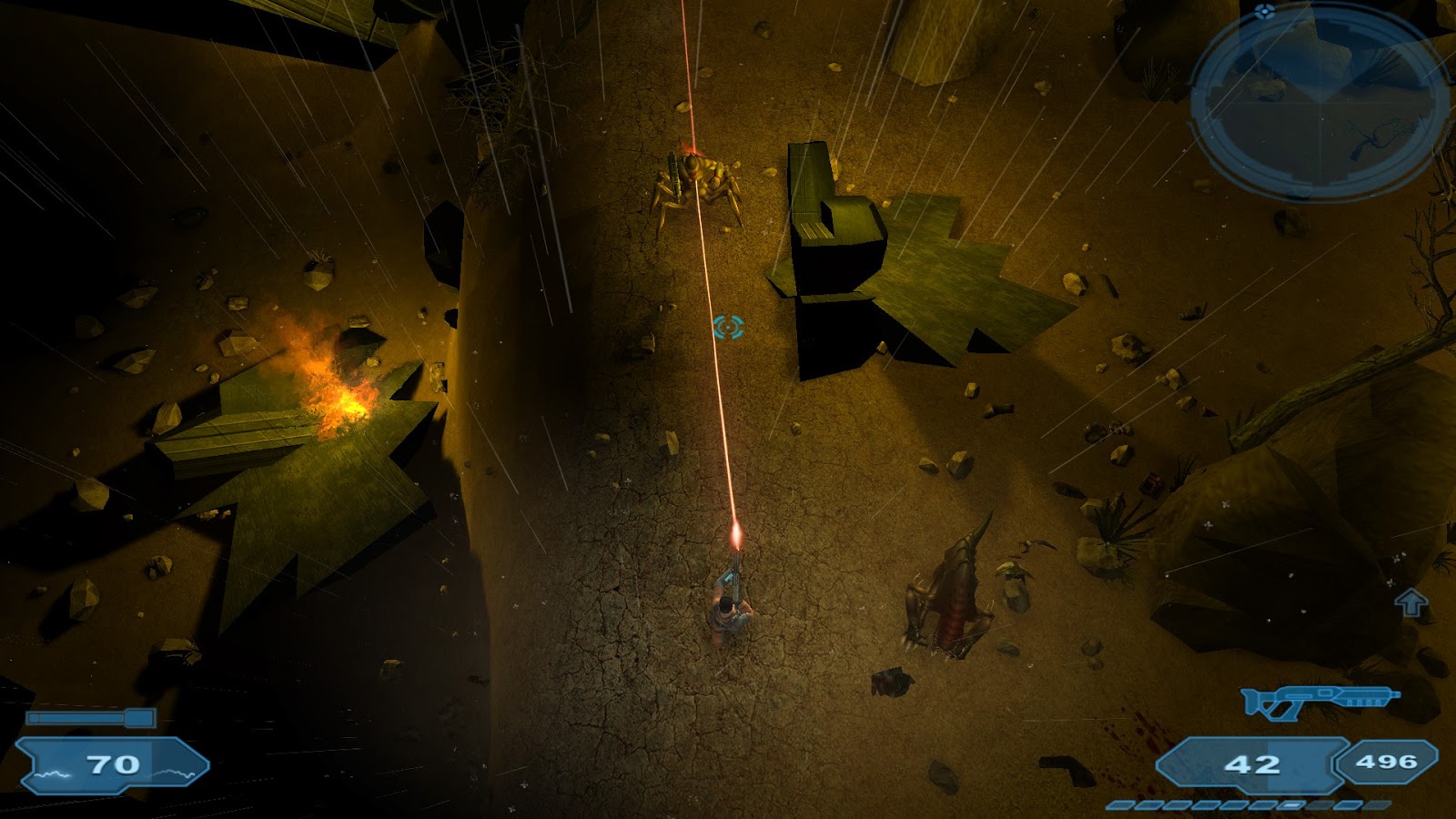
The demo for Shadowgrounds was one of the first games I remember playing courtesy of the Steam storefront. Back in the days where Valve's marketplace was diminutive and I was curious what (non-FPS/Blizzard) wonders lurk within the unexplored jungles of PC gaming, I happened upon this gritty top-down shooter and decided to give it a whirl. I greatly enjoyed what I played, but it wasn't until the Humble Frozenbyte Bundle that I was able to nab both it and its sequel. Nearly a decade later, I finally set aside the time to play through it, and boy, it sure is an action game made in the '00s.


If that's not an enriching description, allow me to paint a better picture by asking some questions. You know how The Matrix had a massive impact on everything that tried to be cool post-1999? And you know how Halo: Combat Evolved (or Starship Troopers if you will) helped popularize placing the American military into sci-fi settings? And ya know how Doom 3 tried the whole horror in space thing? Mix those three things together, add this music to it, and yeah—that essentially covers all six hours I spent with Shadowgrounds.

To its credit, the game doesn't play like anything I mentioned above. The lofty camera angle may fool you into thinking it's a twin-stick shooter but Shadowgrounds isn't as kinetic or exciting as one might think. As strange as it sounds, the game strikes me as more of a bizarre Doom clone. You have an arsenal of ten weapons, your hellish foes require frequent strafing to avoid projectiles, and the nonlinear maps encourage room-by-room sweeps and munitions scavenging. The game doesn't come anywhere close to touching Doom's immaculate design or mechanics, but it echoes its bold style; the best praise I have to heap upon Shadowgrounds is that at times it feels like a European reimagining of id's classic.


Of course, the opening missions of the game do little to convince the player of that. Shadowgrounds has a slow build towards the meat of its gameplay, unapologetically forcing the player to engage in some very boring gunfights until their arsenal begins to expand. Right around when the grenade launcher is introduced and the game replaces its monster waves with patrolling guards is when I found myself most appreciative of the experience. The purchasable skills linked to each of the weapons gives you something to look forward to while you're mowing down countless hordes of faux-Shamblers, and while it may be a bit of a lottery trying to figure out which ones are helpful and which are duds, their inclusion keeps things interesting.

There's not much to the Shadowgrounds besides that. The story is what I'd lovingly refer to as the polar opposite of Deus Ex: Human Revolution: each character, cutscene, and journal entry are wholly meaningless and shockingly boring, to the point where I wouldn't be surprised if a high schooler secretly wrote it. There's not a lot of variety to the setting, and when you do get a change in locale the game tries to be Halo so hard it hurts. The flashlight mechanic is interesting in theory but comes across as irritating (please let me upgrade its battery!), the end of the game introduces shielded enemies that are impossible to fight, and the dodge roll is downright pitiful. None of these issues are worth getting your panties in a bunch though—this is prime C-grade material, so it's prudent to expect some ugly bumps along the way.


There is a mindless joy at the center of Shadowgrounds. The gunplay is decent and the campaign is competent... but it's not anything I'd earnestly recommend. Perhaps it was better off being a gilded memory locked between some synapses in my skull, but hey, at least it was kinda entertaining while it lasted. It's an unremarkable blast from the past that served as a good diversion between the bigger titles getting released this year.

Thursday, May 5, 2016

Deus Ex: Human Revolution - Thoughts


To say I enjoyed my time with Deus Ex: Human Revolution would be an understatement—with no hesitation do I deem it my favorite in the series, as it hones in on what makes the franchise so remarkable. Gone is the streamlining process that hamstrung Invisible War, the intrepid FPS series finally returns to the rich well of player choice its ancestor had unearthed. Yet it approaches the world of Deus Ex with a more serious tone, concerned with the diametric arguments revolving around governments vs. corporations, technology vs. nature, and traditionalism vs. progressivism. Human Revolution poses complicated questions and constructs excellent gameplay scenarios for you to tinker with; while it does have its fair share of problems, Eidos Montreal's risky debut is a resounding return to form.


I'll start by proclaiming that I really like Adam Jensen. In numerous titles nowadays, the main character serves as a somewhat emotionless vehicle for the player to steer, devoid of much personal baggage in order to ensure the dominance of their puppeteer. Jensen fulfills this to a degree, but he's visibly weighed down by the events that occur in the prologue, tormented by what he's irreversibly lost, as well as what he must regrettably become. Both JC and Alex are skeptical of their positions as pawns, but remain confident and effective at their work; Jensen on the other hand is overwhelmed by his burden, robbed of his spouse and frustrated with his employer. My fondness may be because I'm more drawn towards characters that struggle with their inner demons, but I contest that Jensen is the most fascinating protagonist yet. I found myself easily sympathizing with his struggles, eager to hunt down Megan Reed's attackers and discover the shrouded truth.

Just as the game's predecessors had, the story continues to cleverly imagine what an augmented future might hold. While Human Revolution doesn't engage with philosophy as actively as its older siblings, it utilizes dialogue far more naturally, accentuating the believability of the world. I also appreciate how subtly the conspiratorial elements are handled this time around, the game no longer beating you over the head regarding whom belongs to which faction. The plot does take an unexpected turn towards the end (that would seem even wilder without having played the DLC, a la Mass Effect 3), but everything is fleshed out so nicely with dialogue and in-game text that I walk away very pleased from my time with Human Revolution. Too often when I play a game, the story becomes either negligible or trite, so it's always a delight when I can get engrossed in a virtual narrative.

The return of emails reveals what a boon the electronic exposition is to the story, as their absence from Invisible War was sorely missed. Reading text provides frequent breathers between the tense sleuthing, and it's often interesting or sheds light on the world around you. Unfortunately hacking is probably the worst gameplay system you have to interact with, as (while it seems complicated at first) it's quickly distilled down to dull game of probability. There's no excitement or complexity of choice present here—simply click your way to the exit or restart if things go wrong. It's a shame the game has no option to swipe pocket secretaries from guards, as I would've loved a non-confrontational way to gain access to computers or skip having to hack yet another laser grid panel.


Hacking thankfully remains the only mechanical misstep, as the rest of Human Revolution plays superbly. That's not to say that the shooting is on par with Call of Duty—it clearly isn't—but it works well within the framework of the game, keeping firefights dangerous since Jensen doesn't feel like a one man army. Where the Sarif employee excels is at hand-to-hand combat, pushing the game considerably towards a silent melee focus (which worked well for me). Slipping around the seamless third person cover until you can get behind a man and punch him with both your fists is amazingly satisfying, the takedown animations keeping their luster over all 30 hours of play. My personal philosophy was to use non-lethal force unless innocents were involved, which by that point meant the blade arms would get unsheathed. Man, are those blade arms cool. Occasionally stupid, but always cool.

Complementing the excellent stealth are a variety of avenues you can walk down to complete your mission. Side quests are plentiful and the game constantly addresses multiple play styles, hitting the player with a barrage of "oh, I could've done it this way!" whilst exploring. True, Jensen can end up becoming a solid all-rounder at the end, but you still have to use your wits and inventory to work through any problems you rub up against, which is where the series flourishes best. Plus The Missing Link portion of the game is a great tabula rasa moment, letting you play around with an alternate style of play before the ending.

The game does stumble in a couple other places, most notably in forcing you to revisit the major hub cities. I like Detroit and Lower Hengsha a lot, but the amount of backtracking the game thrusts upon the player is a bit excessive (especially in one specific part of The Missing Link). There's some other iffy parts—the belligerent boss fights, that wall-busting is lethal, and how awkwardly stitched in the DLC is—but for the most part the game's highs outshine its problematic lows. For every instance where the game throws a boring backtracking segment at me it lets me do something cool like chuck a pimp off a roof, and for every headache-inducing boss I'm forced to fight I get an exhilarating moment where I make it through a floor unscathed and/or unseen.


Deus Ex: Human Revolution is a lot like Deus Ex, except that it's (arguably) more refined. Certain mechanics have changed and some details got lost in the transition, but the modern coating makes it far more palatable. While I appreciate a lot of what the original did, I was unequivocally more excited to sit down and play Human Revolution every time I booted it up. The game stays loyal to its roots, constructing an intriguing world that feels great to play and is ripe with spectacular scenarios. Human Revolution doesn't suffer from standing in the shadow of Deus Ex like Invisible War did—if anything, the series grows stronger for having it attached.

Now that I'm officially a fan of the franchise, I'm greatly anticipating the release of its sequel this August—here's to hoping it lives up to my high expectations!

Tuesday, April 26, 2016

Banjo-Tooie - Thoughts


Banjo-Kazooie is one of the best collection-focused platformers of the fifth console generation, so naturally an amped-up sequel that's nearly twice as large as the original would be better, right?

Unfortunately, no. While it may not match Donkey Kong 64's insane penchant for collectables, the detrimental symptoms are noticeably present here. It's not an awful game—its bombastic size and scope made it a worthwhile purchase back in '00—but it feels more taxing than its predecessor, requiring a greater effort from the player to solve it. In some respect I suppose it's the ideal sequel to Banjo-Kazooie, but what is lost in the process is the lackadaisical ease of simply "havin' a fun time"; Banjo-Tooie is geared more towards hunting than exploration.


The opening cutscene alone is a good indicator of the length of this game, clocking in at over ten minutes before you can start playing. The story maintains the same bubbly Rare quality, returning its colorful cast to the spotlight with some great new debuts, accompanied by some hilariously dark moments that the narrative brushes over (dead jinjos and children, good lord). I take no qualms here with the plot or writing however—all my concern is rooted in the gameplay and design.

To wit, there's too much laborious backtracking. No longer can you set aside an evening to check off one of the game's eight worlds from your list; each setting is tightly tied to another, requiring you to come back later when you've amassed additional abilities or unlocked new shortcuts. While it provides some mystery to each location, it can be confusing trying to figure out whether or not you've met the requirements to obtain a certain jiggy or frankly haven't found the solution yet. I didn't walk away from each play session feeling like I had accomplished something, but was instead constantly asking "there's still more to do here?!"

The backtracking issue is one that's rooted at the core of the Metroidvania genre—so I really can't fault it all that much—but what compounds this problem are the numerous methods of travel. In Banjo-Kazooie you only had the titular heroes and a Mumbo transformation as vehicles of exploration, but here you have Banjo, Kazooie, Banjo & Kazooie, a Wumba transformation, and Mumbo to contend with. This means that you'll be exploring the same tract of land multiple times over to collect a single jiggy, a painful echo of Donkey Kong 64. Perhaps the most flagrant example of this is the Styracosaurus quest: you run into them as Banjo & Kazooie, return as Banjo, head to the train station, turn back into Banjo & Kazooie, then go to Mumbo at the Isle o' Hags, return as Mumbo to the train, turn back into Banjo & Kazooie, return the train back to Terrydactyland, and you still have to return to the family as Mumbo later. And that's not even the entire quest to obtain a single collectible out of a potential 90. I killed myself in this game countless times just so I could skip having to reunite the bird and bear manually.


Where I found myself pleased with Banjo-Tooie was when it closely resembled Banjo-Kazooie's design. Exploring the ill-lit rafters in Glitter Gulch Mine, burning the behinds of the Rocknuts in Terrydactyland, and outsmarting Mr. Fit in Cloud Cuckooland were all stand-out moments between the frequent back-and-forth-ing that was required (getting to Mr. Fit in particular was a hassle). I think the first-person segments and various egg types are excellent improvements to the game, and though it may not seem like it, I do appreciate what Banjo and Kazooie individually bring to the gameplay this time around. I'm miffed that the music note hunts have been neutered (they used to provide you with something to do while traversing the landscape), but for the most parts these changes at least make the moment-to-moment gameplay a little more interesting.

To reiterate, I don't think the game is terrible as much as it's just not fun when you're forced to do a ton of leg work. Grunty Industries is the greatest offender of this, having some really clever ideas in it (using batteries to power doors, the service lift can only be used by the dishwasher) inside a gargantuan layout that's chock-full of dead ends and questionable design choices (why give me the Snooze Pack ability next to a place where I need the Sack Pack? Is it really necessary to place Weldar's jiggy two rooms over? Why can't the Split-up pad on the first floor be closer to the Waste Disposal entrance?) I thought Click Clock Wood was arduous to finish at 1.5 hours long, but this level took twice as long as that, not to mention how the N64's single digit frame rate was doing my playtime no favors either.


Banjo-Tooie is a good example of why bigger isn't always better. True, it's packed with neat secrets and tricky sections that require some tinkering, its worlds and solutions cleverly interwoven together... yet this expansion stands at odds to the indelible charm of the original game, Banjo-Kazooie's smaller worlds acting more like a playground than a set of puzzles. Whereas the first game invited you on a delightful excursion, Banjo-Tooie asks quite a bit more from the player—whether or not that's your cup of tea is up to you I suppose.
---------------------

Images obtained from:  smashcustommusic.com, giantbomb.com

Thursday, April 21, 2016

Hyper Light Drifter - Thoughts


The Legend of Zelda is the first game that came to mind while playing Hyper Light Drifter. And not the series either—the purposefully obscure NES classic. Both games whisk the player off into a mysterious land that is shockingly cruel beneath its neon exterior, their labyrinthian overworlds concealing dungeons full of traps and animalistic foes. Your wonder is often superseded by your apprehension as you explore each ruined locale, your hand rarely far from your blade. It's the first time in a long while that a game perfectly hits the mark in both presentation and gameplay, marrying the two aspects together to form a jaw-dropping adventure that is a delight to play. Hyper Light Drifter is such a fantastic experience that I nearly played through it five times before pulling myself away to write this entry—I really, really love this game.


Part of the reason why my ardor flares so brightly for this title is because it's clearly made by artists. The world is gorgeous, colors are vibrant, characters are elegant, animations are maddeningly fluid, and every corner of this pixelated playground is handled with delicate care. Since the game is bereft of text, most of the storytelling comes through portraits and environmental set pieces, allowing the player a loose grasp on the surprisingly adult (ie brutal) narrative. That's why it's essential to have artists at the helm for this endeavor, as fleshing out the setting and adding life to its inhabitants comes across more as a labors of love than a mechanical task. Even if you decry pixel art for being nothing more than nostalgic pandering, it's extremely difficult to see Hyper Light Drifter in motion and write it off as nothing special.

Where the game obviously splits from the NES Zelda quite is in the combat. While the latter has kludgy swordplay, Hyper Light Drifter acts more like a top-down Mega Man Zero—which is probably another reason why I'm enamored by it so much. For those that don't know why that's so impressive, what Heart Machine nailed here is arguably the most important aspect for any action game to get right:

The speed.

Attacks are swift and instant, providing incredible feedback as you slice your enemies to ribbons. The sword doesn't do anything more than a standard 3-hit combo, but like Mega Man Zero, the beauty is in the sheer simplicity of the controls. Since there's no elaborate move-sets you're given the chance to immediately connect and react to the combat, keeping it fresh thanks to how fast the encounters play out (the awesome enemy variety also helps). And just when you get a handle on how quickly you can do damage, you'll be able to purchase your first set of upgrades which blow the doors wide open on the gameplay. The chain dash greatly improves mobility, the charge blade dispatches unruly foes with aplomb, the reflective blade neuters snipers, the grenades allow you to swiftly handle minion hordes, etc. On top of all of this you have an arsenal of guns at your fingertips that allow you to play safely from a distance but require melee attacks to recharge, giving encounters a dance-like rhythm as you engage and escape from your opponents.


What I profusely enjoy about this style of gameplay is that it's all about tactical micro-decisions. Each moment-to-moment reaction is peppered with a hint of strategy, offering a copious amount of options to perform in an exceedingly small time frame. From start to finish, Hyper Light Drifter submerges itself in this style of play—a truth that becomes all the more apparent in NG+ (where you die in two hits). No power-up or gun feels useless since each enhancement provides a new dimension to your responses that have their own benefits and risks. And even when the combat isn't keeping you on your toes, it still feels marvelous to traverse the precarious levels and sniff out some well-hidden secrets. Rarely have games been able to go from dire, blood-pumping encounters to quiet, introspective exploration as effortlessly as Hyper Light Drifter does—further evoking the Zelda comparison.

The biggest knock against the game I can come up with is that trying to 100% it is a straight-up chore. While the in-game map is difficult to parse at first, the greatest sin it commits is not revealing any gearbits, keys, or monuments you've collected, meaning you have to keep a mental note of where you've been and what you've grabbed. I had to use an incomplete Steam guide for assistance, and even then it was hard remembering which bits I'd picked up and which I hadn't. On top of that there's a host of other vexing issues too: occasional inputs get eaten, certain combat scenarios are busted when revisiting them from the wrong direction, cutscenes can't be skipped, dashes may miss their intended landmass, the Northern boss is a bit too insane, hard-earned outfits don't convey their respective effects, and the "gearbit becoming whole!" animation should in no way freeze the gameplay (it ruins the pacing!)

These problems range from mildly annoying to arguably detrimental, so it's not hard for me to see why other people may be turned off from playing. I've also seen many claim that Hyper Light Drifter is overly difficult, which is something I think is only true when you get checkpointed with no health left. Personally though, the game shines when it's being harsh, especially when you're pressured to play flawlessly or get sent back to a distant checkpoint. Right about when you pick up the chain dash is when the game hopefully clicks with you, but I in no way will fault someone if they were hoping for it to be a little more relaxing and a lot less demanding. Thankfully, I'm happily sated with the utilization of both of those aspects here.


For me, Hyper Light Drifter is a flawed masterpiece. While at first glance it appears the visuals are the game's strong suit, the gameplay proves to be no slouch either, keeping your tactical responses engaging and interesting. The buttery smooth motions of the Drifter are what made me pick up this title, and the compelling world rife with playful combat is what made me want to stay. I do wish it was better tuned for replays, that the map was more instructive, and that the stupid gearbit animation didn't exist, but all of these issues are easily dwarfed by my awe for this game. It's a euphoric experience that only gets better the more you spend time with it, and it's definitely a title I'm going to soon replay and fall in love with all over again.

Wednesday, April 6, 2016

Stardew Valley - Thoughts


Throughout gaming's turbulent times, an important outlook to keep is that things don't necessarily get worse as much as they simply change. Old franchises die while new ones flourish, and whenever big-budget games grow stale there's always a new idea found just around the corner. The market evolves as its consumers shift, learn, and grow; though the future of the medium may not resemble the past, it learns from its bygone lessons in order to survive. It's undoubtedly tragic and heartbreaking to say goodbye to an era of gaming you greatly enjoyed, but as long as you know where to look you can spot the fulgent rays of another great title in the making, glittering with the greatness you once knew... well, assuming you're not a stubborn fuddy-duddy.

This ostentatious intro may seem like an odd way to introduce Stardew Valley, but it's part of an ongoing trend of Japanese-inspired, Western-made indie games that prove my point. Out of Mega Man's ashes rose Shovel Knight, from the tomb of Earthbound emerged Undertale, and now from the shell of Harvest Moon hatches Stardew Valley. I suppose the catch here is that Harvest Moon isn't necessarily dead yet, but its once cherished presence has now shrunken into obscurity (did you know there was a mobile game of it released this year?), so ConcernedApe rightfully deserves praise for resurrecting the passion for pixelated farming. It's a warm and fuzzy game that caters to obsessive min-maxers and young minds alike, offering you the chance to become a local resident in a fantastic (and mysterious!) land.


Those familiar with Victor Interactive's farming sim will feel right at home in the rolling hills of Stardew Valley. There's a farm to be cleaned and cultivated, livestock to be housed and groomed, and townspeople to chat with and marry. Thankfully ConcernedApe implements some "newer" systems into the game—crafting, combat, and a fishing minigame—so that it doesn't feel like it's shamelessly retreading the same ground. No matter how you set out to go about your day, there's a trove of options that await you on the horizon.

And I feel that this is the most important aspect Stardew Valley gets right: it keeps you busy. Maybe you'll start off by chopping down some encroaching trees but then! you should use this wood to make a keg oh! you need to smelt an iron ingot to build it but! you're one ore away so you decide to get it from Clint. Since you're in town now, you may as well give a gift to the girl you like oh look! there's a bubbling fishing spot by Clint's house so it's a good time to fish although! you're so close to the mine that you should really see if you can make it down 5 more floors or! you could go forage through the woods or! you could just head inside and rearrange your furniture (you really should talk to Robin about getting a new table [and check by Pierre's for some better wallpaper]). And hey, that's just one day!


If that might seem complicated to you, it really isn't—each of your options come naturally. The game has a simple set of tasks it asks you to complete at first, but for the most part you can proceed at your own pace. So you can stress over utilizing your time efficiently (like me), or simply relax and tackle one set goal per day. One of the most engrossing parts for me was planning out and sectioning off how my field would be utilized come my second Spring. What's great is that a lot of different people can find their own thing to get passionate about in the game, since there's a wide net of activities you can do (and you have to do them all if you want to complete those bundles!)

I enjoyed my time with Stardew Valley, but it's not going to be a favorite of mine this year. True—I did play it compulsively, farming all the way up to the beginning of my 3rd Spring before stopping—but the game filled a particular role for me that I think had been missing for a while: a pleasant time companion ("diversion" also works, but sounds a bit more cold than I intend). Once you've experienced most of the townsfolk's standard dialogue, it's a great game to put on a podcast to or marathon a TV series while playing. It still requires some attention and thought, but there's a lot of dead time where you're walking around, farming in the mine, organizing your boxes, etc. that you can fill with harmless background chatter. Of course, you should still keep the game audible, as the delightful intro tunes that kick-off each day are a joy to hear (my personal favorite is The Sun Can Bend An Orange Sky).


Boiled down, I suppose you can look at Stardew Valley as an elaborate checklist of fun things to do. It's more structured than Minecraft but promotes the same kind of open-ended exploration and freedom of expression with your farm, which honestly feels like the direction Harvest Moon was meant to head in. There's a slight sadness when you realize you've nearly ticked off all the boxes on the checklist, but while in the midst of the game, it certainly is enthralling. You'll find yourself constantly saying "I'll play just one more day" hours before you'll actually stop, and for good reason—Stardew Valley is a lovely plot of land.

Thursday, March 24, 2016

Deus Ex: Invisible War - Thoughts


[contains minor spoilers]

Having played Deus Ex and its sequel Deus Ex: Invisible War relatively close together, one thing is certain—Invisible War gets a bit of a bum rap. Though it's not nearly as inventive as its predecessor, Invisible War makes a valiant effort to stay loyal to the classic Deus Ex formula while also trying to modernize it in some ways. Of course, the parts where it flounders stick out like a sore thumb, but its certainly not a betrayal to its namesake, nor a black mark on the series... it remains a mostly fun—albeit inferior—entry in the franchise.


Is the game a step down from the original? Yes. Streamlining is a common occurrence among renovated sequels/reboots nowadays (largely due to the necessity of being console-friendly), so it's easy to look back and see how evident the signs were in Invisible War: locations are smaller, the game-space is far more restrictive, the inventory has been simplified, and skills have been outright abandoned. Biomods still play a significant role in the game but you're reduced to only having six of them, with a good portion of the enhancements being entirely passive. And on top of that, the game is far easier to blow through since you can dispatch most humanoids with little effort and gather a squadron's worth of medkits, omni-tools, and biomod canisters.

Yet simplification is not always a bad thing. No longer do you have to meddle in bothersome inventory management or hit pause to turn on several of your biomods for a single attack. A denser environment leads to a more meaningful use of space, and a smaller pool of biomods creates tougher choices on how to augment your character (I was torn between high melee damage and stealth optimization). While I enjoy having an assortment of gameplay options available to me, I can also appreciate how Invisible War cuts straight to the point. It may be too harsh of a cut at times—there's fewer NPCs for world-building and every "alternate path" is sadly brief—but for the most part, the direction Ion Storm took here makes sense.


Again, this is not to say I loathed the unrestrictive nature of the first game; the most memorable parts of Deus Ex were where I backed myself into a corner and had to puzzle out how my melee build could survive. By contrast, most of Invisible War's problems were solved by oafishly thwacking someone over the noggin, rendering them unconscious in one or two blows. The game also slips up by making combat against some highly armored enemies mandatory in a couple of sections, forcing me to forego my nonlethal tendencies and utilize explosive ordnance. I may have been disappointed that playing the first game as a pacifist was so difficult, but Invisible War exacerbates this problem to a ludicrous degree. To add to the list of frustrations, the AI is pretty mindless, the combat feels dated, by 2003 standards, and friendlies become aggressive due to strange circumstances (like if you happen upon a random spiderbot). Never would I argue that the gameplay design of this entry trumps the first.

Invisible War is also not as long as its predecessor, clocking out to nearly half of its length. This was somewhat of a blessing since the game didn't have long enough legs to support such a grandiose adventure, though it nevertheless remains an appetizer to Deus Ex's entree. Thankfully the plot was surprisingly robust—I came out satisfied with where the story went and the direction each faction took. True, it's idiotic that Saman was far more shallow and atavistic than he first appeared to be (I thought he'd be more Marx and less Spanish Inquisition), but I felt the direction taken with JC's side was superb, since the Helios merger was clearly a questionable choice. The only downside to the narrative I can think of was that it wasn't well supported with the text found throughout the world (sure did find a lot of coffee books [and yes, I get the metaphor]), yet I still enjoyed the story just as much as the first.


After landing in Cairo, I soon came across a checkpoint in the South Medina. What was striking about this checkpoint wasn't just that the SSC guard was a woman, but on her desk was a picture of her husband, as denoted by the text hovering over it. I thought to myself, "See, this is the kind of creative flair that adds to the world and gives even the lowliest enemy some personality." One mission later, that guard (and only that guard) had been aggro'd for some reason I couldn't comprehend (did the camera above the checkpoint not like me?), so I had to avoid that spot for the rest of the game. I feel this perfectly captured the dualistic nature of Invisible War: on one hand you have a cool follow-up to one of the greatest PC games of yore, but on the other... it sure can be dumb about stuff.
---------------------

Images obtained from: visualwalkthroughs.com