Sunday, June 26, 2016

1001 Spikes - Thoughts


The PC version of 1001 Spikes is not my first rodeo with the title. While the Xbox Live Indie Games marketplace was rotten with a whole lotta junk, there were a handful of great gems if you dug deep enough: They BreatheAstroman, Cthulu Saves the World, VolChaosSoulcaster, and Radiangames' numerous arcade titles were among the best. A less-than-stellar entry was the aforementioned (minus one spike) 1000 Spikes, a retro-styled game that takes a page from Prinny's book and hands the player 1000 lives to finish it with. Some parts were clunky while others were overtly cruel, but at the end of the day it was a kinda fun experience. Lo and behold... my opinion has not changed.


"Mean-spirited" is the best way to describe 1001 Spikes. It looks like a simple pixelated platformer but has a lot more DNA in common with I Wanna Be the Guy than Mario, keen on killing the player in indefensibly cheap ways. Of course not every death you'll suffer is cheap, but foreknowledge is your greatest weapon here, and the only way to acquire it is to die, die, and die again. It's not a crushingly difficult game—there's only five or six levels in the campaign that'll truly test your resolve—but it's definitely an experience that prioritizes memorization and repetition over reflexes. Because of that, it's a hard game to recommend unless you have a stomach for punishment or penchant for masochism (or, like me, both).

Having been reared on NES games, I'm beyond pleased with the presentation in 1001 Spikes. Both the music and graphical fidelity are fantastic, respectfully borrowing from the 8-bit era while keeping the controls buttery smooth and responsive. The antiquated style feels like it works in service of the gameplay, but I have to confess that the "oldschool" design could use some improvements. Trap inconsistency really grinds my gears: for instance, the spikes that pop out under your feet can have a range of timings before they recede yet all share the same sprite, and dart traps are a few pixels too thin while the flame traps are a few pixels too long. Crumbling platforms sometimes look the same as regular platforms, and there's no rhyme or reason to the location of hidden spikes. These grievances are central to the "gotcha" style gameplay, which isn't too egregious during the main campaign (where the levels are two screens long) but is constantly vexing during the larger levels post game. That, and some sections are frustratingly obsessed with unevenly-timed patterns (dart traps above hopping statues, penguins running into spike switches), further obscuring the path to the finish line.


The most surprising thing for me was that the PC edition of 1001 Spikes is far and away superior to the XBLIG version. There's a ton more content, new modes, goodies to buy, characters to unlock, and multiplayer! All of these features don't allay the misgivings I have with the game's design, but they are a nice inclusion that help to beef up the title, easily tripling its length. The one addition that feels completely unnecessary is the new narrative; the story told here is absolutely asinine and longwinded, taking up minutes of your time to say something that a single splash screen could handle. It can be thankfully skipped, so it's not quite as detrimental to the game as the nefarious trap placement is.


1001 Spikes provides a pretty decent package if you're up for the challenge. I think the game's greatest strength is its sheer simplicity—there's no mechanics to master or upgrades to choose between. The only thing stopping you from getting to the exit are the innumerable deaths you must suffer to learn the lay of the land, which... admittedly doesn't sound that appealing. For that reason alone I certainly wouldn't classify it as an excellent/must-play experience, but it does what it sets out to do, and I kinda admire it for that. Well, also maaaybe because I have a soft spot for good-looking 8-bit art too.

Friday, June 17, 2016

DOOM (2016) - Thoughts


A palpable shock must have blanketed my face during my first hour with id Software's new Doom. "Wait, this doesn't suck?" is what I was most likely thinking, mouth agape at the spectacle of gore before me. But it wasn't the blood that had me nonplussed—no, it was how good the game felt to play. A bizarre realization unraveled before me in Lovecraftian fashion, a maddening truth sprouting from this newly formed coil—"I'm playing a Doom game in 2016 that doesn't suck!" Better yet, not only did it "not suck" for the entire campaign, but it was actually a hell of a lot of fun.

The catch, of course, is that it contains some of the most baffling design decisions I've seen all year.


For those that don't know, I grew up with the classic 1993 Doom as a kid. I played it and its sequel on my parents' IBM work laptop, and in my spare time nowadays I occasionally make maps for it. Having such a close attachment to a 20+ year old program means that I'm extremely critical of anything that sprouts from the brand's name, skeptical of whether it actually has any relevance nowadays. The crux of my concern for the new Doom was that the series hadn't been relevant for a long time. Sure, Doom 3 was a fun game in its own right, but it took the franchise in a questionable direction, structuring the game largely around its untenable "horror" roots. For myself and many like me, there just didn't seem to be a good way to revive Doom, especially considering how many leaps and strides the FPS genre had taken beyond it. The series felt almost Shakespearian in its relevance, heartily revered for its accomplishments but likely to be laughed at by the common-folk if it was placed on the silver screen today (which ironically happened in '05).

Somehow—somehow!—I was wrong. Doom not only successfully exists as a modern game, but it actively puts other FPS campaigns to shame. The best (and most integral) part about the game is that it is fast. While it's easy to overlook such a simple adjective when you're reading a review, Doom's speed absolutely dominates the gameplay from the moment you take control. No longer must you wait behind cover and gradually lick your wounds; the key to surviving is to blow the face off of any enemy that gets within sniffing distance. Initially the glory kills seem like a gratuitous and pace-breaking inclusion, but they're a brief and satisfying way to pick up health during the first half of the game, perfectly fitting in with the "dumb metal" theme of the game (speaking of, the soundtrack is pretty kick ass too). Before long, you'll get a good handle on zipping around imp fireballs and snapping their jaw clean off their skull—and it'll feel great too.

Complementing the breakneck speed of the game are the bone-shattering weapons. Doom disregards modern FPS conventions by tossing out maximum weapon capacity and reloading, urging the player to constantly switch up their armaments in the midst of battle. Toss in some weapon mods that vastly change how you'll use each of the guns and you have a veritable amusement park of death right at your fingertips. To accompany the variety of firearms are a parade of some of Hell's finest, most requiring a different approach from one another. Hell Knight getting too close? Machine gun rockets or plasma stasis will give you some room. A mancubus blocking the path? Blow that sucker up with some rockets or get up close and personal with the super shotgun. Too many low tier enemies warping in? Rev up the chaingun or line 'em up with a gauss siege shot. The bread and butter of Doom is playing around with its weapon and enemy combinations to see what works, what doesn't, and which are your favorites.


The levels are the cherry on top of the creamy gameplay sundae, wonderfully accentuating the brisk pace of combat. Since staying mobile means staying alive, each of the arenas you'll duke it out in give you plenty of clambering avenues, ensuring that it'll be difficult for your enemies to overwhelm you. Outside of combat you can scour the environment to find some tricky secrets or hidden weapons... until the game starts gating you from backtracking for some reason. And here is where Doom really starts to miss its mark.

The levels work in perfect tandem with the game's battles, but past the Argent Facility (level 4) the design shifts towards unidirectional linear progression, tossing interconnectivity by the wayside. This pushes the game to focus only on combat, even when you're eager to explore its hallways for stray goodies. And for some reason the designers become insistent on stopping you from backtracking to find secrets, even when there is no reason for them to do so. One moment you'll be wandering around and the next a door will slam behind you, lock, and trigger a checkpoint. By the time you get to the end of the campaign, Doom doesn't feel like the full game it promised it would be at its start.

There are copious other issues that unfortunately mar the title too. The starting weapons are blatantly outclassed by the late game armaments, especially once you unlock the final upgrades on the weapon mods. Doom presents its ludicrous story with a straight face (which I commend it for) but feels insistent on forcing the player to sit there and listen to dialogue, even after it's established that the Doom Slayer doesn't care one iota for Hell's sympathizers. The multiplayer is serviceable but lacks an identity (if anything, it made me miss playing Halo), and Snapmap is plagued by the worst of Zdoom-isms: text-laden gameplay that tries it's best to emulate something other than Doom.


In spite of these failings, I continue to want to play Doom. Akin to Hyper Light Drifter, the flaws on display do not outshine the title's greatness; Doom contains one of the most satisfying gameplay systems of 2016. The snappy response of battle, the ease at which you can traverse the environment, tackling the challenge, weapon, & rune tasks in combat, and the excitement that comes from facing the higher difficulties meld together to form a non-stop adrenaline rush that sticks to your mind long after the credits have rolled. Doom joins Wolfenstein: The New Order in not only successfully revitalized a series from perpetually obscurity, but also making its contemporaries look tame and meek in comparison. Do I wish it was a tad better? Yeah. Did I nevertheless enjoy my time with it? Hell yeah.

Monday, June 6, 2016

Valdis Story: Abyssal City - Thoughts


[contains minor spoilers]

It's often easy to overlook subtle design decisions when you begin playing a game, finding yourself easily rapt by the more prominent features (story, gameplay structure, co-op inclusion, etc.) Yet at the end of the day—as long as the framework holds up—it's the nuance that you'll engage with most upon repeated visits to a title. Small aspects like attack sound effects, length of invulnerability frames, character walk speed, menu simplicity, and UI readability all contribute to a player's overall impressions of a game, sometimes to a significant degree. It's why some people hate the character movement in Dark Souls II, or criticize the muddy combat of Uncharted 3, or even disparage the greats like Ocarina of Time for its incessant menu pausing to switch out a single item. On the flip side these small and overlooked details can also add to a game's longevity in a profound fashion, like the satisfying sound of the gunfire in Battlefield 3, the speedy respawn rate of Super Meat Boy, and the ease of comparing equipment in Diablo 3. These aren't often make-or-break features of a game, but they can subversively influence if you want to continue playing or not.

My time with Valdis Story: Abyssal City can be summarized with a seemingly innocuous design choice that spoiled a lot of the fun: juggling. Well, that and a couple other issues too.


For what it's worth, the game starts off promising. It has a distinctive artstyle, intriguing setting (city at the bottom of the sea), multiple playable characters, and an extensive skill tree. There's loads of items and gear to find/upgrade, a variety spells that blend with the combo system, and plenty of unique bosses that will test your mettle. What piqued my interest in the game was hearing it described as "if Platinum made a Metroidvania"—if that's not an enticing proposition, I'm not sure what is. And the first hour with it appeared to deliver on that premise.

Ah, but the devil is in the detail! Struggling against Jahzracht as Reina on Hard is what caused me to reach the end of my rope; too many times I found myself getting caught in his fire tornado or bouncing off flame geysers. I'm not leery of difficult games—far from it—but there was just no feasible way to beat this boss. I was dying too quickly, had no equipment or items that could help me, and couldn't even retreat out of the level to hunt down more upgrades. Ultimately I had to restart on Normal, and proceeded to blow my way through the rest of the game, S-ranking almost every boss after Jahzracht. I went from occasionally struggling with the game to outright crushing all of my opponents, especially after I began to upgrade my critical hit chance. The key difference?

I could juggle my foes to death before they could do the same to me.


There are almost no invulnerability frames in Valdis Story, and any time your character suffers a hit they go into a stunned animation. Coupling these things together means you'll easily find yourself helplessly bouncing across a spiked floor until you're dead. It also means that any time a boss uses an attack that does 40 damage instead of 10, there's a high chance the attack will hit you multiple times in a row unless you're a safe distance away. This makes the game feel less a tactical fighter and more like an unfair brawler, where your highest priority is to strike first and keep the enemy dazed. It turns fighting multiple low level enemies into a greater pain than the bosses, and traversing the environments a chore while under fire. The combo system can be fun when you get a grip on dodging attacks right in the nick of time, but it doesn't negate the fact that a single combo loop and spell set carried me through the entire game.

And when it's not the juggling that's driving me up a wall, it's a myriad of other issues. There's no indicator over the player character that the dodge cancel has been refreshed, so you always have to keep an eye on the corner of the HUD (plus it pauses at random times so you can't intuitively memorize how long between dashes you have). The method of teleporting throughout the world in this game—the tram—doesn't go to the library headquarters and all the shopkeeps sell different items, which makes remembering which upgrades require what materials and where they're located a mess. The door timers don't change between difficulties which means that they all require tight timing, and there's almost no reason to collect other equipment once you start upgrading one armor set. Focus finishers are more flashy than they are practical, and delegating the double jump to a missable NPC is a travesty.

Lastly, the final boss is a slap in the face. Valdis Story's strength is in its combo system, so guess how you tackle its final foe? By striking orbs back at it for infinitesimal damage. Whereas I could shred most bosses down in under a minute, this fight took over five, which was only made worse by the fact that I was constantly taking damage thanks to the severe cold of the area. Eventually I had to backtrack and pick up a warmth elixir since the fight is essentially impossible to survive without it, something I wouldn't need if I could've just hit the boss. I was outright flabbergasted that the game's best asset—the combat—was cast aside for its biggest and longest fight, and upon completion I promptly uninstalled the title.


At certain points, I really did enjoy Valdis Story. Since the game was basically created by a single person (Kyron Ramsey), I don't feel too comfortable with ranting about it at length—if anything, I'm just greatly disappointed I didn't enjoy it more. Ramsey clearly knows how to design a video game, it's just that this particular title begins to fall apart once you apply a critical lens to its mechanics. I suppose it's a niche game that will resonate strongly with some, but all I felt when I watched my character bounce endlessly between two enemy attacks was sheer frustration.

Thursday, May 26, 2016

Why Uncharted 4's ending bums me out - Opinion

[contains spoilers]

Silence—a first for the series.

Boot up any of the other Uncharted games, and you'll be greeted with momentous fanfare that pumps you up for yet another exciting adventure. It's fittingly titled "Nate's Theme" after our intrepid hero, capturing both his bravery and the exotic thrills that await him on the road ahead. But Uncharted 4: A Thief's End eschews with the series' bravado, opting to instead welcome the player with a solitary, silent, and haunting image:


The tonal shift feels deliberate; the dead pirate serves as a warning for those that tread down this path. And as you progress through the game's story, it's clear Uncharted 4's narrative revolves around greed and its consequences. Sam's naivety and lust for treasure sweeps his brother off his feet, transporting them both to Avery's island in a race to find the legendary captain's treasure before their ruthless adversaries do. Elena is also dragged into the struggle, first to rebuke Nate for his betrayal but then to watch over her reckless husband. Shortly after the two reunite on the island, they share a pithy exchange that reveals what's at stake:

Nate: "Thanks for saving me. Again."

Elena: "I almost didn't this time."

This journey isn't merely about risking one's life for gold and glory—it's about straining the fragile trust of those closest to you. Uncharted 4 masterfully echoes this in the tale of Libertalia and New Devon, where colonists and pirate leaders alike were deceived, tortured, and slaughtered by each other. Their internal strife shattered their proud allegiance, the venerable pirate utopia now left abandoned, flooded, and booby trapped. For half the game you stand in awe at what the pirate brigade was able to accomplish together, but eventually you uncover the truth of their arrogance, violence, and madness. Greed ultimately consumed them, and their mistrust for one another ensured that no one would survive to tell the tale.

Similar seeds of doubt are strewn amongst the main cast late into the game: Sam has lied to Nate, Nate has lied to Elena, and the uneasy alliance of Rafe and Nadine is quickly crumbling. Nate realizes the severity of this obsession with gold, first chiding himself for taking advantage of his wife and then bearing witness to the horrors of New Devon. It's clear this treasure is cursed—insofar as the people seeking to covet it don't seem to survive for long—and after reuniting with Sam, Nate makes a bold decision: they're all getting off the island, empty pockets in tow.

Nate & co. abandoning the plot wholesale was an interesting pivot in the story for me. Even though it felt like the game was warming up to an explosive finale (especially after the amazing ship graveyard section), this decision felt logical—after going through so much trouble to locate Avery's stash, our resilient hero has seen where this path takes him. His time with Elena has grounded him, Sam's betrayal let him taste his own bitter medicine, and the letters he collected illustrated how this tale would play out. This life wasn't fun—it was extremely selfish and dangerous. The player is then struck with an elongated period of silence as the cast slowly descends down the mountain back to the plane, an unceremonious anti-climax to our story.

Yet this is not where the game ends.


Sam somberly remarks about the explosions off in the distance, aching for the same resolution the player is. Eventually he gets separated and heads off to finish the journey he and his brother started. Nate coincidentally stumbles into an opportunity to pursue him, and does so. At this point, I figured the story was going to conclude with a fistfight to bring Sam back, as it seemed like an appropriate and emotional crescendo to close on (after all, how often do you brawl with the final boss in order to save his/her life?) Perhaps—I figured—there might be an epilogue of a playable Rafe or Nadine (or even Sam) descending into Avery's ship, discovering that the grisly pirate had rigged the vessel to burst if anyone stumbled upon his loot-laden corpse. Thieves dying with their desperately-sought treasure isn't exactly a fresh trope, but if there's something Avery seemed dead-set on, it was killing anyone that dared to steal from him.

To my surprise (but I'm sure the delight of many players), there's no subversion or shock—Nate travels to the pirate ship, duels with Rafe, and saves his brother. He escapes the crumbling vessel and returns home to shed his boring life, managing a salvage company with his wife which undertakes less risky ventures and explores the world. Almost everything ends better than expected for Uncharted 4's cast, the villains of the story being the only ones to receive a reprimand for their greed. Sure, Sam can't get back the time he lost in prison, but there's still a whole life full of adventure ahead of him with the best partner a guy can ask for.

I don't like this ending.

It may feel like a fitting conclusion for a sentimental fan of the Uncharted series, but it is not a good closer for this particular story. I know these games are a far cry from the bleak world of The Last of Us, but I expected a more serious resolution to accompany the more mature writing. Instead, the game follows in the thematic footsteps of the past three titles, placing Nate in constant peril but doing nothing to leave a lasting impression that he learned anything on this journey. At best Nathan realized he shouldn't lie to his wife, but at worst Elena's concern for him comes across as incessant nagging that keeps him from his true calling. Nearly nothing of importance occurred to convince me that this was definitely his final outing into the wild, other than the developers stating so.

A major part of my disappointment is because there were no demonstrable opportunities for Nate to quell his greed. I yearned for the mountaintop brawl with Sam because it would be a dynamic way to prove the treasure wasn't worth sacrificing one's life for, especially because Sam was emulating Nate's younger/more brash side. Instead, Avery's ship is set ablaze so the brothers—under immediate duress—can only escape with their lives, the lagoon caving in to ensure that the treasure was irrecoverable. But what would have happened if they had an opportunity to pillage it safely, or if they had the choice to hand it over to Rafe and Nadine? Doesn't Nate being forced to pull Sam away from the gilded goods sound like it would reinforce the narrative the players received throughout the game?

Robbing the story's main character of his agency to reject this lifestyle proves nothing to the player. Despite the subtitle, Uncharted 4 isn't about a thief's end—it's about a thief's reward. It's about how scavenging, trespassing, shooting, and narrowly avoiding death every minute can be quite thrilling and glamorous. As long as you act like the good guy, you get rewarded with a loyal wife, a fantastic job, a gorgeous beach house island, and a brilliant daughter. There are no lasting injuries, dead friends, or monetary losses to speak of—only the splendor of a life well-lived. Hell, the game ends on Nate recounting how fun and awesome his memories of the first game were. That right there is prime evidence of how enviable this lifestyle is, outside of your wife potentially thumbing her nose at you for doing it without her permission.


Perhaps, looking back, The Last of Us set too high a bar for Naughty Dog to achieve. Whereas that story ended exactly when it needed to and with the perfect tone, I can't help but feel that Uncharted 4 is a squandered opportunity. So many magnificent little details lured me in the wrong direction: the inclusion of the two thieves that were crucified with Jesus, the old woman at the estate alienating her family, and the discovery Burnes' grandson's corpse moments before the climax of the story. These remarkable tidbits unfortunately stand in stark opposition to how the narrative wraps up. There was no punishment for Nathan's thievery in the end; all the treasure hunter needed to do was stop chasing after illegal jobs and he was perfectly fine. Compare that to Avery's beloved Saint Dismas—despite being penitent, the man still suffered and died for his trespasses, only able to find solace through repenting for his sins.

Uncharted 4 should've just opened with a dramatic shot over Avery's island with Nate's Theme 4.0 playing. The lone skeleton swinging in the rusted gibbet is the exact opposite tone of this mindlessly optimistic game.
---------------------

Images obtained from: gamepur.com, playstationlifestyle.net, ign.com

Friday, May 13, 2016

Shadowgrounds - Thoughts


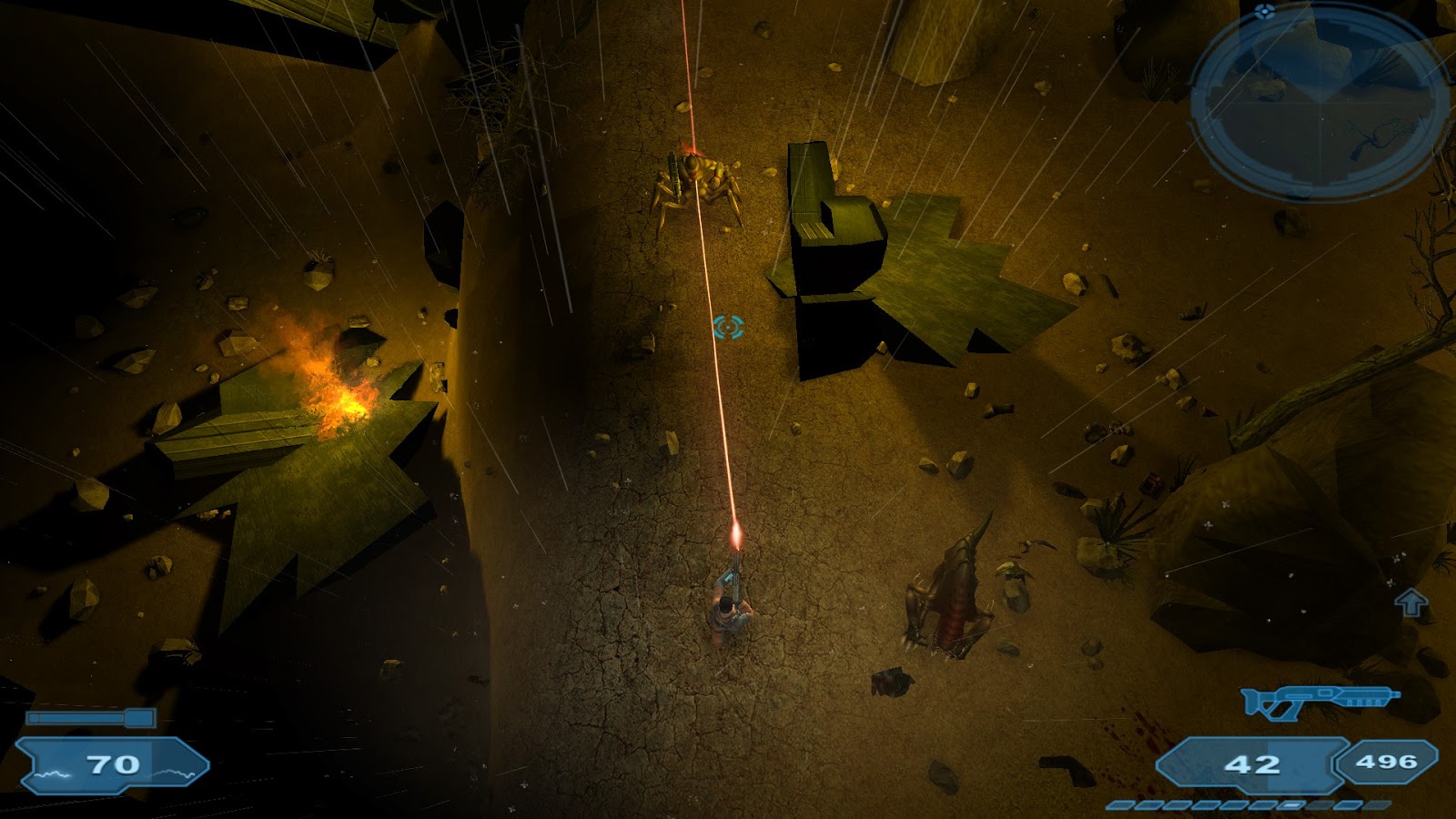
The demo for Shadowgrounds was one of the first games I remember playing courtesy of the Steam storefront. Back in the days where Valve's marketplace was diminutive and I was curious what (non-FPS/Blizzard) wonders lurk within the unexplored jungles of PC gaming, I happened upon this gritty top-down shooter and decided to give it a whirl. I greatly enjoyed what I played, but it wasn't until the Humble Frozenbyte Bundle that I was able to nab both it and its sequel. Nearly a decade later, I finally set aside the time to play through it, and boy, it sure is an action game made in the '00s.


If that's not an enriching description, allow me to paint a better picture by asking some questions. You know how The Matrix had a massive impact on everything that tried to be cool post-1999? And you know how Halo: Combat Evolved (or Starship Troopers if you will) helped popularize placing the American military into sci-fi settings? And ya know how Doom 3 tried the whole horror in space thing? Mix those three things together, add this music to it, and yeah—that essentially covers all six hours I spent with Shadowgrounds.

To its credit, the game doesn't play like anything I mentioned above. The lofty camera angle may fool you into thinking it's a twin-stick shooter but Shadowgrounds isn't as kinetic or exciting as one might think. As strange as it sounds, the game strikes me as more of a bizarre Doom clone. You have an arsenal of ten weapons, your hellish foes require frequent strafing to avoid projectiles, and the nonlinear maps encourage room-by-room sweeps and munitions scavenging. The game doesn't come anywhere close to touching Doom's immaculate design or mechanics, but it echoes its bold style; the best praise I have to heap upon Shadowgrounds is that at times it feels like a European reimagining of id's classic.


Of course, the opening missions of the game do little to convince the player of that. Shadowgrounds has a slow build towards the meat of its gameplay, unapologetically forcing the player to engage in some very boring gunfights until their arsenal begins to expand. Right around when the grenade launcher is introduced and the game replaces its monster waves with patrolling guards is when I found myself most appreciative of the experience. The purchasable skills linked to each of the weapons gives you something to look forward to while you're mowing down countless hordes of faux-Shamblers, and while it may be a bit of a lottery trying to figure out which ones are helpful and which are duds, their inclusion keeps things interesting.

There's not much to the Shadowgrounds besides that. The story is what I'd lovingly refer to as the polar opposite of Deus Ex: Human Revolution: each character, cutscene, and journal entry are wholly meaningless and shockingly boring, to the point where I wouldn't be surprised if a high schooler secretly wrote it. There's not a lot of variety to the setting, and when you do get a change in locale the game tries to be Halo so hard it hurts. The flashlight mechanic is interesting in theory but comes across as irritating (please let me upgrade its battery!), the end of the game introduces shielded enemies that are impossible to fight, and the dodge roll is downright pitiful. None of these issues are worth getting your panties in a bunch though—this is prime C-grade material, so it's prudent to expect some ugly bumps along the way.


There is a mindless joy at the center of Shadowgrounds. The gunplay is decent and the campaign is competent... but it's not anything I'd earnestly recommend. Perhaps it was better off being a gilded memory locked between some synapses in my skull, but hey, at least it was kinda entertaining while it lasted. It's an unremarkable blast from the past that served as a good diversion between the bigger titles getting released this year.

Thursday, May 5, 2016

Deus Ex: Human Revolution - Thoughts


To say I enjoyed my time with Deus Ex: Human Revolution would be an understatement—with no hesitation do I deem it my favorite in the series, as it hones in on what makes the franchise so remarkable. Gone is the streamlining process that hamstrung Invisible War, the intrepid FPS series finally returns to the rich well of player choice its ancestor had unearthed. Yet it approaches the world of Deus Ex with a more serious tone, concerned with the diametric arguments revolving around governments vs. corporations, technology vs. nature, and traditionalism vs. progressivism. Human Revolution poses complicated questions and constructs excellent gameplay scenarios for you to tinker with; while it does have its fair share of problems, Eidos Montreal's risky debut is a resounding return to form.


I'll start by proclaiming that I really like Adam Jensen. In numerous titles nowadays, the main character serves as a somewhat emotionless vehicle for the player to steer, devoid of much personal baggage in order to ensure the dominance of their puppeteer. Jensen fulfills this to a degree, but he's visibly weighed down by the events that occur in the prologue, tormented by what he's irreversibly lost, as well as what he must regrettably become. Both JC and Alex are skeptical of their positions as pawns, but remain confident and effective at their work; Jensen on the other hand is overwhelmed by his burden, robbed of his spouse and frustrated with his employer. My fondness may be because I'm more drawn towards characters that struggle with their inner demons, but I contest that Jensen is the most fascinating protagonist yet. I found myself easily sympathizing with his struggles, eager to hunt down Megan Reed's attackers and discover the shrouded truth.

Just as the game's predecessors had, the story continues to cleverly imagine what an augmented future might hold. While Human Revolution doesn't engage with philosophy as actively as its older siblings, it utilizes dialogue far more naturally, accentuating the believability of the world. I also appreciate how subtly the conspiratorial elements are handled this time around, the game no longer beating you over the head regarding whom belongs to which faction. The plot does take an unexpected turn towards the end (that would seem even wilder without having played the DLC, a la Mass Effect 3), but everything is fleshed out so nicely with dialogue and in-game text that I walk away very pleased from my time with Human Revolution. Too often when I play a game, the story becomes either negligible or trite, so it's always a delight when I can get engrossed in a virtual narrative.

The return of emails reveals what a boon the electronic exposition is to the story, as their absence from Invisible War was sorely missed. Reading text provides frequent breathers between the tense sleuthing, and it's often interesting or sheds light on the world around you. Unfortunately hacking is probably the worst gameplay system you have to interact with, as (while it seems complicated at first) it's quickly distilled down to dull game of probability. There's no excitement or complexity of choice present here—simply click your way to the exit or restart if things go wrong. It's a shame the game has no option to swipe pocket secretaries from guards, as I would've loved a non-confrontational way to gain access to computers or skip having to hack yet another laser grid panel.


Hacking thankfully remains the only mechanical misstep, as the rest of Human Revolution plays superbly. That's not to say that the shooting is on par with Call of Duty—it clearly isn't—but it works well within the framework of the game, keeping firefights dangerous since Jensen doesn't feel like a one man army. Where the Sarif employee excels is at hand-to-hand combat, pushing the game considerably towards a silent melee focus (which worked well for me). Slipping around the seamless third person cover until you can get behind a man and punch him with both your fists is amazingly satisfying, the takedown animations keeping their luster over all 30 hours of play. My personal philosophy was to use non-lethal force unless innocents were involved, which by that point meant the blade arms would get unsheathed. Man, are those blade arms cool. Occasionally stupid, but always cool.

Complementing the excellent stealth are a variety of avenues you can walk down to complete your mission. Side quests are plentiful and the game constantly addresses multiple play styles, hitting the player with a barrage of "oh, I could've done it this way!" whilst exploring. True, Jensen can end up becoming a solid all-rounder at the end, but you still have to use your wits and inventory to work through any problems you rub up against, which is where the series flourishes best. Plus The Missing Link portion of the game is a great tabula rasa moment, letting you play around with an alternate style of play before the ending.

The game does stumble in a couple other places, most notably in forcing you to revisit the major hub cities. I like Detroit and Lower Hengsha a lot, but the amount of backtracking the game thrusts upon the player is a bit excessive (especially in one specific part of The Missing Link). There's some other iffy parts—the belligerent boss fights, that wall-busting is lethal, and how awkwardly stitched in the DLC is—but for the most part the game's highs outshine its problematic lows. For every instance where the game throws a boring backtracking segment at me it lets me do something cool like chuck a pimp off a roof, and for every headache-inducing boss I'm forced to fight I get an exhilarating moment where I make it through a floor unscathed and/or unseen.


Deus Ex: Human Revolution is a lot like Deus Ex, except that it's (arguably) more refined. Certain mechanics have changed and some details got lost in the transition, but the modern coating makes it far more palatable. While I appreciate a lot of what the original did, I was unequivocally more excited to sit down and play Human Revolution every time I booted it up. The game stays loyal to its roots, constructing an intriguing world that feels great to play and is ripe with spectacular scenarios. Human Revolution doesn't suffer from standing in the shadow of Deus Ex like Invisible War did—if anything, the series grows stronger for having it attached.

Now that I'm officially a fan of the franchise, I'm greatly anticipating the release of its sequel this August—here's to hoping it lives up to my high expectations!

Tuesday, April 26, 2016

Banjo-Tooie - Thoughts


Banjo-Kazooie is one of the best collection-focused platformers of the fifth console generation, so naturally an amped-up sequel that's nearly twice as large as the original would be better, right?

Unfortunately, no. While it may not match Donkey Kong 64's insane penchant for collectables, the detrimental symptoms are noticeably present here. It's not an awful game—its bombastic size and scope made it a worthwhile purchase back in '00—but it feels more taxing than its predecessor, requiring a greater effort from the player to solve it. In some respect I suppose it's the ideal sequel to Banjo-Kazooie, but what is lost in the process is the lackadaisical ease of simply "havin' a fun time"; Banjo-Tooie is geared more towards hunting than exploration.


The opening cutscene alone is a good indicator of the length of this game, clocking in at over ten minutes before you can start playing. The story maintains the same bubbly Rare quality, returning its colorful cast to the spotlight with some great new debuts, accompanied by some hilariously dark moments that the narrative brushes over (dead jinjos and children, good lord). I take no qualms here with the plot or writing however—all my concern is rooted in the gameplay and design.

To wit, there's too much laborious backtracking. No longer can you set aside an evening to check off one of the game's eight worlds from your list; each setting is tightly tied to another, requiring you to come back later when you've amassed additional abilities or unlocked new shortcuts. While it provides some mystery to each location, it can be confusing trying to figure out whether or not you've met the requirements to obtain a certain jiggy or frankly haven't found the solution yet. I didn't walk away from each play session feeling like I had accomplished something, but was instead constantly asking "there's still more to do here?!"

The backtracking issue is one that's rooted at the core of the Metroidvania genre—so I really can't fault it all that much—but what compounds this problem are the numerous methods of travel. In Banjo-Kazooie you only had the titular heroes and a Mumbo transformation as vehicles of exploration, but here you have Banjo, Kazooie, Banjo & Kazooie, a Wumba transformation, and Mumbo to contend with. This means that you'll be exploring the same tract of land multiple times over to collect a single jiggy, a painful echo of Donkey Kong 64. Perhaps the most flagrant example of this is the Styracosaurus quest: you run into them as Banjo & Kazooie, return as Banjo, head to the train station, turn back into Banjo & Kazooie, then go to Mumbo at the Isle o' Hags, return as Mumbo to the train, turn back into Banjo & Kazooie, return the train back to Terrydactyland, and you still have to return to the family as Mumbo later. And that's not even the entire quest to obtain a single collectible out of a potential 90. I killed myself in this game countless times just so I could skip having to reunite the bird and bear manually.


Where I found myself pleased with Banjo-Tooie was when it closely resembled Banjo-Kazooie's design. Exploring the ill-lit rafters in Glitter Gulch Mine, burning the behinds of the Rocknuts in Terrydactyland, and outsmarting Mr. Fit in Cloud Cuckooland were all stand-out moments between the frequent back-and-forth-ing that was required (getting to Mr. Fit in particular was a hassle). I think the first-person segments and various egg types are excellent improvements to the game, and though it may not seem like it, I do appreciate what Banjo and Kazooie individually bring to the gameplay this time around. I'm miffed that the music note hunts have been neutered (they used to provide you with something to do while traversing the landscape), but for the most parts these changes at least make the moment-to-moment gameplay a little more interesting.

To reiterate, I don't think the game is terrible as much as it's just not fun when you're forced to do a ton of leg work. Grunty Industries is the greatest offender of this, having some really clever ideas in it (using batteries to power doors, the service lift can only be used by the dishwasher) inside a gargantuan layout that's chock-full of dead ends and questionable design choices (why give me the Snooze Pack ability next to a place where I need the Sack Pack? Is it really necessary to place Weldar's jiggy two rooms over? Why can't the Split-up pad on the first floor be closer to the Waste Disposal entrance?) I thought Click Clock Wood was arduous to finish at 1.5 hours long, but this level took twice as long as that, not to mention how the N64's single digit frame rate was doing my playtime no favors either.


Banjo-Tooie is a good example of why bigger isn't always better. True, it's packed with neat secrets and tricky sections that require some tinkering, its worlds and solutions cleverly interwoven together... yet this expansion stands at odds to the indelible charm of the original game, Banjo-Kazooie's smaller worlds acting more like a playground than a set of puzzles. Whereas the first game invited you on a delightful excursion, Banjo-Tooie asks quite a bit more from the player—whether or not that's your cup of tea is up to you I suppose.
---------------------

Images obtained from:  smashcustommusic.com, giantbomb.com