Wednesday, March 31, 2021

Into the Breach - Thoughts

 
Into the Breach is a paradox. And no, not a time-travelling one; Subset Games' sophomore effort is a perfect experience that's dogged by its perfection. It sounds nonsensical, but hear me out: you know how there's some games you love but probably won't ever play again? Usually they require too much of a time investment (World of Warcraft) or offer the greatest value on your first experience (Undertale), but either way you're not compelled to return. To have this happen with a procedurally generated game—one that's designed for repeated playthroughs—typically forewarns of a broken system, lack of variety, or crushing length. Into the Breach has none of those, but is instead so beautifully balanced that finally figuring out how to play it eliminates your need to.


The premise for Into the Breach is phenomenal: ginormous bugs are attacking Earth, and the only way to stop them is by using equally ginormous robots (that uh, also travel through time). While it sounds like the perfect pitch for an EDF clone, Into the Breach plays closer to a game like chess, prioritizing positional advantages and impactful moves. Each battle opens by showing you how the bugs plan to attack, and you must counter them for four or five turns, whereupon the pests will retreat. The catch is that more bugs will emerge out of the ground every turn, so you must keenly balance offense with defense, eliminating major threats while finding ways to deny their reinforcements.

After a few runs you'll see that the chess comparison isn't just for show: turns are porcelain-delicate, with one wrong move sending you spiraling into defeat. Eventually, you'll shift your thinking from "how do I kill these bugs" to "how do I kill them as efficiently as possible", scouring the battlefield for a better move than the one you have. You'll learn to create two results from a single action, visualize the HP of your mechs as an expendable resource, and finally, reach the epiphany that your objective is simply to stop the bugs, not kill them. To help you on this journey are different mech squads that can be unlocked over time, expanding not only your toolkit, but also the way you approach problem solving. While there are a ton of intricate systems you'll have to adapt to, don't let that discourage you—you can succeed on your very first run so long as you use your brain.

This brings us to Into the Breach's biggest draw, as well as the Achilles' heel of its replayability: semi-perfect information. Most of the game's randomness is dealt with before and after a battle, when you're choosing assignments to take, opening time pods, and purchasing items from a shop. Though enemy reinforcements are somewhat unpredictable, you won't be overwhelmed with more than you can handle—and even if that does happen, it's usually because you made a dumb mistake somewhere (like foolishly going to the island with the spider boss). The only hard dice rolling the game does is actually in your favor, in the form of a "grid defense" that has a low (but appreciable) percent chance for buildings to avoid taking damage. Into the Breach is so meticulously balanced that any team you pick is guaranteed to net you a four-island victory on Hard, provided you know how to correctly react to the RNG you're given.


That might sound obvious to roguelite players, but Into the Breach isn't nearly as susceptible to faulty reactions or lethal saving throws; all pertinent information is given to you, so there's always a salvageable move somewhere. That's not to say you will never lose, but that your losses will make perfect sense in hindsight. Besides resignations from chasing achievements, I only had three serious defeats on Hard mode that I can recall: one for choosing poor weapons for the final fight, another for letting the spider boss grow out of control, and the last for picking a custom squad that lacked "push" potential. While it might be tempting to blame the "grid defense" for failing me, the truth is that I could've rectified all three runs had I made better choices along the journey.

And therein lies the rub; Into the Breach is a majestic Rubik's Cube of options, where fun is found in discerning a method by which to solve it, rather than physically completing the task. The game can still entertain in a meditative way, similar to daily chess and sudoku puzzles, but absent is the nail-biting thrill found in an FTL run, where you're anxiously scouring the sector map for a repair station. And sometimes, it's nice to play a game that's devoid of RNG-failure, where messy fights won't leave you bruised or bitter. Sure, frustration tends to play an element (my artillery got webbed AGAIN?!) but your quest to 100% the game will see you achieving a zen state, fear and doubt leaving the equation. You'll understand that every map is solvable, every pilot useful, and that you've won run before launching out of the hangar. In being so well-balanced, Into the Breach effectively solves itself, and then asks you whether or not you can replicate its solution.

However, I'd be remiss if I didn't mention that there is an absurdly difficult optional challenge: take no building damage over the entire run. While it is doable, it requires a level of transcendence that I probably won't be able to reach, demanding intimate knowledge of every weapon, map, and even the enemy AI. I've gotten somewhat close at times but I always make a mistake somewhere, given that 2+ hours is a long time to play a game flawlessly. And while I appreciate the existence of that challenge, it conversely creates disappointment; there's nothing to test your mettle between the extremes of "no damage taken" and "Hard mode." The closest thing I can think of is selecting a "Random Squad" as your team, which will hand you occasionally tricky combinations (three science vessels?!) Yet one or two store visits will usually round out your arsenal—if you haven't crashed and burned before getting to that point. I think more modes could go a long way towards spicing things up, but as it currently stands, knowing the game "well enough" works somewhat to its detriment.


I hope what I've written isn't misleading—I adore Into the Breach and would rate it at least a 9/10. But... I'm obviously bothered by my lack of need to return to it. Perhaps I'm just judging it too harshly. Most roguelites succumb to mastery eventually, where even difficult games like Nethack, Spelunky and Slay the Spire can yield double digit winstreaks. But personally, I still look at those games and see the ominous possibility of failure looming overhead, heavy as a headsman's ax. Into the Breach on the other hand carries a footnote of failure, one devoid of bad luck, poor response time, and unfair design. If humanity falls to the insect invasion, the most probable reason is that you were simply too impulsive. Into the Breach is a wonderful, enthralling experience while it lasts—but once you can read it like a book, I guess there's little else to do besides shut it and move on.

Wednesday, March 17, 2021

Dragon Age 2 - Thoughts


[contains minor spoilers]

I spent half of my blog entry on Dragon Age: Origin griping about how difficult the game was, so imagine my surprise when I sauntered into Dragon Age 2 and found it to be even harder. I'm not sure what compelled BioWare to double-down on the unforgiving nature of the series, but double down they did and man oh man did it give me a rough time. My playthrough took nearly sixty hours and I'd say a good twenty of that was spent in menus, meticulously equipping and re-equipping my companions, staring blurry-eyed at their skill trees, hoping to find an OP ability somewhere. But no, Dragon Age 2 told me there would be no easy paths through life, and by the end I've grown to like its tough attitude—and it's not just the gameplay that gets tough.


As damning as this observation is to make, Dragon Age 2 reminds me most of Deus Ex: Invisible War. Both games are competent titles that have gotten bum raps from trying to streamline a beloved older brother. In Dragon Age 2's case, it looks towards Mass Effect 2 for inspiration, narrowing its scope and preferring combat to be flashy rather than mundane. But these changes are taken to their extreme, reducing the world of Thedas to a single city and having every single character—even the mages!—exaggerate their attacks as if they're middle school LARPers.

However, these issues—low locale variety and over-the-top action—are detrimental only on first glance. While Kirkwall undoubtedly would've benefited from more dungeon layouts, trapping you in the city means that you'll grow attached to the solitary setting, gradually learning more of its uncomfortable history with time. And the flashy combat is mechanically a non-issue—you can turn off button mashing in the options and basically play the game like Dragon Age: Origins, auto-attacking enemies and adjusting companion AI to suit your party's needs. For console players, not only does the spell wheel return fully intact, but it now boasts a vital new command: "move here", a tiny feature which quickly becomes an essential part of your arsenal.

Dialogue is unfortunately one aspect that's been definitely downgraded. Folks online cheekily dilute Bioware's dialogue wheel to "good choice, evil choice, sarcastic choice," but Dragon Age 2 is where the meme must've come from, because those are precisely your three options. Sure, occasionally you can lie or let one of your companions handle things, but you're no longer spoiled with the multitude of responses Origins provides, let alone the variety. Most of the choices in this game will result in binary outcomes—and even then, you're lucky if they don't inevitably turn into the same boss fight. The best thing I can say about the dialogue wheel is there's a new "mood" icon in the center of it, although good luck figuring out what "five-pointed star" and "purple diamond" mean.


That's not to say your choices don't matter or that the narrative feels weak however. The story in Dragon Age 2 is solid, but... kind of strange. Whereas most of BioWare's other games provide a central plot looming in the distance (Saren, the Reapers, the Archdemon) Dragon Age 2 doesn't have one. There's an array of offbeat story arcs and shady characters to be on the lookout for, but Hawke has no core motivation beyond a hazy "protect my family" instinct. Dragon Age 2 is a tangle of side quests that may or may not interweave with one another, knotted around three distinct threads that are mostly unrelated from one another. You'll bounce from one story, to another, to another, until eventually the game decides it's finished and rolls credits.

But like I said, this pivot isn't a detrimental move—by removing a titanic evil looming in the distance, Dragon Age 2 instead focuses on the layperson and their individual plight. Rather than deciding the fate of kings and kingdoms, you help folks find their lost shipments, foolhardy sons, and missing wives (or... what's left of them.) In turn, the conflicts in Dragon Age 2 feel more personal, as years down the line you may be forced to deal with the ramifications of your actions, forced to confront—or kill—someone you once aided. And that should scare you because a lot of outcomes in Dragon Age 2 are fairly bleak: by the end, my love dumped me, most of my relatives were dead, and I was morally obligated to execute my best party member. The narrative can certainly get frustrating at times—its overly binary and has no qualms about removing companions key to your party makeup—but it's a frustration that helps keep you on edge. Hard decisions are constantly pushed in your face, making you question whether or not you can survive the outcome.

And that bleakness wouldn't feel as potent if it weren't for the brutal gameplay design. By far the most unforgivable part about the game is that it will drop enemy reinforcements around the perimeter of the area, which has several nasty consequences: new enemies are quick to target squishy characters, area of effect spells have low utility, and you're never really sure when a fight will be winding down or starting up. Since warriors are atrocious at pulling aggro (Taunt has a 20 second cooldown!), your best bet is to spec for offense and learn to identify-then-dispatch of the problem children immediately: mages, horrors, assassins, and venomous spiders. If you don't stay on top of your party's health and positioning, you'll either blow through all your expensive consumables or watch as your ranged characters are downed fight after fight. Origins eventually dropped off in difficulty whereas Dragon Age 2 starts hard and ends hard—and this is without getting into the absurd boss fights (I hope you enjoy fighting 70 adds and navigating rock walls!)

Like with Origins, you'll eventually learn to adapt to the game's surprise drops, even if you never become a fan of them. Given that combat is considerably more lethal, you'll be spending even more time combing over your skill trees and equipment perks. Both of these features have been simplified from Origins, but it's a minor thing you'll hardly notice once you accept that you're not in charge of your companions' body armor. In fact I think I like the skill trees in Dragon Age 2 more because they let you spend talent points on modifiers to your existing abilities, which makes up for rotating through a long list of similar-feeling spells. Not a single time did I ever feel like Dragon Age 2 was tactically inferior to Origins; my biggest gripe will forever be that the game needs to take a chill pill when it comes to sending sending enemy reinforcements at you. And that magic resistance is too swingy. Aaand bosses are too tanky.


Going into Dragon Age 2, I was prepared for a neutered experience that was all style and no substance. Instead I got a game that was deep, full of good character moments, and much harder than either Doom Eternal or Sekiro. My experience wasn't all sunshine and smiles of course—the word "frustrating" immediately comes to mind—but I respect the game for challenging me with its narrative, economy, and gameplay. There's plenty of value to be found in Dragon Age 2, but you need to head into it understanding that it has an insatiable (and somewhat unfair) penchant for punishment.

---------------------

Images obtained from: microsoft.com, superior-realities, reddit.com, youtube.com

Thursday, March 11, 2021

Momodora: Reverie Under the Moonlight - Thoughts


Momodora III was the first entry in the series to feel like a proper game, but rdein's fourth attempt, Momodora: Reverie Under the Moonlight, makes III look positively childish. Reverie is Momodora but all grown-up and anxiety-riddled, filled with gloomy locations, darker story beats, and a subdued—but fitting—color palette. Gone are the simplistic Cave Story references and chibi girls slapping goofy eyeballs (well, you'll still slap monsters with a leaf, but they'll be of the shadowy and abominable variety.) Your adventure through the City of Karst will be equal parts foreboding and awe-inspiring, unsettling and beautiful; Reverie Under the Moonlight is the elegant culmination of everything rdein has learned thus far.


I'll start by revealing that Reverie is short, but not bite-sized short. I've run through the game multiple times (on increased difficulties) and none of my playthroughs have extended past three hours, with the shortest being just shy of sixty minutes. That's not to say that Reverie feels brief though; you spend a decent amount of time in each location, and just as you start to get a grasp on the enemies and traps in one area, you'll soon venture into another. This keeps Reverie feeling punchy and fresh, maintaining the energetic spirit of the old Momodora titles, but giving you enough time to settle into each zone so that you grow attached to the music and enemies as you search for goodies.

Structurally, Reverie Under the Moonlight returns to the Metroidvania genre, but keeps its levels and boss fights compact, akin to Momodora III. There's health upgrades to collect and various baubles you can equip, which add some minor flair to your combat repertoire. While there are hints of a neat combo system here, given Kaho's well-animated 3-hit chain and enemy flinch states, it's... not very deep. It is, however, quite satisfying, especially with how easily you can mix in powerful ranged attacks. The hardest difficulty requires you to essentially play the game flawlessly, taking nearly zero hits—which would brutal if not for the fact that the bow is your best offensive ability, letting you play cautiously and melt most of the bosses. If you learn to love it, the bow shall reward you well.


Not that most people will be playing the "1-hit kill" mode of course. The default difficulty is well-balanced for your first playthrough, though rdein's difficulty curve will vary from room to room. Some areas will test you with tricky foes and nasty spikes, while other times you'll stroll through a section just to unlock a shortcut and go "wait, that was it?" This is the charm of rdein's games though: you never know what to expect from one screen to the next, whether it be new foes, a new boss, or environmental vignettes.

Speaking of: Reverie, like other Momodora games, has a simple narrative that's cloaked in its own enigmatic history. Unlike Dark Souls however, there aren't easy ways to decipher and unravel it; you're a stranger to Karst and its adjoining lands, encountering and dispatching of characters that have six lines of dialogue or less. I like this approach because it gives precedence to the ambiance of Reverie over its lore, evoking the history of the Queendom in short glimpses, often found in stray details like a burnt painting or broken bird cage. Sure, there are NPCs that will give you a general gist of what's going on, but you'll feel like you're interrupting the lives of most folks you encounter—or what little life they have left.

Lastly, the game is smooth as butter to play. rdein has always nailed player control in the previous titles so this isn't a huge surprise, but coupled with the larger sprites and more detailed backgrounds, it's impossible not to be impressed with the aesthetic Reverie displays. Throw in some melancholic melodies that underpin just how forgone Karst is, and you'll find yourself remembering sections of Reverie more often than in rdein's older games. And maybe that's what strikes me so much about Reverie: it has that ineffable quality where it stays glued to your brain, even after the credits roll.


Even though I enjoyed the previous entry plenty, Momodora: Reverie Under the Moonlight was so captivating that I immediately started a Hard playthrough upon finishing it—and yet another playthrough after that. It's a greatly enjoyable mini-metroidvania, although using the word "mini-" belies its quality; what it lacks in longevity it makes up for in personality. Reverie feels like a complete package, full of good fights, interesting settings, smooth controls, and some really stunning music. I'd still call Momodora a quaint series, but with Reverie it's no longer as small or quiet as it used to be—and it's all the better for it.

Tuesday, March 2, 2021

Diablo III - Thoughts


Diablo III is an exceedingly strange game. On the surface, it doesn't look like it—Blizzard brought their trademark polish and shine to the title, making it look, feel, and sound better than any other action RPG on the market in 2012. But all the bells and whistles belie a barebones interior keeping Diablo III held aloft. It's a game of infinitesimal improvement and repetitive farming, of endless achievements and quixotic gimmicks every season. You get into Diablo III not for its lore, community, or even the clever builds; the main draw is its bottomless, meaningless, tedious grind. And while it may not be a terrible grind, it is an absolutely shameless one.


Before we get to the grind, let's talk about the elephant in the room: Diablo III's main campaign is a bust. I'm typically one of the folks that defends video game narratives (game prose is on par with serialized television at least), but Diablo III is the poster child for lackluster writing. I paid attention to the story, I gathered the bestiary books, and I engaged in the side conversations—yet not a single thing stood out as interesting. My most "captivating" discovery was that the big bad Malthael had once been the Archangel of Wisdom... but the game does absolutely nothing clever with that realization. All the villains are unambiguously evil, their plans positively brainless; comics from the 1970's could generate more hooks in 20 pages than all 20 hours of Diablo III's campaign combined.

That leaves Diablo III's core gameplay loop as the main draw, which is a nest of webs to navigate due to two reasons, the first being its heavy reliance on equipment. That might sound like a petty complaint—aren't all ARPGs centered around their loot?—but Diablo III is unique in that your build is determined first and foremost by what you find rather than the skills you pick. During my replay of Diablo III's campaign, my hardcore Monk was absolutely useless (on T1) until she stumbled across a level 14 legendary item (Cesar's Memento), which granted a whopping 750% bonus damage to a skill I didn't even like (Tempest Rush). But to avoid fights that could take upwards of five minutes, I had to center my build around activating that boring ability as much as possible, never needing to switch it off my main skills when the bracers became horribly outdated.

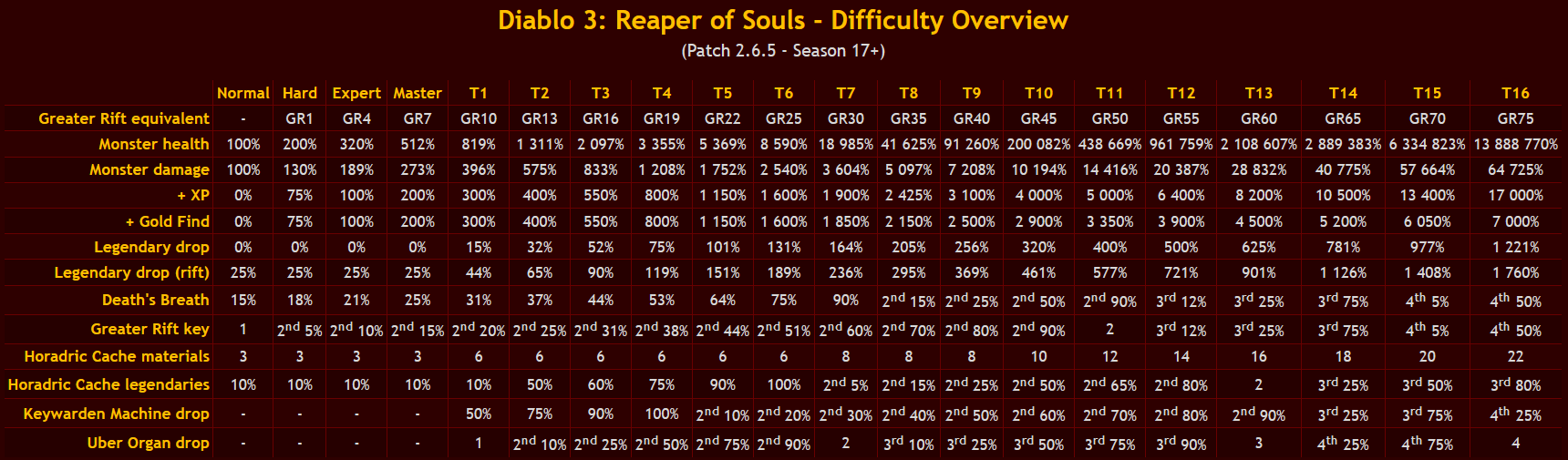
If having to balance your build around random item drops sounds awful, don't worry—you can opt to ignore equipment synergy by instead grappling with Diablo III's second issue: the ludicrous Torment system. The game boasts a total twenty tiers of difficulties, 80% of which are just numerical additions to the word "Torment". Sure, you can play through the game on its base difficulty of Normal or Hard, but you'll never be challenged so long as you remember to equip gear (any gear!) that's around your level range. To fully engage with your skill set and feel a modicum of accomplishment, you'll have to dive into the Torment difficulties—and even then you're not likely to make it beyond Torment IV unless you really know what you're doing.


I dove into Season 22 of Diablo III prepared to finally make an endgame build that could topple the highest difficulty: Torment XVI. I watched a video on the Masquerade Bone Spear Necromancer and dug into the icy-veins page to get a better handling on what every piece did and why. For the most part, it was fairly fun battling my way to level 70 with my skeleton mage army, and then knocking off the seasonal achievements one by one until I could claim the entire Masquerade set as my own. After that, my goal was to fill every equipment slot with its recommended legendary, having to mix and match what I was wearing until the fabled Haunted Visions amulet—the linchpin of the entire build—landed in my lap. From there, all that was left to do was reroll the stats on my current gear, or hope to find Ancient/Primal versions of it (ie rare max stat mutations) either via Kunai's Cube or Rifts.

If a lot of that sounds like nonsense to you, let me break things down more clearly: once reaching level 70 in Adventure mode, you run one activity (Rifts) 90% of the time and do another activity (Bounties) 10% of the time. Once you get good gear you raise the difficulty, which allows you to find more gear to further optimize your build, letting you raise the difficulty to find even more gear in order to raise the difficulty and so on and so forth until you become a snake eating its own tail in the belly of a Greater Rift. As Rifts are just recycled content (same with Bounties), you're not really seeing or experiencing anything "new"—your adventure through Torment X will mirror your experience with Torment VII, IV, XIII, etc. Even when you topple the fairly lethal Torment XVI, you can try your hand at Greater Rift pushing, where you can play all the way up to a theoretical super-duper lethal Torment XXXII—which, need I remind you, boasts no new content outside of inflated enemy health and damage.

I could posit that I soured on Diablo III after finally reaching Torment XVI, but I think from the very beginning the game was slowly, gradually ebbing my excitement. To its credit, Diablo III at least hides this process very well—every class is a lot of fun to play and there's bound to be some abilities you'll never get tired of using (Disintegrate, Falling Sword, Corpse Spiders). But the game's one-two punch of gear dependence and arbitrary difficulty settings will always leave me stupefied. And it's not that it's wrong to allow players to tweak the difficulty—Supergiant Games is a master at this—but Diablo III's Torment tiers all blend together, testing you in the exact same way from the first numbered iteration to the last. Eventually you'll find yourself playing the game as a habitual way to kill time, collecting loot you'll never need and spending Paragon points to increase your stats by a fraction of a percent. It's a great game to play while listening to an audiobook or podcast, largely because your brain will need something more captivating to do in the meantime.


In a way, it's weird that I can't accurately speak to what Diablo III was like in 2012. I played through it at launch but didn't explore the harder difficulties, nor engage with the real-money auction house. I'm sure—as fans are quick to note—that the game is in a better state now, but I'd hesitate to call the features that have been tacked on (Rifts, Torments, Haedrig's Gift) "solutions". They certainly add to the replayable and help the game feel more diverse, but fundamentally, Diablo III's blueprint is severely lacking. I've funneled more than 200 hours into the title but most of that time was spent looking for something meaningful and rewarding out of its complex systems and plethora of gear. In the end, I'll have to face the fact that I'm walking away from the Diablo III with my hands...

... empty.

Thursday, January 14, 2021

Hitman: Contracts - Thoughts


[contains minor spoilers]

From the onset, the Hitman series was severely flawed. Despite showing hints of creativity at times, the first two games were rotten with awful firefights, linear paths, and security guards so vigilant that they could put the secret service to shame. Hitman and Hitman 2 wanted to be sneaky, but by creating a world that was actively on the lookout for an assassin, it was hard to have fun. I'm not claiming that it's impossible to enjoy these games—Hitman 2 certainly has its moments—but it is impossible to play them and not feel hamstrung by either the narrow design or finicky alert mechanic.

With the release of Hitman: Contracts, IO Interactive has hit its stride, finally bringing the premise of playing as a dapper assassin to life.


The game's not perfect of course, but IOI has continued their upward trend of making better games. Just as Hitman 2 was leagues above the original, Contracts strides ahead of its older sibling... despite looking and playing exactly the same. The only noticeable aesthetic difference between the two is that Contracts is considerably darker, in both tone and style. Most of the stages take place at night and are drenched in bad weather, and rather than infiltrating mob estates and middle-eastern bunkers you're sent into a meat-fetish party and a biker bar with a naked man being tortured in its basement. Contracts is still in line with the franchise's playfully dark sense of humor, but most of the humor has been wrung out, the playfulness draped in blood.

What puts Hitman: Contracts easily above the other two games for me is that its alert system is finally manageable. No longer will guards burst into a murderous frenzy upon seeing you sprinting to your next location, providing some much-needed freedom that was denied in Hitman 2. Likewise, the threat meter will flash red only when you're dangerously close to being uncovered (likely from being dangerously close to a guard), giving a better indication for when you're about to blow your cover. It's a bit easier to tell where you can and can't go thanks to guards flashing the "stop" sign, and stealth mode is finally faster than enemy walk speeds—albeit fractionally. Add a lot of clever assassination opportunities on top of this system and at last you have a Hitman game you can ghost through!... or... at least achieve a Silent Assassin ranking on most of the missions without a guide.


There are, however, still plenty of kinks left in Hitman's stealth system. The most obnoxious is that as soon as enemies are alerted via a discovered dead body or panicked civilian, they'll be impossible to shake. Your disguises thereafter become suspicious over time, and then it only takes a momentary glance for a curious guard to deduce your identity. This stands in stark contrast to the guards' neutral behavior where they'll think nothing of you stalking them for half the level, nor will they care if you conga line their boss into the bathroom. I found that it was easy to achieve the Silent Assassin ranking on Normal because getting anything less would devolve the stage into one big firefight, and I've definitely had my fill of shooting dumbass AIs in this series.

The design of the levels can be pretty hit or miss, with the first half of the game being much stronger than the second half. This is due to two factors, the first being that the back end of Hitman: Contracts strangely consists of Hitman: Codename 47 missions remade in the Contracts engine. For the most part, it is kind of neat—the stages look and play much better, with some of the worst offenders scaled down (Lee Hong) or left out entirely (all of Colombia, thank god.) The issue with this is that the levels aren't all that fresh or exciting, as all of the old tactics (snipe the triad member, bomb the car, poison the soup) still work and are also the optimal ways to beat the levels quickly. For those that haven't played 47's origin story, this is undoubtedly the better way to go through these levels, but for me it was kind of a... been-there, done-that experience.

The other factor bringing down the latter half of the game is that your options are significantly limited, thanks in part to the constrictive design of the Codename 47 missions. "The Meat King's Party" and "Beldingford Manor" are two brilliant stages thanks to their quirky themes, nonlinear maps, and unique approaches to dispatching your targets. Contrast something like dropping a gas can down a fireplace for an explosive assassination with the majority of the Hong Kong missions, where head-shotting your target is the only "silent" way to subdue them. Lee Hong gets a special kudos for being an absolute pain in the ass to eliminate, as he's surrounded by guards all the time and will also randomly attack you with a supernatural premonition. Hitman: Contracts may not reach the sewer-stinkin' lows of its siblings, but it's still disappointing to have its first few hours be its unquestionable best.


The only thing Hitman: Contracts gets wrong with respect to the rest of the series is that it has a filler-story. The cutscenes are extremely well-done and moody, but Contracts tells of a paper-thin payoff that closes out with a cliffhanger. Plot-wise, Contracts is somewhere between a nothing-game and a teaser, but in every other respect it blows the other titles out of the water. It's logical, concise, creative, and best of all, an actual stealth game that let me complete my job with only one or two guards to add to the obituary pages. I had such a good time that I never once resorted to my starting silenced pistol, which is about the biggest stamp of approval I can hand the game. I'm curious to see how Blood Money will hold up, because thus far IO Interactive has been getting better and better.

Friday, January 8, 2021

Doom 3: BFG Edition - Thoughts


Doom 3 has always been saddled with an unsolvable riddle: would it have been more liked had it not been called Doom?

The franchise had been in hibernation for nearly a decade when Doom 3 came out, and as a fan of the series I was hyped beyond belief for the third official entry. It didn't let me down—I absolutely loved it—but even I could recognize that it was the black sheep of the series. It was a horror-shooter, with more of an emphasis on shooter than horror, taking cues from Doom 64's brooding notebook rather than the middle-school metal-mentality of the first two games. Gone were the goofy textures, non-sequitur level themes, and blazing-fast combat. Instead you had flashlight juggling, endless jump scares, and dull techbase after dull techbase. Back in 2004, I liked the tense flashlight-swapping combat and was giddy at seeing old foes return like the hell knight and archvile. But my enjoyment came with a caveat: I had to like Doom 3, because it was Doom!

Sixteen years later, having shuffled off most of the nostalgia that comes with branding, Doom 3 feels nothing like Doom, but rather a glorified tech demo trapped in an arcade shooter's body.


Of course, this crass assumption comes with the foreknowledge that 2016's Doom would return the franchise to its roots, injecting it with some much-needed adrenaline. Because of that, it's hard to play Doom 3 and not be disappointed by it in one way or another. Doomguy is sluggish, his weapons anemic, and I can count the number of nonlinear sections throughout the campaign on one hand. That's not to say the game lacks any strengths—the lighting remains impressive and Hell is appropriately unnerving—but it's a product defined by the era it was made in. The mid-2000s were littered with mediocre first person shooters, and Doom 3 stands shamelessly atop that pile, king of the drek.

The central problem with Doom 3 is that it is an adventure of few surprises. While there are a lot of jump scares (of which an embarrassing amount "got" me), I'd hardly call it an "inspired design choice" to hide a crouching imp behind a closed door, especially when it's used several times over. But these jump scares (and monster closets) are all Doom 3 really has; remove the need for a flashlight and you're left with a repetitive shooter that's practically on rails. Most of the time you're traversing narrow hallways with enemies spawning either directly ahead or behind you, and your only recourse is to just shoot it for a few seconds until it dies. There's no cool arenas to parkour around, nor fights with an engaging ebb and flow, nor any risk-reward analysis required when selecting a weapon. Just... choose whatever gun you like, hold down the fire button, and check behind yourself for a sneak attack—because there will always be one.

In a way, it's impressive how Doom 3's blandness is spread so evenly across every one of the game's aspects. Levels are overly constrictive and blend together since they're filled with non-descript gray machinery that may or may not be shooting green beams. The plot is paper thin despite having dozens of audio logs and emails to comb through. NPCs that talk to you bark orders most of the time, making you feel less like Earth's last defense and more like an interstellar whipping boy. A bunch of enemies not only fulfill the same role (there's like six melee-only dudes) but also have roughly the same health and lumbering movement speed, making them feel interchangeable. Several of your weapons are rapid-firing rifles that do similar damage and share equivalent reload times, meaning your arsenal feels interchangeable as well. Secrets are mostly relegated to triple-digit armory lockers that never require more than a peek through your PDA or glance to a nearby console. Armor is useless since you never fall below max armor, and the BFG Edition bafflingly throws more ammo at the player than it does fireballs. All of these facets merge together to form an experience that's dark, hazy, and unmemorable. id Software doubtlessly cared more about how Doom 3 looked than how it played.


My thoughts thus far have been pretty damning, but I'll concede something important: I don't think Doom 3 is "bad." It's not great, or exciting, or worthwhile, but there is a dry charm once you get into it. Sound effects are satisfyingly chunky even when the weapons aren't, and watching corpses disintegrate is always mildly amusing. Towards the end of the game the combat picks up due to more enemies being thrown at the player, though occasionally it'll forget whom is on the roster and just throws the same two types at you over and over. The BFG feels adequately dangerous and the Soul Cube is an excellent addition to your arsenal, as it provides the player with modicum of strategy (ie choose a single foe to kill to recovery your health). I liked the grenades too, though the fact that they're tossed underhanded makes them aggravating to use against enemies at a higher elevation. Lastly the encounter design does pick up in the last fourth of the campaign, but the instances where the enemy placement feels "smart" still remain few and far between. For the most part, Doom 3 only knows one trick: to stick the player in a never-ending hallway and loudly shout "boo!" over and over until randomly deciding to give up.

The expansions on the other hand, are a marked improvement. Similar to Doom 2, Resurrection of Evil doesn't radically change things up, but rather provides a much-needed improvement to the enemy roster. Namely, the vulgar and bruiser, which are more aggressive versions of the imp and mancubus. They demand more dexterity from the player beyond simply strafing left and right, which already makes them harder than the final boss of the base campaign. Meanwhile the double barrel shotgun is a decent (albeit marginal) improvement over the regular shotty, and the Artifact is a nifty slow-mo ability that quickly becomes overpowered, allowing you to melt the toughest enemies into a fine crimson mist. I think the overall design in Resurrection of Evil is better than Doom 3—there's significantly less enemies biting at your ass after all—but it's not such a far cry from the base game that I'd recommend playing Resurrection over it.

Finally, Lost Mission is a strong send-off to Doom 3, as it removes both the Soul Cube and Artifact from your arsenal in order to make fights tense again. Don't get me wrong; I like the variety both abilities bring to the table, but it's nice to have hell knights feel intimidating again (even if they can be easily kited.) Lost Mission's greatest strength has to be its design, as it pivots away from corridor-based combat and leans more into arenas, making fights longer and meaner—a pale foretelling of 2016's Doom. Some of the arenas are great (like the elevator room at the end of Underground 2) but others simply showcase how feeble and slow your enemies are, especially since the nimble vulgar is bizarrely missing from the enemy line-up. Like Resurrection of Evil, it's definitely better than Doom 3's base campaign, but that fact doesn't absolve it from the sins written into its code.


Back in 2004, I doubt anyone could picture what a "modern" Doom would look like. I knew I couldn't, which is why I was more than happy that Doom 3 brought a pulse back to the franchise... even if it was more dour and serious than I would've liked. And even now I kind of appreciate its dedication to trapping you in a dark, mechanical labyrinth overrun with ambling abominations. But that's about as far as my gratitude can extend. The initial rush of nostalgia had worn off three hours into my playthrough, replaced by a sinking feeling that what I was playing wasn't really that fun. Levels were boring, the weapons weren't stimulating, and Hell must've been overrun with imps because that's all I was fighting. Doom 3 relied on using darkness so much not because it loved the gimmick, but because that's all it had going for it.

So would Doom 3 have been more liked if had it not been called Doom? I thought I was unsure, but if you swap "more" with "less", the answer becomes clear for me.

Monday, November 30, 2020

Dragon Age: Origins - Thoughts


[contains minor spoilers]

I've had a Western RPG gap in my gaming knowledge for far too long. There's a lot of elements about the genre that I love—the D&D roots, the challenging design, the expansive role-playing options—but for some reason I've never been compelled to jump in. Part of it is that I've been primarily a console gamer for my youth, but what's kept me away for the past decade is that the big-name games look daunting. Baldur's Gate II is massive, Morrowind has stolen hundreds of hours from players, and some series like Ultima and Wizardry extend so far back into gaming's history that I didn't know where to begin. On top of this, there are horror stories abound on gaming boards about "wrong builds," "cheap encounters," and most ominously of all, the sempiternal shadow of "game breaking bugs."

But over time, I've come to dabble in CRPGs as more of their systems become mainstream. Bethesda introduced me to Fallout and Skyrim, Larian Studios blew me away with the Divinity: Original Sin games, and I backed a good portion of the CRPG renaissance titles on kickstarter. While I'm still ignorant on a lot of the fabled "classic" RPGs of yore, I think I've gotten my foot in the door with Dragon Age: Origins. Speaking plainly, Origins is a very good game. It's not a revolutionary entry like Skyrim or Mass Effect 2 are, but it doesn't need to be—Dragon Age: Origins is a confident game, one whose strengths easily outshine its weaknesses.


My playthrough of the Mass Effect trilogy came under the lens of an appreciative appraisal, given that I had played the games in their entirety before. However, I'm going into Dragon Age franchise blind, only able to analyze the first game in the series—Dragon Age: Origins—as its own complete experience, uninfluenced by the direction of its younger siblings. And for the most part, it is a complete experience; besides some vague foreshadowing in the Witch Hunt DLC, you'll get a proper beginning, middle, and end to Origins that leaves you feeling satisfied and accomplished. That makes Origins an easy title to recommend to anyone, since you won't have to worry over how future titles will handle your favorite companions, nor will the dread of a divisive ending loom over your playthrough like a ten-story tombstone.

But my recommendation comes with a pretty sizeable asterisk: the combat is no joke. I played on the Xbox 360, which despite being labeled as the "easier" experience compared to the PC version of Origins, was nowhere near easy. "This is a dumb thing to claim," you might critique, "since you played on Hard. What did you expect?" Well, given that I had played through the Mass Effect series on the same difficulty (and Doom Eternal and The Last of Us on their hardest), I was taken aback to find that Dragon Age: Origins put up the biggest fight out of any game I've played this year. Scaling back to "normal" would've alleviated some of my pain, but the source of my agony was the design, not the numbers it was dishing out.

I struggled most at the start of the game for numerous reasons: relatively few crowd control abilities, melee classes lacking decent gear, a dearth of potions provided to the player, the game's healer squirreled away in a tower, and some minor nuisances like fireball being a BS insta-cast spell that applies damage over time AND knockdown. But the biggest culprit would have to be the fact that you can't manually pick and choose where all your party members go, making enemy mages with AoE spells the bane of your playthrough. You'd open a door, see a mage casting fireball, and sigh as you can only direct one unit to safety, the others gawking at the spell like a deer in headlights.

Since you can only control a single character at a time (though you can have each queue up an ability), Origins prioritizing sticking together, which leads to some incomprehensibly annoying behavior. For instance, if you tell your rogue to split off from the group and attack an enemy mage, he'll poke the caster once with a knife and then jog back to your side. Even if you spend some time tweaking the AI "Tactics" menu, you can't cover for every instance—or even every spell! Mass Effect worked fine when you could only control Shepard because you alone were a force to be reckoned with; Origins on the other hand, is in dire need of the spatial strategy granted by controlling individual positions. Without it, be prepared for your party to walk into traps and spells like a lost puppy looking for love.


Eventually, I learned to roll with Dragon Age: Origins' merciless blows. As you come across better gear, more reagents, and the occasional pouch of gold, your faults will gradually get patched over until nary a chink remains in your armor. Once you learn where to acquire for elfroot and lyrium dust for potions you can brute force most fights, and for those you can't you'll have to rely on the holy tetralogy: sleep, fireball, cone of cold, and paralysis. There's some other good ones—I used haste and shock almost every fight—but victory in Origins hinges on who can get off their crowd control spells first, so opening with an immobilization spell will often end a fight before it begins. This can make non-boss battles feel redundant in the endgame, especially once you have two characters that can alternate fireball, but to Origins's credit, I rarely found myself bored with its combat. It's no Divinity: Original Sin, but as far as gameplay in RPGs go, it's absolutely in the upper echelon.

While the combat helped cushion the length of my +80 hour playtime, it was the story that drove me forward, pushing me to explore every corner of the world. The plot may not be as sweeping and grandiose as Mass Effect, but Dragon Age: Origins excels where the spacefaring trilogy occasionally struggled: choices. And not that it provides jaw-dropping ramifications for your actions (though the epilogue may hold a surprise or two), but that the dialogue options present folks that like to play "virtuously" with icky moral quagmires. Do you force your friend into an arranged marriage for the good of the nation? Should treason be punishable by death? For how long are brutalized minorities allowed their bloody revenge?

Although the central plot of Dragon Age: Origins is about as rote as fantasy can get (oh no, super evil faux-orcs want to conquer the world!), it's the intermediary story lines that'll stick with you. Likewise, while your allies will regale you with their own storied histories, it's the party banter they have behind your back that will make you glad you brought them along. In fact it's kind of stunning that BioWare largely dropped the inter-party bickering for the Mass Effect series, since it's a great way to make your comrades more personable beyond asking them twenty questions. I also thought their love/hate reactions to your NPC interactions lend an excellent weight to your decisions, though the bars are hilariously videogamey in that you can shower someone with gifts to make them overlook your extrajudicial killings. Still, it's a cool feature to have that applies a little bit of pressure to every choice you make.


There aren't many reasons I can think of for why one might want to steer clear of Dragon Age: Origins beyond its towering difficulty. At times the game can be fairly crass—expect a lot of women to be threatened with you-know-what—but the richness of the world and its central players do plenty to blunt the edge of the stereotypical "grim fantasy" tropes. Dragon Age: Origins offers a large, realized universe that's not only bursting with content (the tiny Awakening expansion could be its own game!) but also glowing with heart and charm beneath its visually drab exterior. I have yet to dive into the real "classics" of the CRPG era, but if Dragon Age: Origins is any indication, I'm in for a hell of a ride.

---------------------

Images obtained from: Biased Video Game Blog, giantbomb.com