Showing posts with label Zelda. Show all posts
Wednesday, May 17, 2017
The Legend of Zelda: Breath of the Wild - Thoughts
[contains minor spoilers]
Zelda is back baby!
Well actually, for many fans of the series, Zelda never left. Similar to the Super Mario games, The Legend of Zelda franchise is one that's never really fallen from grace—the worst the series has done is momentarily waver in quality at the high end of the spectrum. Sure, you'll find plenty of people that detest Skyward Sword and Phantom Hourglass with a fiery passion, but all of the games have been well produced and meticulously designed, making it difficult to fault them for more than just their shortcomings. There are no embarrassing blemishes on the series like Final Fantasy XIII, Mega Man X6, or Metroid: Other M; The Legend of Zelda has been a dependable name ever since its humble debut back in 1986.
But it was about damn time the series got more experimental. The Legend of Zelda: Breath of the Wild eschews with the traditional Zelda formula and places the player in the director's chair, allowing them to explore according to their whims. So many people have become enraptured by Breath of the Wild that the game has been talked about to death, igniting a heated discussion over the usefulness of Metacritic and flooding YouTube with a bazillion Let's Plays. Therefore it's unlikely I have anything groundbreaking to add to the general consensus, but I'll try my best to go beyond claiming "It's really good!"
The Legend of Zelda: Breath of the Wild succeeds on the most basic level as a video game because it never stops asking the player, "hey, what's over there?" A lot of open world games technically do this, but Breath of the Wild is a wildly different beast; being able to climb anything and everything is completely unique, brilliant mechanic. And notice that I said "climb" and not "hookshot to"—Breath of the Wild makes you earn your pioneering badge by forcing you to manually scale every landmark, which means you'll be surveying the world constantly for vertical routes. My favorite adventuring experience was attempting to shimmy up a thin wooden windmill located at the bottom of a seemingly inescapable gorge. My stamina was barely upgraded so halfway I up I had to chug my last remaining stamina potion and fidget atop a metal nut until I was ready to climb again. It was brutal—and felt clunky—but it was so satisfying when I finally reached the top, even though it didn't really lead me anywhere. My goal was to mount that windmill, and by god I did it.
Being excited to tell a small, pointless, yet awesome tales like that is perhaps Breath of the Wild's greatest strength. Since the game hands the player the reigns once they glide off the Great Plateau, everyone learns the game in their own way, whether it be by traipsing towards a tower in the distance or skipping off to find adventure on their own. I began by exploring the southeast region, struggling to cope with the copious rainfall and getting struck by lightning while climbing trees. It was here I learned how to use Cryonics to make a stairway up waterfalls, blown away that I had discovered a gameplay mechanic that the game in no way pestered me about how to perform. Deciding to push Breath of the Wild to its limits, I charted course for Hyrule Castle, determined to see how the game would gate me from reaching Ganon.
Yet despite all odds, I did it! Well, I reached him anyway—obviously with my puny arsenal I wasn't going to stand a chance. But the cool part was pushing myself to my limits, trying to find ways to avoid the turrets while making decent headway into the defiled castle. What helped me succeed was—to my delight!—the Cryonic's waterfall ability, the ice pillars forming makeshift cover from turrets as I hopped up each block to reach the castle's pinnacle. Honestly that was probably my favorite experience with the game, as it taught me just what Breath of the Wild was trying to accomplish as a game, and it was where I was tested the most (well, that, or my first Major Feat of Strength).
The rest of the time I had with the game was fantastic as well. I got to slowly learn the world piece by piece, discover which recipes gave the most hearts, and figure out which weapons I liked (those elemental spears—oh baby) and loathed (slow weapons booooo!). I initially thought the low durability on the weapons would drive me nuts but I really enjoyed having to swap my equipment depending on my enemy and situation, though I was considerably less enthusiastic about the paltry amount Link could carry (I had to constantly ditch my dupes). The shrines scattered about provide some nice puzzles and I was pleased with the spacial awareness required in each of the Divine Beast dungeons. The scope of the world and the amount of side quests to engage in is staggering even by Zelda standards, and I'm extremely pleased that, like Horizon, this is a game that stands tall on its own two legs without the need for DLC or a sequel to polish its mistakes.
However,
I weep over the lack of proper dungeons in this game. Don't get me wrong—I think the Divine Beasts are cool and creative—but they're essentially extended shrines, only testing your combat prowess when they conclude with one of four disappointingly similar bosses. There's no grand adventure like Hyrule Castle that lets you carve your own path through the dungeon while avoiding difficult enemies; each Divine Beast contains a handful of guardians to fight and only one solution to each of its five node puzzles. Again, I think these dungeons are pretty good for what they are, but The Legend of Zelda series is the only one I can come to for that sweet sweet "map->compass->dungeon item->big key->dungeon boss" gameplay loop Nintendo has peerlessly perfected. Being bereft of that—as well as any sort of gameplay challenge that would test my equipment & consumables—ultimately meant I was let down.
There are some other unfortunate blemishes on the game I can't ignore, like the abysmal frame rate for the Wii U version of the game. Also considering how long the game is, I desperately hoped for more enemy variation than I got (I've murdered countless Lizalfoses and never want to fight them again), and once you've collected every type of weapon the treasure chests you stumble upon start to lose their luster. At one point I realized I wasn't going to finish all of the shrines in the game simply because I felt that my time with it had come to a close; my journey was finally complete. There's a part of me that wants to go back and keep playing the game—the feeling you get when climbing stuff you aren't supposed to is addicting—but I also need more of an incentive beyond seeing overfamiliar content recycled and reoriented.
I must note that these grievances truly underscore the copious amount of personal experiences Breath of the Wild offers. The first dozen or so hours are among the best since everything is fresh, funny, and new; you'll stumble upon hundreds of humorous little moments, like chasing after an apple rolling down a hill or witnessing angry bees butchering bokoblins. There are some breathtaking sights to behold, like the first time you spot an ancient dragon or when you finally arrive to the gorgeously rendered Zora's Domain. The story and score are neither here nor there—I like the way in which some citizens remember Link and the Hyrule Castle theme has an epic feel to it—but they are both secondary to the pedestrian joy of wandering around Hyrule with no particular destination in mind. Plus it's also nice for the first time in decades to play a Zelda game that is unafraid to kill the player.
The Legend of Zelda: Breath of the Wild is the change the Zelda series needed. Even though I lament the loss of the classic dungeon-spelunking item-collecting gameplay, I can't ignore how great it feels to sit down with the game and simply go. Breath of the Wild is simultaneously a serene and invigorating experience, recapturing the same emotions that made the original NES game so magical, long after we've grown up and gotten used to what a Zelda game was supposed to be. To evoke that childhood wonder; to rekindle the desire to mess around in sprawling virtual playgrounds; Breath of the Wild is not only a fresh breath for the series, but it is perhaps the perfect distillation of the word "adventure".
---------------------
Images obtained from: zelda.com, pvplive.net, destructoid.com, zeldadungeon.net
Sunday, December 18, 2016
The Legend of Zelda: Oracle of Ages/Seasons - Thoughts
I vividly remember the astronomical levels of hype I had for The Legend of Zelda: Oracle of Ages and Seasons on the eve of their release. Having played and adored Link's Awakening to death, I was understandably stoked for two more games being released in its style, developed in part by Capcom no less (who, at the time, could do absolutely no wrong in my eyes). I bought Oracle of Ages while my brother purchased Oracle of Seasons, and though he didn't get much play time out of his game I obsessively played both of our copies, completing them each four times over a period of a few years. While I ardently enjoyed the Oracle twins I have some kinda spotty memories of both entries looking back on them; I remember the entirety of Link's Awakening like the back of my hand, while the Oracle games are more like a hazy dream I can only recall bits of pieces of. Yearning for more clarity, I decided to replay the games once more, wondering how well they stand compared to their wizened monochrome ancestor.
As a minor aside, I'm grouping both games into one entry because for the most part, the titles are pretty similar. Though they feature different dungeons, items, and stories, their mold most closely resembles Link's Awakening, rarely straying far from its take on the traditional Zelda formula (a huge amount of sprites and tunes are taken directly from Awakening, after all). That's not to say the two titles are indecipherable from one another, but it's probably best for me to compile my thoughts into one big text dump rather than rob the second entry of any pertinent notes I'll make here.
Both Ages and Seasons are relatively meaty adventures for a handheld device. Not only are the dungeons bigger and more complex, but the intermittent journey you go on to reach your next dungeon can be pretty lengthy as well (Tokay Island in Ages is the best example of this). Whereas Link's Awakening feels compact and humble, the multiple means of traversing the overworlds in both Oracle games provide them with a grander sense of scale and exploration, even if at times it feels like unnecessary padding (something that I've become less and less tolerant of as I've gotten older). There's a host of minigames to play, NPCs to chat with, and some utterly pointless rings to collect; there are things to fault the games for but lack of content is not one of them.
Feel free to fault the games for a lack of personality though. Besides a few items and Subrosia, the Oracle games don't really bring a whole lot of new material to the table. A big part of it is that they share a bit too much DNA with Link's Awakening—the overworld themes being exactly the same is a really unfortunate oversight. The plot of both games are your typical fare of "evil person desires chaos, chosen hero must defeat them" with little to no poignant insight into the denizens of each land. The Oracle games take on a decidedly lighter, more formal tone than Link's Awakening; you're here to save the world, not to listen to sad backstories. And to be fair—that's okay! Majora's Mask and Link's Awakening are the only Zelda games that dive into malaise affairs, but the problem is that every other Zelda title in comparison has something going for it; the Oracle games really don't amount to much more than "don't you wish that Game Boy game you liked so much was longer?"
Since my original journey through the duology began with Ages, this time I decided to swap the order around and start with the action-oriented Seasons—and by "action-oriented", I mean many of the rooms in dungeons will simply require you to vanquish your enemies in order to unlock progression. The original Legend of Zelda throwbacks are a cool touch, especially since the bosses get a considerable face-lift. The dungeons themselves are inferior to their Ages counterparts however, as many of them lack individuality that separates them from the last (barring Level 8 and its latent gimmick). The overworld is a bit more fun to traverse since you don't have to deal with the brief but extremely repetitive time travelling cutscene, and I feel the magnetic gloves rival the mermaid suit in ingenuity (both items are a great addition to Link's repertoire). Subrosia is a bit cumbersome to navigate but as I stated above, it provides some much needed individuality to Seasons.
Ages remains my favorite though, largely thanks to the more cerebral puzzles it offers. The tile treading and colored cube challenges are extremely satisfying problems to solve, and a majority of the dungeons attempt to have a central conceit for you to tackle. The game peaks at the brilliant Level 7, which is basically "the Water Temple part two"—a phrase that would strike fear into most but is a delicious task to undertake for the intrepid. I'm also a lot more fond of the final boss fight in Ages, as it feels more like a traditional Zelda battle compared to its slightly unfair brethren in Seasons. I generally find the content in the overworld to be more interesting as well, except for the never-ending Goron section at the top right of the map.
There's a bunch of linked goodies that the player can tap into if they possess both Oracle titles, but having gone through the games so much in the past I opted to skip out on most of it this time. I did transfer my save data over and give the optional dungeons a go, which I enjoyed considerably since those weren't as strongly embedded into my memory as the main campaign. The password trading and ring transfer stuff is neat but ultimately strikes me as shallow, barely adding anything to the game besides more menial tasks to undertake for completionist's sake. In a way I'm kinda glad that the third game in the Oracle series was scrapped, as these two titles offer more than enough roughage for any Zelda fan to digest.
The most damning praise I can offer the Oracle games is that they feel like expansions to Link's Awakening. They're full of competent ideas, shiny new items, and plenty of cool areas to explore, and yet they don't feel quite as "must play" as Link's Awakening does. I applaud the work Nintendo and Capcom put into the titles, but I suppose my honeymoon phase with these games has ended; it was honestly kinda difficult to write this entry because there wasn't a lot of material I felt required elucidation. They're fun Game Boy games that don't really amount to anything more than just that—fun Game Boy games.
Friday, July 10, 2015
The Legend of Zelda: Link's Awakening DX - Thoughts
There is an inimitable charm to The Legend of Zelda: Link's Awakening that we're likely never to see again. It came at the right time and landed on the right platform, allowing it to be a smaller, sillier title with some themes many would consider "too strange" for a traditional Zelda game (though Majora's Mask would push that envelope further in a more bleaker, crushing direction). It remains my favorite Zelda entry—though I wouldn't argue for it being the best—and the quaint simplicity of it makes Link's Awakening possibly the best title on the Game Boy.
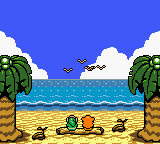
Having the game be on a handheld complements its themes extremely well. In a nutshell, Link's Awakening is about bliss found in ignorance as well as the bittersweet sadness of letting go. The goal of the journey is to venture off of Koholint Island, but to do so Link must wake the Wind Fish and end its dream (and thereby terminating the island and all of its denizens). Curiously however, none of the inhabitants outside of the Owl are cognizant of the dream, or the rise of the Nightmares intending to keep the island from vanishing. Everyone lives in a perpetual state of naivete, trapped within the dictation of their desires, and even the ever-curious Marin is bound by the dream in her human form.
These are important themes because nearly every other Zelda reverses this progression—Hyrule is in a state of disarray and it's up to Link to fix the problems of the people, climaxing with the defeat of the ultimate baddie. In Link's Awakening, the people have no overarching problem as the plot revolves around Link freeing himself from this ethereal prison, whereby he erases them. Sure, some island dwellers would like eclectic items (dog food or pen pal letter) and Madam MeowMeow gets her chain chomp stolen, but the issues of the islanders are relatively sedate compared to Agahnim's police state or Ganondorf's vile transformation of Hyrule. Link's adventure revolves solely around himself on Koholint Island, the island folk resulting in nothing more than passing memories by the time the curtains close.
Link's Awakening a lonely, ephemeral experience. It's the quintessential Game Boy entry because it embodies the transitory state of "mobile games" in the 90s, existing to tide you over until the next big (console) experience. The game is simple but astonishingly pithy with its story, prodding the player to grapple with the nature of reality without ever forcing it upon them (the Nightmares are the only creatures that explicitly criticize you for your actions). "Ballad of the Wind Fish" deserves a special mention here as well for perfectly capturing the mood in the game, conveying it in a way words are incapable of expressing. The slow wash of all the characters along with entire island while the ending theme plays is still one of the most striking things I've experienced on a handheld; parting is indeed such sweet sorrow, especially when you know you'll never see one another again.
With my melancholy reflections out of the way, I should take a couple sentences to at least talk about the gameplay. For the most part it works as intended, being a more bite-sized version of Link to the Past with a larger emphasis on puzzles. It's not too difficult of a game—there were a couple spots that gave me trouble as a kid that I could now breeze through—and it lasts a comfortable amount of time (not too long, not too short). The biggest con I can think of is that switching out items on the menu becomes a major drag on the game, but most Zelda games suffer from this dilemma so it's not a unique gripe. Oh, and there's a ton of text you have to mash through every time you pick up the compass (or bump against a rock or crystal). These are minor blemishes on an otherwise joyous experience. Perhaps the best thing that can be said about the design is that—along with Ocarina of Time—it works perfectly as an introduction to the Zelda style of gameplay.
All things go through a process of change—some of which are irrevocable. Before venturing into the game's fifth dungeon, Catfish's Maw, you have to escort a gloomy ghost back to the house he used to live in. It's a brief but heartfelt moment as he looks upon the decrepit cottage, feeling intense nostalgia for the tiny box that had once been his home. In some ways I feel like the ghost when gazing upon this game, looking back upon the hours & hours I spent playing it as a kid and using the screen warp to clip my way into places I shouldn't have been. It didn't age nearly as much as the cottage had, but it still ekes a tear out of me when visiting familiar areas or watching Tarun get chased by bees.
Truly a poignant masterpiece for its time.
---------------------
Images obtained from: addictedgamewise.com
Subscribe to:
Posts (Atom)