Tuesday, September 7, 2021

Star Wars Jedi: Fallen Order


If you had told me the Titanfall developers would go on to make a game that blends Sekiro, Uncharted, and Metroid Prime 3 together, I would've said "there's no way that can work" before pre-ordering the hell out of it. However, if you added "... and it's a Star Wars game!", I would've been considerably less eager. That's why Star Wars Jedi: Fallen Order completely flew past my radar; Star Wars is as unappealing to me as bug-eyed highschool anime girls are to others (which yes, I did watch all of Clannad). I don't have a problem with people that are drawn to it, but personally I've grown bored of evil empires and jedi mind tricks long before The Force Awakens was even in production.

Yet when Fallen Order came to Microsoft's Game Pass, it was hard to ignore it—especially after getting rave reviews from my friends. And while the game hasn't shifted my opinion on the franchise as a whole, it does make a serious argument for being the best video game bearing the Star Wars brand.


One of the best things Star Wars Jedi: Fallen Order has going for it is that it's (mostly) untethered from any of the movies, letting the player run around the universe and meet brand new characters. This keeps the experience feeling fresh as you're not tasked with blowing up the Death Star for the 100th time, but instead retracing the steps of a jedi master, taking you from subterranean alien dens to the top of a gargantuan world tree. There's a good variety of planets that manage to feel distinct from one another, though they're all winding mazes of predominantly one color. Their labyrinthine nature shouldn't be understated either; expect to stare at the map often if you want to hunt out secret areas and power-ups.

Unfortunately, Fallen Order is pretty barebones when it comes to power-ups. There's the ever-important estus upgrades stim cannisters, focus upgrades, health upgrades, and... that's basically it. A majority of the goodies you'll scavenge are mere codex entries and cosmetic options, which—while neat—don't expand your gameplay options nor add a strong incentive to keep exploring. Really, the best thing about opening those space-chests is that it's one less spot that'll distract you on the hunt for stim cannisters. There's also a number of mandatory upgrades that'll expand your traversal options, but I didn't really find any of them clever or unique enough to comment on.


But Fallen Order doesn't really need to be clever or unique to do well, an approach it takes with its parry-heavy combat. It's unfair to weigh it against Sekiro as both titles were in development at the same time, but the comparison is unavoidable: Fallen Order plays like a slightly sloppier Sekiro. The key word there is slightly as you can still enter a room and dispatch half a dozen storm troopers without breaking a sweat, but I never really felt confident in my parrying. It was hard deducing when to counter certain attacks due to the small delay in blocking, or if parrying would even work at times—it generally felt like a crapshoot against creatures larger than you. Sekiro may have suffered from a block-spam problem, but Fallen Order's alternative is to make blocking feel like a gamble; halfway through I stopped caring about attacks slipping through my defenses and focused more on offense. Also the input for healing can sometimes go ignored too, which just makes Sekiro shine that much brighter in comparison.

Note that receiving the "runner-up" award for parry mechanics is still an achievement unto itself. Fallen Order's encounters are rarely something you'll shy away from, as you'll be champing at the bit to flex your skills. Both the enemies and the player dish out considerable damage, making fights meaningful and delicate, rarely lasting more than twenty seconds. Throw in some nifty force powers that let you toss obnoxious snipers off cliffs, as well as a diverse cast of imperial henchmen to learn, and Fallen Order stands tall on its combat alone. Sadly boss fights are few and far between, with most of them being regular enemies with souped-up health. I think it's neat how bosses can get thrown at you at unexpected times, but if you're expecting climactic fights to close out your adventure through each world, know that Fallen Order doesn't play by those rules.

Combat may be at the heart of Fallen Order, but you'll be spending just as much time climbing across ruins and scavenging through downed ships. Fallen Order's levels are massive, multi-layered beasts that can be hard to read at times; the mandatory path is always easy to find, but backtracking can feel like untangling an elaborate knot of pathways. On one hand each planet is a marvel of intricate level design, but on the other you'll be aching for a quicker way to move around (given that there's no fast travel). Again, this isn't an issue that pops up if you play the game as a linear campaign, especially since Respawn is pretty good about giving you something to do on your way back to your ship. Once you venture out on your own, however, be prepared to circle back through a lot of familiar areas and enemies.


Star Wars Jedi: Fallen Order delivers a good time, whether you're a fan of the franchise or not. There's exploration and puzzles for adventure fans, quick and flashy combat for action fans, and a decent chunk of cutscenes for those in need of a reason to push on. I may have spent an inordinate amount of time griping about Fallen Order's problems, but they're minor things, no worse than a dent on your bumper. The campaign presented here is admirable; Respawn Entertainment is slowly cementing themselves as one of the best single player developers in the AAA scene.

Tuesday, August 31, 2021

Donkey Kong 64 - Thoughts


I had always thought of Donkey Kong 64 as a "worse Banjo-Kazooie", but my recent 101% revisit confirmed just how pitiful it truly is. Donkey Kong 64 is not just a poor video game—it's probably the nadir of collect-a-thons, or at least a strong contender for the odious title. It's long, boring, repetitive, dreary, and humorless, lacking both the stellar design of Donkey Kong Country and the warm charm of Banjo-Kazooie. How Rare of all developers churned out a game so irreparably vapid is beyond me.


I don't think Donkey Kong 64 was destined to fail just because it jumped to the third dimension, but it was facing an uphill battle. The Country series is defined by its unique stage gimmicks and deviously hidden bonus barrels, both of which could work in 3D but would require a focused "smaller stage" approach, similar to Super Mario 3D World. Instead Rare honed in on the "completionist" aspect of the series, using Banjo-Kazooie as a springboard. Donkey Kong 64 would have a hub world, several learnable moves, and hundreds of items to keep track of. Then Rare lost their goddamn mind and jammed five playable characters into the game, each with their own collectibles to gather on every level.

While that didn't necessarily condemn Donkey Kong 64 to the trash bin, the inclusion of the tag barrel certainly did. With it, the player can only swap characters at designated spots, meaning that they'll have to backtrack to a tag barrel just to re-explore a level. And exploring isn't all that fun since stages are filled with boring enemies and nearly zero platforming. There's what, the sand you have to hop across in Angry Aztec, the entirety of Creepy Castle... and that's it for notable obstacles. Most of the time you'll be holding forward on the control stick, ignoring enemies, and slowly climbing up trees. And then at the top you'll realize you need Diddy Kong not Lanky Kong to obtain those five bananas, so you'll saunter back to the tag barrel, switch characters, forget where that particular tree was, and lose a bit more of your sanity.

People often deride the game for forcing you to play it essentially five times, but I think the senseless level design is what's truly detrimental. There's nothing to do the first time you're in the area let alone your fifth, besides activating teleport pads and making note of what Kongs you'll need where (and good luck remembering it all.) Stages are just boring busywork meant to waste time until you get to a golden banana challenge, which at their best are simply "okay." Sometimes you can't progress deeper into a level without a particular Kong's skillset either, and the lack of consistency here bugs me. You might need to shoot a switch or use a music pad or grab a golden banana to unlock a new area—and all of these will look the same as every other switch, pad, and banana. It's frustrating because it means you can't start a level with a single Kong and net all their goodies; you'll have to frequently swap between all five simians, only stumbling upon an "optimal route" after the stage is fully cleared.

Hell, there's no consistency in the golden banana rewards either. Sometimes you'll be given one for merely hitting a switch, and other times you'll have to undertake multiple steps and platform through an area just to get to an accursed bonus barrel, which contain their own challenge. It feels like it's a 50/50 shot whether you'll get a bonus barrel at the end of your road or not, and almost none of them are enjoyable. I think an argument can be made for Minecart Mayhem and Kremling Kosh, but the others alternate between mindless (Peril Path Panic, Krazy Kong Klamor) and unbelievably frustrating (Big Bug Bash, Searchlight Seek, Beaver Bother.) Worse still is that most of the bonus barrel minigames repeat themselves, so you might find yourself playing Beaver Bother twice in a single stage—with zero variation between the two minigames, no less!


Speaking of, Donkey Kong 64 has some really bizarre, unjustified spikes in difficulty. The aforementioned Beaver Bother is a buggy nightmare that takes an hour (or two) to learn to play properly, and both races against the beetle are way, way too demanding. These aren't just "hard" either; they require such articulate, flawless execution that they spiral into torture until you miraculously manage to edge out a victory. It's one thing if your goal is to make a dull game that you can practically sleepwalk through, but these spikes (among a few others) are so unbelievably rude that the game morphs into Schrödinger's Disrespect: I don't know whether Donkey Kong 64 is going to demand too little or too much from me until I hop into the bonus barrel.

While I think the stage design and bonus barrels are the worst part of the game, I think there's also significant lost potential with the characters. Sure, they all have a distinct personalities and gear—but they don't play all that differently. DK and Chunky are big and slow, Tiny and Diddy are small and fast, Lanky can attack enemies from far away... and that's about it? Each one uses essentially the same gun, their musical instruments all have the same effect, they can all ground pound, and even the way they lob oranges is the same. Most unique abilities—like Lanky's floating and Chunky's gigantism—only work at designated areas that limit how long you can stay in that state, or just bar you from exploring beyond a specified pen. You basically play as the same character five different times, with individuality allotted only where the game deems fit. Diddy Kong's jetpack is probably the most unique ability, but even that thing feels so slow that I'd rather not use it most of the time.

I'll throw Rare a bone and admit that while the design is atrocious, it's a generally well-made game. Sure, there are a number of bugs and glitches (I fell out of bounds once), but it technically works and doesn't have any dumb ways to lock yourself out of 101%. That, and the end of the game is pretty good, all things considered. Hideout Helm is a decent test of all you've learned and the final battle is ironically one of the best fights Rare has ever produced. It's just a shame that they're locked behind so much mediocre-to-bad gameplay; they're diamonds in the rough, if the "rough" was a mile wide pit of banana-yellow quicksand.


Donkey Kong 64 is a 20+ hour collect-a-thon that is massively unrewarding. Even if you like the idea of scouring a level for hours on end looking for any nooks you've missed, Banjo-Tooie's got you covered. As a Donkey Kong fan, this is the lowest the series has ever been and I pray the franchise won't ever return to this formula. It's not hyperbole to claim the best thing about it is that deliciously corny DK rap; Donkey Kong 64 is just not worth playing, let alone completing.

---------------------

Images obtained from: gamesradar.com, hardcoregaming.net

Thursday, August 19, 2021

Mario Kart 7 - Thoughts


Due to being wedged between the influential Wii and essential 8 (Deluxe) entries, Mario Kart 7 is often derided as the most forgettable Mario Kart. It's a game that suffers from very few problems... yet doesn't offer compelling reasons to play it nowadays. Which is a shame because had 7 come out a few entries earlier, it would've felt like a breath of fresh air, energizing the series with a smart drifting system and some phenomenal tracks. Even its unique gameplay additions—gliders and propellers—weirdly feel like claims that belong to 8 instead. Mario Kart 7 is a great racer that unfortunately can't escape from the shadow of its siblings.


First off, the game is gorgeous to see in motion, boasting a buttery-smooth 60-fps framerate even in 3D. Mario Kart DS was fairly impressive for the time but 7 makes you forget that it was designed for a handheld console. Plus unlike DS, the selection of retro courses in 7 is excellent, due to having more than the first three games to pull from. Waluigi's Pinball, Coconut Mall, Dino Dino Jungle, DK Pass—the retro cups are worthy of being served on a silver platter. And the nitro cups aren't sleepers either—Shy Guy Bazaar, Music Park, Wario Shipyard, and Rainbow Road ensure that any cup you pick has at least one stellar track to keep you on the edge of your seat.

And coins are back! I used to loathe them when I first played Mario Kart 7—why complicated an intentionally simple racing game?—but since revisiting the series, their return makes a lot more sense, especially with the new drift boost. In the old games, you'd use a lot of energy rocking the controller back and forth, having to judge whether or not you had the room (or thumb dexterity) to built up a boost. But with automatic boosts, it's much easier for the player to simply focus on racing an optimum path, making laps more methodical—as well as stale. By throwing coins into the mix (which increase your top speed a miniscule amount), the optimal path has some competition: do you go out of your way to grab some coins or stay the course? The gold goodies keep the gameplay mostly reactive rather than rote, especially since you'll be losing them frequently from pits, lightning bolts, and blue shells.

And boy, do I have a bone to pick with blue shells.


Now, blue shells have been a staple of the series for a long time—they were first introduced in Mario Kart 64 but the CPU wouldn't get ahold of them until Super Circuit. And honestly, they're a miserable tool, punishing the player in first while simultaneously doing nothing for the poor sap that launched it. I understand that they're a necessary evil that keeps matches competitive (especially online), but there's no rhyme or reason to their use; they pop up in close races just as often as runaway victories. And once you introduce a ranking system into the mix, blue shells turn Mario Kart into an RNG hellhole where flawless races can—and will—be stolen a hair from the finish line. In seeking to level the playing field, the blue demon arbitrarily punishes merit.

One good thing Mario Kart 7 has going for it is that it's relatively stingy with its blue shells—you can expect one or two per match. And since the CPU hangs onto them for 3-5 seconds, you have ample time to notice one coming thanks to the bottom screen revealing who has what item. Unfortunately, this still makes gunning for 3-stars kind of a silly experience; every straightaway has you frantically checking the bottom screen, hoping that your rival is close enough that you can slam on the brake and let them pass you. It's not too difficult to net triple stars across the board, but expect some bitter defeats that you'll have no control over... it's something I'll whinge about in more detail once I get to the DS entry.

Probably the most "serious" problem Mario Kart 7 faces is that it's a smidge light on content. It has fewer racers than the Wii version, hides items when using the full map, and contains no VS mode for some inexplicable reason, meaning you can't pit yourself against the CPU on a specific course unless you're playing an entire cup. None of these make or break the game however; I honestly take more of an issue with the tail powerup, as it's not only a situational item but occupies the item slot while it's active, leaving you naked when it expires. In almost every situation I would've much preferred a green shell or banana, just so I had some form of reliable defense.


Boasting some of the strongest courses in the series, Mario Kart 7 is worthy of a playthrough today, even if it does feel a bit barebones. There are aspects worth complaining about—again, why no VS mode?!—but every Mario Kart comes burdened with its own niggling issues, and I'm thankful 7 sports relatively few. It may not feel like a "must-play" but it paved the way for 8 and is loads of fun on its own. Maybe the most damning thing is that it shows how capable of an F-Zero the console was... but even 8 overshadows 7 in that respect.
---------------------

Images obtained from: clipartkey.com, nintendosoup.com, slashgear.com, nintendo.fandom.com

Friday, August 6, 2021

Mario Kart 64 - Thoughts


After suffering through Mario Kart: Super Circuit, I was left with a burning question: would Mario Kart 64 feel terrible to return to? I don't have a lot of love for the N64 because most of my favorite Nintendo games aren't on it (outside of the immaculate Star Fox 64.) Most rudimentary 3D titles would see better sequels released for the Gamecube or Wii—and Mario Kart 64 was no exception. While it's probably my most-played Mario Kart, I haven't gone back to it in roughly fifteen years... because there wasn't a reason to. Mario Kart 64 was an archaic stepping stone, one that gave way to bigger and better racers which were more deserving of my attention.

But hey, guess what: in 2021, it kinda holds up!


What doesn't hold up is the terrible N64 controller, as to drift boost you have to rock the control stick back and forth—and little pushes don't count. Thus repeated boosts can wear on your thumb, due to the controller's notoriously hard plastic and stiff resistance. It's nothing too terrible though; you'll simply botch drifts on occasion and will be forced to give your thumb a break between cups. I prefer modern Mario Kart's drift boost more (the longer you drift, the bigger the boost), but this oldschool style works decently enough once you get used to it.

Yet whatever problems I have with drift boosting pale in comparison to how annoying the AI is. The other racers are designed to catch up to the player in order to keep the match competitive, even on 50cc. That makes any leads fleeting as your two closest competitors will always bounce back, even if they're struck with a red shell and fly out of bounds. This is especially annoying on 150cc as any headway they'll make they'll keep, giving you no chance to surpass them as they move at inhuman speeds through the course. Toad's Turnpike in Mirror mode is a prime example of how atrocious the rubber banding is; the CPU can crash into oncoming traffic all they want but if you make one mistake, you're likely placing 2nd or below.

I wouldn't say this ruins the game however—it's just really obnoxious most of the time. To win matches you'll need to save a good item for the final stretch that'll allow you to zip ahead of your competitors, like a mushroom, star, red shell, or lightning bolt. Considering that's nearly half the items, you often have a good chance of grabbing something early on and using it as your ace in the hole on the last lap. And unlike every Mario Kart post-64, the AI has a separate item pool from the player, which thankfully lacks both blue and red shells. The most common offensive move the AI pulls is to toss bananas ahead of you, and it's honestly more of a danger to them than it is to you.


The biggest handicap Mario Kart 64 grants the player arguably nullifies the brutal rubber banding of the CPU: as long as you place 5th or lower, you can retry a course as much as you like. This is especially useful for any track you struggle with (like Choco Mountain), as not only can you gamble on items until you get a decent selection, but occasionally your rival will fall behind and eliminate themselves from the competition. The downside to this tactic is that you're forced to finish the race in order to have the option to restart, but riding out a single race is less punishing than retrying an entire cup. Individual matches will still often feel unfair—especially if the CPU sprints ahead early—but being able to Groundhog's Day until you win makes 64 the easiest Mario Kart to win in the series.

Plus it helps that the game still controls and plays well. There are definitely a couple of troubling issues that later games thankfully fix—I groan every time a red shell slams into a wall—but the driving and drifting work just fine. Any time you see an obstacle or an item box you can usually intercept or avoid it, which feels like a godsend after Mario Kart: Super Circuit would send my kart careening off the road. Also the long courses weren't as dull as I thought they were going to be, largely because they're packed with corners just begging to be drift boosted. Wario Stadium may lack visual flair and stage variety, but it'll keep your thumbs just as active as Mario Kart 8's courses.


Mario Kart 64 is far from exceptional—despite all the praise I've levied, I think every other 3D Mario Kart game is flat-out better than it. Yet I don't think I'd label 64 as "bad" or even "lackluster". The courses are decent, boost drifting requires some finesse to pull off, and grabbing the gold on 150cc & Mirror is less stress-inducing than shooting for 3-star ranks in future titles. Mario Kart 64's innate issue is that it's obsolete, sporting middling graphics, a paltry 16 courses, and an AI that's shamelessly busted. Fun can still be had with it, but you won't be sticking around for long.

---------------------

Images obtained from: imdb.com, mkworldrecords.fandom.com, nerdbacon.com, n64today.com

Sunday, July 25, 2021

Mario Kart: Super Circuit - Thoughts

 
I don't think Mario Kart: Super Circuit for the Game Boy Advance is a good game. I didn't like it when I first tried it out years ago, and still don't like it after recently acquiring every gold medal. My issue with the game is simple: Super Circuit feels terrible to play. And no, it's not because of the hardware it's trapped on; F-Zero: Maximum Velocity (which came out several months prior) is an excellent GBA game with silky smooth controls. Super Circuit's problem is that it loyally models itself after Super Mario Kart, meaning that you're going to be involuntarily sliding, bouncing, and crashing into walls.


Racing games are somewhat unique in that their quality is first and foremost determined by how they play. Games with awkward or poor controls can have other strengths to help mitigate that (story, visuals, growth), but how many people are willing to devote more than an hour to a racing game if it just doesn't feel good? Of course, you have to be careful differentiating between "terrible controls" and a "high bar to entry"—I wasn't a fan of Wipeout HD when I first played it—but by the time you've conquered the "normal" difficulty of a game, it's likely that you'll know where you stand. For Mario Kart: Super Circuit I tried to keep an open mind, testing out every racer and different drifting strats, but I could never get a handle on how slippery the game felt even after finishing 150cc.

If you haven't played Super Circuit, just imagine playing a Mario Kart game wherein steering always makes you feel like you're drifting. Right turns can easily morph into a wide arcs, preserving your sideways momentum as if the tarmac is frozen. Worse still, nudging left or right to course correct can send you in strange directions, making you overshoot item boxes by dumb margins. As for drifting, it would frequently send me so far off course that I never used it for 150cc, given that cornering accurately won races more reliably than trying to eke out a speed boost here and there. In Super Circuit it feels less like you're in control of a go-kart and more like you're barely in control of the entire course, sloppily rotating it around your racer like a greased turntable.


The sliding is a huge pain in the ass because it transforms most turns into an exaggerated ordeal. It's not too hard to clear 90° angles but for anything wider, you're going to have to use the brake in order to avoid veering off road, which doesn't sound too annoying—except for the fact that the AI doesn't have this problem! Nowhere is this issue more vexing than in the Extra tracks, which are all taken from the winding SNES courses. Enjoy agonizing over hairpin turns as the computer zooms past you, able to effortlessly change direction even with a mushroom active (seriously, try the Extra Star Cup and tell me the game controls "just fine.")

While most of these complaints can be levied at the original Super Mario Kart, I think hindsight should've allowed Intelligent Systems to produce a better-playing game. Even if they wanted to be loyal to the hoverboard-like controls, it baffles me that they also kept the "bump racers and lose coins, regardless of weight" aspect. This dumb, cruel system needlessly makes the AI stronger, forcing you to avoid bumping racers even as Bowser unless you want to risk spinning out early. And strangely, even though the game includes all of the old SNES tracks, it removes a lot of their unique hazards like monty moles and thwomps... despite thwomps appearing in the regular GBA tracks. I also think the modern item box system makes the tracks worse, given that if a racer ahead of you takes an item box, it can leave you powerless for an entire lap.

While I don't like Super Circuit, I'll grudgingly admit it has a couple of things going for it. The game is vibrant and pretty, containing a lot of unique backgrounds that help distract the player from the ugly pixel warping on the race course. The SNES tracks, while inferior and flawed, still add a good amount of value, effectively doubling the playable content. Lastly 150cc is a fair and challenging difficulty most of the time, where poor steering will be the cause of your loss rather than suffering a flurry of red shells or blue shells. The dreaded blue shell in particular is extremely rare, showing up about once every twenty races or so—which is fine by me.


I don't regret having grown up without Mario Kart: Super Circuit, especially since I had F-Zero: Maximum Velocity to fill my portable speed-needs. I've always been in a bit of a love-hate relationship with Mario Kart, but I can still appreciate the flavorful track design and quirky vehicles of Mario Kart Wii, 7, and 8—basically every game other than the first three. Hell, I still hold a lot of nostalgia for Mario Kart 64, despite that entry having some of the longest, most dry circuits in the series. But these games remain fun to play, no matter what gripes I have; I can't say the same for Super Mario Kart, and in turn, its hunchbacked successor Super Circuit. Most tracks feel too similar, impassable walls blend in with the floor, but worst of all, it's a chore to play. We might be living through a nostalgic gaming renaissance, but Mario Kart: Super Circuit puts forth a sobering argument as to why sprite racers will be one genre to never see a comeback.

Monday, July 19, 2021

Frogger (1997) - Thoughts


It's always interesting to return to a game that you haven't played since your childhood. Before you develop qualitative reasonings behind "good" vs "bad", games are simply games: digital challenges you're meant to overcome. Sure, some of them are harder than others, but you don't yet have a nuanced understanding to differentiate between a carefully curated difficulty and a RNG-based one. Generally, stuff you can beat is fair, and whatever you can't beat is unfair. Later on you might return to realize that what you thought was impossible or unfair is actually wisely balanced, and what you thought was fair—just because you could beat it—may be far from what you'd label as "good."

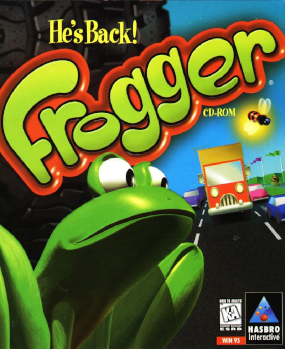
Enter Frogger, the rad 1997 reboot of the old arcade game. I'm not quite sure when I got it on PC, but I was at least 10 or 11 years old—and Frogger was tough. It wasn't tough like Doom 2 on Nightmare or the Starcraft campaign, but it was challenging enough to stump me... primarily because I didn't know how to rotate the camera. I returned a few years later and beat it, cementing Frogger as one of my favorite platformers that wasn't a 2D sidescroller. My fondness for it was such that every time I saw the cover image, my heart would soar and I would think, "Man, I should play that again." Now at over double the age I beat it at, I've returned to complete Frogger once more...

... and uh, let's just say I am ambivalent.


First off, I love how this game looks. It's bright, peppy, and always vivid, even in dark or murky areas like the caves and sewers. Every locale feels distinct, housing unique platforms and foes, though all either does is follow a predetermined loop around the stage. Still, as a big fan Super Mario Bros 3 and Mega Man, the focus on strongly-themed zones is right up my alley, and in a way Frogger might've helped shaped that. I also like how quick and snappy the green amphibian feels, allowing you to effortlessly zip past enemies if you see a gap in their pathing. For a game that looks so kid-friendly, you might be surprised at how fast you can move—and how fast you'll need to move.

That's because Frogger is ruthlessly challenging. The game takes roughly 8-10 hours to beat, though a single stage's playtime rarely runs over five minutes. With only 28 stages total that means there's about 6-8 hours that you're going to spend dying over and over and OVER. Deaths will come suddenly and without mercy; should the faintest sliver of Frogger's hitbox brush against an enemy's leg, that frog's as dead as roadkill. If there's another thing I can commend the game for, it's that the starting arcade-throwback zone is the perfect indicator of how mean-spirit the game will soon become.

A big part of Frogger's difficulty lies in the fact that the game is unabashedly oldschool, valuing your patience for trail and error far more than quick reflexes or clever thinking. Every level has five frogs you'll need to rescue strewn somewhere across it, and while you can get a handful of them without foreknowledge, expect to discover most while making a suicidal dash through the stage. You'll be hemmed in by three aspects that make the world of Frogger a menace to explore: a strict timer, asynchronous patterns, and a camera that's glued to your slimy back.


The timer is the most threatening aspect that, ironically, won't actually kill you most of the time. It can be absurdly tight on some stages, pressuring you to barrel through the level without delay—and as you can imagine, this will often send you straight into the jaws of doom. Yet while I can appreciate a game with a no-nonsense timer, the asynchronous patterns are a massive headache to deal with. Crisscrossing foes or parallel platforms fall in and out of sync as stages drag on, and neither dying nor rescuing a frog will reset them. On a decent number of levels this is somewhat manageable, but when your path narrows down to a one-way road, expect an unavoidable death to pop up most of the time.

Adding salt to this wound is the camera, which will zoom in and out whenever it pleases. Sometimes you'll be riding a single-space platform, unable to see where you're going—and Frogger isn't shy about tossing you off a cliff. Other times you'll be trekking down that dreaded one-way road, unable to observe if the crisscrossing enemies are in sync until it's too late and you're sandwiched. The stage that exemplifies this problem the most is Big Boulder Alley, a monstrous experience that took me a good two hours to finally beat, requiring a level of memorization and planning that would make Battletoads jealous. Seriously, a full day later and I still remember it clearly: go east, hop over two bugs, north, hop over one bug, east, then south, double hop two bugs, double hop two bugs, east two spaces, hop, east two spaces, hop, north, hop two bugs, north until wall. That's only half of the path to a single frog and a fraction of a second worth of delay will ruin the entire run.

The cherry on top of this devil's dessert is that there's no "retry" option when you pause the game; as you die, your muscle memory becomes useless as the entire level is out of sync. For the easier levels this doesn't pose a problem, but there's a number of difficult levels where you absolutely can't see what's coming up ahead of you (Retro Level 5, Frogger Goes Skiing, Resevoir Frogs), making it feel like you're playing blindfolded. And on top of this you're booted straight to the main menu whenever you game over, despite that the game uses a level select system that can take you right back to where you were. Why no "retry stage" options? What was the reasoning here? At times Frogger just feels plain mean-spirited for the sake of it, as if it's harkening back to the arcade days where the layman was given no quarter (or rather, gave all their quarters, ba-dum-tss)


In the I end, I still enjoyed my time with Frogger. The game is embedded so firmly in my nostalgia center that I could never hate it. But the simple premise and warm colors belie a game with an unaccommodating design, one that really needed to use the brake pedal more often. At times it's interestingly and fairly designed—the final level is a well-balanced obstacle course—but Frogger's worst offenders drag the game down considerably, reverting you back to a red-faced child about to toss their controller. On one hand I'm impressed that I managed to conquer Frogger at a young age, but on the other I can see why it fell through the cracks and was forgotten post-adolescence.

---------------------

Images obtained from: arcadingonline.com, myabandonware.com

Thursday, July 8, 2021

Monster Hunter - Thoughts


In preparation of Monster Hunter Rise's release, I thought it was a good idea to slowly chip away at the granddaddy of the series: Monster Hunter on the PS2. And with no uncertainty do these next words come: don't play this game. You might flinch at that statement, thinking the worst the game has to offer is that it's outdated or visually unappealing, but it goes so much deeper than that. The first Monster Hunter was an online game meant to be played with friends, where rote hunts and boring load times were counterbalanced by idle banter. Without that, you are left with a raw, brutish solo experience that I'd be surprised if anyone—even diehard fans of the series—can stick with past the opening hours.

And it's not that Monster Hunter is too difficult or awkward to play—it's that it has a soul-crushing grind for gear.


There are two aspects that Monster Hunter can laud over its successors, the first being its originality. Monster Hunter established almost all of the series' staples, whether it's the core gameplay, resource gathering, item crafting, weapon trees, armor trees, enemies, setting, story structure—you name it. Even the weird way the game separates online and offline quests traces its roots to this humble title, with the exception that you can't even enter the hub without a network adapter installed (which is no big loss since the servers are dead anyway.) Monster Hunter is kind of like Pokemon in that the first entry laid the foundation for every other title going forward, even though many of its designs nowadays could be considered tedious and punishingly draconic.

The only other thing Monster Hunter excels at is that it makes you work hard for your victories. There's no expedition hunts, no lock on, no palico buddies, no farm—not even a goddamn canteen to stuff your face at at. All you get are two expensive stores with pitiful stocks and a box with two pages of inventory. Every potion you consume needs to be manually crafted from ingredients found out in the wild, the nodes often blending in with their surroundings (good luck spotting mushrooms.) Combat can't be won by roll spamming or button mashing (er, analog mashing, as attacks are mapped to the right stick of all things) since your character's movements are as slow as molasses in the dead of winter. Plus monsters not only hit hard but have some crazy hitboxes attached to their body, dishing out near-instantaneous hip checks and tail spins that'll wreck you if you're anywhere near them. I used to think folks online were joking about Yian Kut-Ku being their first roadblock, but hoo boy, that fight against him in the jungle biome can really test your patience (as well as vision—why are there so many damn trees?!)

The neat thing about this is that you're forced to engage with all of Monster Hunter's systems on a conscious level. Unlike modern Monster Hunter titles where you can luck into a new piece of equipment after a single hunt, here you'll be spending a lot of time grinding out low rank gear in order to survive. Ingredients are no longer something that you'll mindless gather either; you'll beeline out of your way during hunts to visit honey, mushroom, and ore deposits, possibly restarting the hunt if the hauls are poor. And monsters being no joke makes preparing before a hunt paramount, as every second Plesioth spends in the water inches you that much closer to the dreaded time-out. There's no other game in the series that forces you to be as "ready" as the original Monster Hunter—but this compliment is tainted with a poisonous consequence...

... That you have to do a lot of mindless grinding.


Before I begin, let me just say that I have nearly 1000 cumulative hours spread across four (now five!) games in the series, and it's become one of my all-time favorites. Therefore my frustration with Monster Hunter on the PS2 likely doesn't come from a disdain for the franchise, nor confusion as to why its mechanics work the way they do. I've endured the egg deliveries, I've withstood the Khezu roar-spam, and I no longer groan at being paralyzed by vespoids while mining. I appreciate the series for its eccentricity and stubbornness, and sympathize with fans that gripe about how the modern games have been streamlined, such as with the removal of paintballs or allowing you to switch gear mid-hunt. As Monster Hunter has becoming more accommodating, it's chiseled down its barrier to entry, losing some of the grit and workmanship that was required to get into it—two aspects that could make even mundane hunts rewarding.

But the first Monster Hunter game is terrible. I could go on about the pathetic monster roster, the lack of quest variety, how imprecise it feels to attack with the right analog stick, and how vexing Velocipreys are (JUST LET ME CARVE), but what broke my back was the process of making gear. You start the game with a sword & shield and no armor, which makes finding new gear a top priority. But the economy in Monster Hunter is brutal: you receive about 300-800 zenny per quest, yet armor costs anywhere from 1500-3000 per part. Plus every piece of equipment requires you to mine for ore, but iron pickaxes cost 160 zenny and can snap after a single use, so you'll be digging through your box often for monster parts to sell. But that's not the worst part, oh no—it's the damn machalite ore.

This garbage mineral is found only in area 5 of the starting zone, despite there being ore deposits in areas 6 and 11. Worse yet is that the node has roughly a 10-15% chance to drop machalite when mined, and nodes can not only exhaust after a single use but also stay depleted for the entire hunt! And even worse is that there's no ore gathering quests, meaning the quickest and most efficient way to farm machalite is to start a Velocidrome quest, run to area 5, pray for a single drop, and then hunt the Velocidrome! I must've run through this hunt a hundred or so times; I acquired over 100,000 zenny from selling nothing other than Velocidrome scales and fangs—but I still didn't have all the ore I needed!


To upgrade my hammer to its final level, I had to mine a whopping 85 machalite ore, of which I reckon I had a 50/50 chance of obtaining 1 per Velocidrome hunt. Considering that the hunt takes roughly five minutes, this totals to 10 hours of grinding, which checks out: I reached the Rathalos by hour 27 of my playthrough, and managed to best him around around hour 36. Luckily I used audiobooks to numb my sorrow, but I can't express how absolutely dull this entire process was. I wasn't playing Monster Hunter anymore—I was struggling with a fickle one-armed bandit that paid out with 6 machalite ore only once and 0 machalite dozens and dozens of times.

And I know what you're thinking: "Why did you need the best hammer to beat Rathalos? Why not get better armor? Or mine in a different locale? Or just play better?" Alas, I seriously tried all three avenues. The best armor I could get with fire resist was the Yian Kut-Ku set—which I made. While the desert and jungle settings had machalite nodes (only one each AFAIK), the former required farming piscine livers (nooo thank you) and the latter had you gathering 10 mushrooms in vespoid-infested areas. Lastly, I gave the Rathalos about three admirable attempts, all of which took over thirty minutes and ended in crushing defeat. After besting him I think I could've done it with the penultimate hammer upgrade, but knowing I had a goddamn Plesioth ahead of me, I figured it was better to do my grinding now rather than later. And thank god I did because that Plesioth hunt was absurdly dull, repetitive, and long—timing out there would've put me in a straight jacket.

What really rubs me the wrong way is that Monster Hunter didn't need to be like this. It could've had a mineral gathering quest, or let the player go on expeditions, or allow nodes to replenish, or add a Rathian (or Basarios) hunt before the Rathalos hunt so you could craft better armor—all of which future titles would do! Even something simple like giving the player invulnerability frames while they're on the ground can make a huge difference in a fight, as the game loves to combo you to death in a corner and there's nothing you can do about it (getting up is automatically done for you!) I know a lot of this is me looking backwards and struggling to see what the first Monster Hunter did right instead of wrong, but what it did wrong is in the meat of its gameplay, present at every moment you're in control. It's baffling to me that the game managed to take off in Japan considering how janky, agitating, and obstinate the first entry is. Was the online that good? Was the concept that novel that it helped folks overlook how shamelessly repetitive the game is?

And god, there are so many other parts of Monster Hunter that grate on me. Why are quests randomly unavailable? Why does the cooking minigame have such tight timing?  Why make all the starting weapons so expensive? Why do I have to personally bring my materials to the blacksmith for crafting when they know how much of a material I have? Why end the village questline on a Monoblos hunt instead of one of the three elder dragons? Why is the egg delivery the only quest with a thirty minute time limit? Why make the fish wyverns spend 90% of their time not on land? Why make bullfangos? Why infinitely spawn monsters in some zones but not others? Why do some quests get hot/cold drinks in the supply box but not others? And why the hell doesn't the game let you know that you can't capture an enraged monster? Oh don't worry—you can still put them to sleep inside of the goddamn trap, but as long as they're enraged the hunt doesn't complete! I failed to capture a Rathalos twice due to this, wracking my brain as his sleeping muzzle poked partway out of the pitfall trap, mocking me. I only found out that it's impossible to capture enraged monsters from reading youtube comments in broken english, which is where my tolerance for the game had truly reached its end.


I was excited to sit down and play the original Monster Hunter, to discover where the series had started and learn how much it had grown. Plus it would give me some fun bragging rights—lots of people may have played through Freedom, but how many reached the credits of the original PS2 game? Unfortunately, there's no bragging rights to be found here; pouring hours into the game will only yield what I'd honestly describe as a miserable experience. I could only recommend Monster Hunter to veterans of the series that not only have an unshakable love for it, but also find old bad games to be better than new good games. The progenitor of the Monster Hunter franchise may boast a promising premise, but it lacks quantity as well as quality, doling out 1 minute of fun for every 10 minutes of suffering. 

And it's only mediocre fun, at that.
---------------------

Images obtained from: amazon.com, neoseeker.com, Amazon.com