Wednesday, March 22, 2023

Loot River - Thoughts


Like a hobo's bindle, Loot River is a ratty patchwork of incongruous ideas. Occasionally you'll glimpse snapshots of a clever gimmick—such as gambling with your healing potions to earn more of them next stage—but promising concepts are the best the game has to offer. Spending a mere hour with Loot River will reveal that it's less than half the game that it should be. It's not simply rough around the edges or in urgent need of more playtesting; Loot River is completely unrefined, like a gnarled tree trunk posing as an IKEA dining table.


Loot River's premise is distinctly alluring: a top-down action roguelite that sees you venturing through a forgotten, flooded city via sliding polyominos that you control with the right analogue stick. It blends tense combat with impromptu puzzle solving, letting you choose how and when to engage groups of enemies. You can briefly connect platforms to pull enemies one at a time, or split the battlefield in half to deal with the runts first, or blitz your way over to a block, break away, and forego combat altogether. A lot of the decision-making is left in the player's hands, which is one of the rare things Loot River gets right.

A shame that everything else is such a mess.

First up, build variety doesn't exist because the player is given nearly no choice in what to receive. Despite there being a decently-sized unlock tree for weapons, armor, and spells, there's no way to start a run with the paraphernalia of your choice. Instead, you'll either receive the default starting set or a completely randomized loadout. New gear can be found during a run, but not only is such a thing rare, but its quality is completely randomized—meaning you stumble across low level equipment even in the endgame. So expect to find one or two upgrades at best.

Shops could theoretically remedy this issue, but there are only a handful in the game—all of which offer a single randomized item at a time. It boggles the mind! There are over 50 pieces of equipment to choose from, which could have easily expanded the shop inventory to three or five items—or at least allow categorization by type (weapons, armor, spells, etc)—but Loot River simply shrugs its shoulders to such obvious solutions. Exacerbating this are the randomized shop prices, tending to land on the expensive side more often than not. So shops wind up being a complete non-factor in determining a winning run—which is a bizarre design decision for a roguelite that leans so heavily on its item pool for variety!

And that's all without getting into how rubbish the majority of your equipment actually is!


If you seek to best Loot River, you must understand one simple rule: speed is king. Big weapons might look impressive as your character drags them across the ground, but they're too unwieldy, lacking both the damage and reach needed to offset their slow attack speed. Parrying is also linked to weapon attack speed, granting quick blades nigh-invulnerable when you spam the parry button again—a tactic that works on almost every enemy in the game! And there's no drawback to it either! Loot River lacks a stamina system to punish you for spammy play, meaning you mash your way through any fight and escape those you can't by repeatedly dodging over and over again. And since bosses are the only lock-in fights, it's fairly easy to sprint to the end of the game and parry the final boss to death with your starting weapon. I tested this out a few times and got a sub-10 minute run, placing me in the top 10 for the XBOX PC leaderboards... an achievement I'm not sure I'm proud of.

There's a bit more to the combat—like a string of combos, charge attack, and spellcasting—but you won't need anything beyond the very first attack. By far the optimal strategy is to attack once and then dash behind the target, resetting your combo so you perform your opening attack again. This is because some weapons like the axe and rapier have blazingly-fast pokes that do solid damage, capable of stunlocking enemies and pounding bosses into a pulp. Better yet is if your weapon is enhanced with electricity, as it will continue to damage and paralyze enemies while you're dashing behind them—a maneuver that even keeps even the final boss fully locked down and helpless! The other enhancements (poison, fire) are hilariously useless in comparison, applying a single damage DoT (as in, one damage) that does little more than color your foe a light shade of green or orange. Seriously, if you find a lightning rapier somewhere—no matter the level quality—prepare to steamroll through the game faster than a Ferrari through a sand castle.

You may be wondering if there's any incentive for fighting enemies you can easily flee from, and my response would be "kind of". You receive both gold and experience from squashing your foes, but the former is so scant as to rarely matter (again, shops price gouge like crazy), and you only need a small amount of the latter to beat the game. When you level up you can increase one out of six of your stats, which sounds like an interesting choice—except that it isn't. What you'll end up doing nine times out of ten is increasing VIT to 13 and then, depending on the weapon you're wielding, dumping the rest into either STR or DEX. Sure, you might be tempted to spend your points elsewhere, but considering that you only net 6-8 levels before your run concludes, it's hard to beat the unstoppable combo of HP & DPS. And considering how floaty, inconsistent, and obfuscated the combat feels, you really won't want to play more than you have to. Seriously, the game needs to sit down and figure out what Hyper Light Drifter and Curse of the Dead Gods did right, because it's barely better than a Newgrounds flash game.

There are a couple more systems Loot River includes that range from curious (using run modifiers to unlock the true last boss is neat) to obnoxious (why send the player back to the hub after every stage? Why make some of the charms so ineffectual and others OP? Why does the fetid shawl drop over and over and over again?!) but I grow tired thinking about this game more than the developers clearly have. Loot River lacks common sense, too eager to blend ideas and playstyles together while doing little to make itself enticing, cohesive, or properly balanced. Its combat is messy, its equipment is boring, the money is useless, and experience is practically predetermined—but the most odious culprit is the titular loot. Loot River is not keen on doling its items out to you, and even when it stubbornly does, expect it to be hot garbage most of the time.


While playing through Loot River, I was reminded at times of the equally-strange Loop Hero... but any comparison I could draw between the two will betray how distant they are in quality. Loop Hero may fall short of its true potential, but one can walk away from it having been satisfied by the puzzle presented—or at least, tickled by its mechanics. Loot River on the other hand, is half-baked, routinely imbalanced, and—at most—mildly entertaining when it works as intended. Which is not often! Perhaps one might find it fascinating from a cautionary, post-mortem perspective, the same way that failing a midterm test can convey the importance of routine studying. As for me (and much to Loot River's chagrin) the only thing I found notable about it is that it's one of the firmest "do not recommend"s I've played in a long while.

Friday, March 17, 2023

Moonscars - Thoughts


Left in the wake of Salt and Sanctuary was a tantalizing concept: Dark Souls as a 2D metroidvania. Ska Studios showed it was possible—with a one man team of all things!—so indie studios got to work on creating their own Frankenstein's monster. Numerous notable titles emerged from this trend such as Blasphemous, Ender Lilies, and GRIME, with the tally only growing each year. But this sudden burst in popularity brought with it a muddying of the genre, blending many of these gothic-medieval games into a gray soup of stamina bars, cryptic lore, and corpse runs. It became harder to stand out; harder to tell at a glance what your game does differently from the myriad of others.

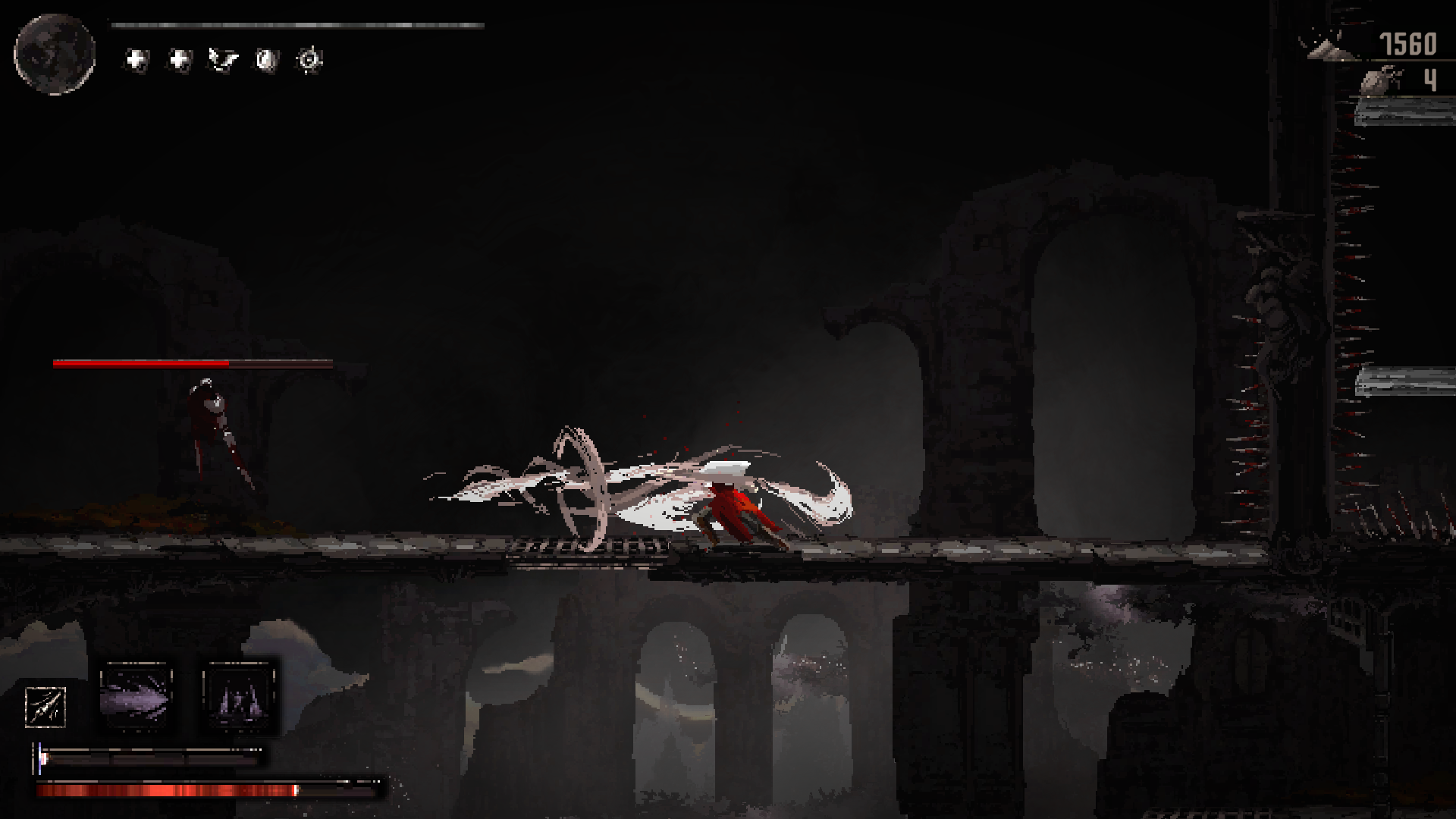
Moonscars tries to leap ahead of its kin thanks to a strong art style and gorgeous animations, but it never fully emerges from the muddy swamp. Rather, it is stuck waist-deep in mediocrity, vainly reaching for the feet of its golden idols.


Before I begin, let me just state that Black Mermaid should be proud of the work they've achieved here. To come out of nowhere and drop such an impressive, gif-juicy game like Moonscars is admirable, even if the experience is far from perfect. There's a lot of praiseworthy material here: the world is somber and alluring, attacks have great weight and flourish to them, and the smeared, smudgy art style is a clever fit for the game's earthern theme. The magic system is also an interesting departure from genre conventions, utilizing a replenishable resource that doubles as your healing pool. Since magic can only be recovered by attacking, it stops you from having to constantly return to a save point to restore health, while simultaneously encouraging a risky, aggressive playstyle. It's a smart system... 

... would that I could say the same for the rest of the game.

The boldest idea Moonscars brings to the table is its roguelite perks: transitory passives that reset upon death. Although you can hold up to five perks, there are a scant six in total to choose from, with a majority allowed to be taken twice. This means you're likely to end up with the same exact build every time: two 25% heal increases, two 10% crit increase, and whatever fifth suits your needs at the time (like the full hp heal). Toward the latter half of the game you'll come to lean more on the spell cost reduction perks, but it hardly feels like a game changer. Eventually you'll realize that perks largely serve as a "death tax", momentarily weakening you until you slaughter a handful of enemies to get back up to speed. And considering how the game bizarrely has endgame enemies provide the same amount of experience as its starting foes, expect to warp back to the beginning to do some menial, risk-free grinding over and over again.


What you won't grind for, strangely enough, is experience. And that's because there are no level ups in Moonscars—only spells, trinkets, and permanent upgrades scattered throughout the wild. This renders the power curve distinctly flat with a slight uphill slant; although you'll be stronger at the end of your journey than its start, it'll be mostly due to the hours of play time you'll spend studying enemy attacks, as well as your own. The only vital items to hunt for in Moonscars are the damage upgrades, but they suffer from a bizarre artistic flaw: looking like every other sparkly item on the ground. This deflates the joy found in exploration, as you have barely any upgrades to keep an eye out for—and those you are in need of look like every other useless trinket that'll clog your inventory.

Plus, it's not as if exploration is one of Moonscars' key features. Despite having all the telltale signs of a metroidvania, the world of Moonscars is practically on rails, guiding you from one area to another. You can't stumble upon anything you aren't supposed to, nor fight any of the bosses out of order. Only when you find the game's lone mobility upgrade does the world open up a little bit, but even then the new paths will lead to dead ends until you visit them in a specific sequence. The final act in the game kills the metroidvania comparisons outright, devolving into a string of dull arena fights against enemies in flat arenas that you've dispatched a dozen times already. Lastly, the in-game map is horridly unwieldy, lacking markers for both switches & doors, as well as scrolling agonizingly slow (seriously, what is it with metroidvania games having glacial, impractical scrolling?!)


Perhaps you're hoping that the lore of the world can keep you hooked, but the story is sadly ripped wholesale from From's catalogue. The analogues to Dark Souls/Bloodborne are glaring: the medieval kingdom has fallen into disrepair, Clayborn are Undead, getting cleft is going hollow, the moon is a major antagonist, and every NPC is an asshole that speaks in riddles. There's a kernel of a good idea here—namely, every death letting you slough off a useless skin that may or may not come back to haunt you—but the storytelling in Moonscars is needlessly convoluted and poorly explained, throwing line after line of dialogue at you that ultimately reveals nothing. The gargoyles in the hub are the worst offenders, prattling on without end while glibly mocking you the entire time. While there are major character reveals and plot developments, nothing in Moonscars is surprising because nothing is expected; the story is a nonsensical proper noun salad that vacates your mind as soon as you turn off the game.

Combat stays strong for the most part, but even it starts to stagnate by the end. Despite the alluring animation of the game's heavier weapons (like the hammer and painwheel), Moonscars values quick attacks over outwardly impressive ones. This, combined with the slow start-up of spells and high damage of parries, funnels you into a rapidly striking playstyle where retaliation is king. This only becomes more true as the game gets harder, with enemies lobbing off half of your health bar in a single, wide strike. And even when you realize the power of the parry, it remains a temperamental and finicky maneuver, no matter how often you use it. The best tip I can give is to try and parry enemies before you think you need to.

Speaking of enemies, Moonscars could've benefitted from a larger bestiary. What's here is thankfully varied, but the game runs out of new monsters in its last third, a problem further exacerbated by the shift to arena battles. To mask this shortcoming, old foes are reintroduced with an immunity to physical attacks—a gimmick you're either going to find mildly interesting or painfully annoying. While this does prompt the player to reexamine their spell loadout, flying foes are an eternal nuisance, as there aren't a lot of quick and effective aerial spells. It doesn't help that the skybound enemies are some of the worst in the game, whether it be the floating priests that spam a powerful AoE heal or the tiny gargoyles with their deceptively wide spears. Bosses at least provide an interesting challenge, but not only are they few and far between, but half of them are also aerial foes, meaning your solitary midair swipe will be getting quite the workout.


Moonscars makes a valiant effort but ultimately falls short of greatness. Everything besides its animations comes up lacking: an uninspired world, lifeless map, hitchy combat, low build variety, and square room after square room of enemies made immune to 70% of your combat repertoire. Despite my cartoonishly long list of grievances (that continue to unfurl and bounce down a staircase), I nevertheless had fun with Moonscars, and would recommend it only to diehard fans of the genre. The game has inarguable foibles, but the worst of its sins are still forgivable, merely needing more polish rather than a drastic overhaul. If I was to make a single, potentially-damning comparison, Moonscars feels like the Mortal Shell of the 2D Soulslike genre.

Thursday, March 2, 2023

Raft - Thoughts


Amid a sea of crafting games, Raft asks an interesting question: what if you had to take your base with you when you traveled? Or rather: what if the only way to travel was to take your base with you? At first it seems a cruel joke, your buoyed home little more than a block of wood set mysteriously adrift. But by the end it'll feel like home—your home, complete with its own shoddy craftmanship, loose inventory, and piecemeal renovations. With this home, you'll sail across the endless expanse of blue, looking for other survivors, uncovering new schematics, and maybe even bringing some animal buddies onboard.

Raft justifies a playthrough based off of its houseboat concept alone, but where it really shines—as hard as it is to believe for an open-world crafting game—is in its story missions.


A word of warning I'd issue to new players is that Raft's food and water meters are grueling taskmasters. They deplete so fast at the start of the game that it's far easier (and less resource-intensive) to simply die and wait for an ally to revive you. Even when your kitchen can finally serve enough food and water for your crew, you'll be rapidly depleting its stock at all times. This is doubly true for the story missions, where you're docked at a single location for days at a time, devouring every fish, fruit, and vegetable in sight. The sooner you can establish a self-sustaining farm the better—and the larger you make it, the less often you'll have to hear groans of "we're out of watermelons again!"

What complicates this is that real estate cannot be found—it must be built. Combing the ocean's surface for detritus is the best way to gather raw materials for an expansion, but raft tiles aren't cheap, requiring a constant upkeep thanks to the ravenous shark biting at your wooden heels. Trawling the waves grants a steady but measly income, only allowing you to splurge on a home renovation once every few days. This, combined with the food drought, encourages you to always stay on the move, dropping by islands just to deplete them of their resources, like a button-up villain from an eco-friendly kids cartoon.

On one hand, the inexhaustible need to find more resources keeps Raft interesting, rarely making it so you can sit idly by and watch the waves. But on the other hand, due to the game keeping you constrained to a single raft, it can feel frustrating being beholden to the meager drip-feed of flotsam—especially when you hit a dry patch on the ocean. Other games like Valheim and Terraria allow players to split up and specialize, so one player can focus on fighting, another on gathering, another on building, etc. But Raft glues everyone to the same location, its freedom sharply ending at the boundary of the boat. Sure, you can still specialize in a way, but your roles will change moment-to-moment, determined by what resources are in which chest. As a survival game, it's a fascinating cooperative experience that demands flexibility; as a crafting game, it's an inconvenient, boring, and glacial crawl towards affluence.

But luckily, the story more than make up for this.


Before you get too excited, Raft's plot itself isn't anything to write home about. There's plenty there for the player that needs backstory in their games, but at no point did it ever pique my interest. No, where Raft captivates is in the sprawling design of its unique story islands, blending together item gathering, platforming, and the occasional puzzle solving. It harkens back to the PC FPSs of yore like Half-Life and Undying, where janky jumps and obscure paths forward were features and not flaws. Since this kind of unguided design has been absent in modern gaming (sans Destiny), it was refreshing to be thrown back into an open environment with nary a hint as to what I'm looking for. And thankfully, Raft never gets too bizarre or entrenched in moon logic; the entire campaign can be solved without a guide, as long as you're willing to experiment every now and then.

Plus the variety in the story missions is great—especially for an indie studio! Each islet has its own distinct themes and obstacles, with commonalities between any two kept to a minimum. You'll venture to some makeshift shanty towns, to an abandoned biosphere, and even to an arctic base sleeping in the shadow of a nuclear plant. What's great about Raft is that it keeps you wondering what's around the next corner, curious what's been hidden behind every locked door you come across. Sure, a lot of it is fairly mundane (expect to find a lot of scrap metal and cooked beats), but the game always goes off the rails at the right moments, slapping you across the face with some unexpected surprises. Playing with friends or family makes these moments even better, as you'll occasionally hear confused, breathless reactions while you're carrying out some menial task on the ship ("Help! There's a vulture dropping boulders on me!")

What really sweetens the deal (for me) is that Raft is a quick play, letting you speed through the game in under 24 hours. That might not sound quick, but I think it's exceptionally brief for a crafting game featuring nearly a hundred recipes. It won't all be smooth sailing—you'll run into the some resource bottlenecks like iron and titanium ore—but you can hack away at the story every time you sit down to play. For some folks however, Raft might feel too small—an issue exacerbated by the fact that there's no reason to continue playing after the story concludes. Well, unless you want to keep working on your dream house and don't mind scaring away sharks and seagulls every two goddamn minutes for the rest of your life (seriously, where were the endgame upgrades to repel them for longer?!) But in an era where games are encouraged to keep you playing as long as possible, I found Raft's brevity to be a plus—especially since short-but-meaty coop experiences are too few and far between.


It's obvious Raft was made by a small but passionate team. From the moment you dive in you'll have to adapt to some strange quirks that aren't likely to get patched out, like how opening a chest will show your backpack in the center and push the chests' contents off to the side, or that waiting long enough after a death lets you safely teleport your body back aboard your vessel (thus bypassing any kind of penalty). There's also not a lot of variety in the random non-story islands, nor is there enough titanium to build everything in the game (unless you REALLY like to scrounge). But if you're okay with the blemishes and ugly bumps, Raft's ride is a joy to undertake, one that will take you to some strange places. The game may lack the rags-to-riches glow-up of Terraria, but it's fun seeing how your modest, waterborne craft gradually transforms into a floating fortress, one that's capable of ferrying to the ends of the earth and back again.

Wednesday, February 15, 2023

Doki Doki Literature Club! - Thoughts


To talk about Doki Doki Literature Club candidly is to spoil what makes it special. There's no practical way around that; the best advice one can give to a curious onlooker is to "go in blind." Even starting the game reveals a glimpse into DDLC's secret, with text boxes popping up to ward away the squeamish. It's a game that can and should be played without a guide, a visual novel that's strikingly competent with its writing and themes. If you have a penchant for the strange or unnerving, give it a chance—DDLC may be slow and unremarkable at the start, but I promise it'll unfold into an experience you won't soon forget.

[spoilers ahead]


Boy, what a journey! All I knew before diving into Doki Doki Literature Club was that it was supposed to be "scary", but I wasn't quite sure what that entailed. Was it a jumpscare game like Five Nights at Freddy's? Solemnly spooky like Silent Hill? Or a discordant, gut-wrenching spiral to hell like Saya No Uta? Astonishingly it's kind of a mix of all three—with plenty of humor slathered on top for levity! There are definitely some pitch black moments to jolt you from your seat (like Sayori and Yuri's deaths), but DDLC is a surprisingly funny game that prefers to amuse you more than scare your pants off. Yuri's crazy eyes best exemplify this trait: they're an initially terrifying reveal that's fairly silly in retrospect, especially considering she's just a lovesick loon that's as attracted to you as she is paranoid of her own perversion.

The best part about Doki Doki Literature Club for me—hands down—was the game's numerous one-off surprises. Stuff like the weird pitch change in music, Monika's head popping up while writing a poem, the creeping dutch tilt as you talk with Yuri, the mouse cursor dragging back towards Monika's choice, your real name drop—there are a ton of fun moments DDLC uses once and then never again. Only after I finished it did I learn the game was furtively dropping mysterious files into its own folder, a great meta-touch that shows how committed Dan Salvato is to actualizing his world. And nothing symbolizes DDLC's ingenuity better than its crowning achievement: deleting Monika's character file.


Video games are a fascinating medium due to the fact that they (most often) require player participation in order to function properly. Stories don't simply solve themselves—you have to put in some legwork to see the end, even if campaigns nowadays guarantee you a safe passage on "story mode". But occasionally, a game will use the gameplay itself to make a thematic statement. Think of the borrowed strength at the end of Brothers, Undertale's genocide route requiring pure psychopathy from the player, and a handful of brilliant others that veer too closely to spoiler territory (like Kotaro Uchikoshi and Yoko Taro's works). Mechanics like these not only reinforce the narrative in an unexpected way, but are only possible in the interactive-driven medium of video games.

Doki Doki Literature Club joins these vaunted ranks by requiring you to manually delete the game's main antagonist off of your hard drive to reach its ending. It's perhaps the most brutal way a VN love interest has ever been rejected. The idea itself induces a double take, evolving from a suspicious "wait, could I?" to a full-throated gamble that risks destroying the executable. I like how the move echoes Monika's own actions too, treating her as she treated others—despite the timeless void arguably being the game's "happiest" end. And even after this betrayal from the player, Monika continues to love them, the remnants of her code irreversibly corrupting the game to save them from its soulless, affection-starved inhabitants.

What I love about this bittersweet closure is how it rehabilitates Monika back into being a sympathetic character. She's by far the most unsettling heroine of the lot, despite never engaging in anything outwardly "scary" the entire game (I adore Yuri, but she's definitely queen freak). And yet Monika's cool demeanor is precisely what makes her so chilling; beneath those calm emerald eyes is a manipulative, cruel, and cunning schemer with the detached patience of a mortician. She argues that she's above the others simply because she can see a world outside of the ones and zeroes, but she too falls prey to the player's infallible charm, programmed to love them even after being tossed into the recycle bin. The Portal-esque serenade at the ending credits paint her as a tragic figure—and in turn, can kindle a curious, Stockholm-like fondness in the player's heart. They might come to idolize Doki Doki's maladjusted cast just as they were idolized in turn, a Newton's cradle of unrequited love bound to spiral into obsession if left unchecked. DDLC is a visual novel that boldly suggests that sometimes, falling in love can be to the benefit of no one if it is not mutual.

And in those cases, it's simply better to leave and let be.


My feelings for Doki Doki Literature Club rose from a dry amusement to genuine curiosity as soon as the game presented me its first poem. I love the idea of learning about someone via their vulnerable art—but Doki Doki's girls weren't vulnerable as much as they were plainly disturbed. And while it was indeed a disturbing experience, it was also (quite literally) a doki-doki experience, full of tension, excitement, and genuine heart. It's a game clearly born of a love for both visual novels and horror, wanting to thrill you in its own quirky, special, deranged way. For as short as it was, Doki Doki Literature Club was a great ride, one that left me only slightly worried that Monika might still be stowed away on my computer somewhere, judging me for having Nekopara in my Steam library.

(it was part of a VN bundle!!!)

Monday, February 6, 2023

Super Cyborg - Thoughts


As fan-made spiritual successors to dormant franchises continue to spring up, it's been harder and harder to keep track of the notable ones. Thanks to one Shmup Junkie, Super Cyborg blipped onto my radar, prompting some playthroughs from me between the larger titles I'm chewing on. I had previously thought Blazing Chrome had given me all the Contra nostalgia I could ever ask for, but Super Cyborg is of a markedly different breed; whereas Blazing Chrome idolizes Contra Hard Corps, Super Cyborg (unsurprisingly) adores the older Super C. But something went wrong with its creation—Super Cyborg was submerged in a vat of acid, sloughing off the game's merciful exterior to expose its raw meat and bones. What survived the acid bath is one of the most difficult run'n'guns I've played to date, demanding a level of consistency, precision, and memorization more befitting of Ghosts 'n Goblins than Contra.


It bears repeating: Super Cyborg is as tough as diamond nails. Its "easy" difficulty is a gross misnomer; nothing about the game is easy, besides maybe its first stage. You'll likely hit a wall in the runner-infested cliffside of Stage 3, and then another in the claustrophobic guts of Stage 5, but nothing can prepare you for the final stage: a terrifying gauntlet of constant enemies, attacks from the rear, and a long elevator ride to an even longer final boss you'll have to learn inside and out. It's no joke—over half of your playtime will be spent inside this infested hellnest, where losing a single power-up induces a full stage reset. Seriously, just try to fight the final boss without the Spread gun and see if you can stay alive for 10 seconds.

The good news (if you choose to take it as such) is that easy teaches you everything you need to know to tackle normal. The bump up in difficulty only makes two adjustments: more popcorn foes and a ~33% increase in enemy health. While it makes the hard levels a bit harder (Stage 7's elevator is an even bigger pain in the ass), you don't really need to change any of your tactics or learn new boss attacks—just make sure to shoot behind yourself every now and then. Hard mode is an entirely different ballpark however, adding so many new projectiles and enemies into the mix that I nope'd out of it by Stage 3. I found the difficulties to be smartly balanced in the end, but I would've liked to see more differentiation in the stock of lives provided, as no matter which difficulty level you choose you only have 4 lives to see your mission through. A 7/5/3 life split for easy/normal/hard would've been preferable—or at the very least, midstage checkpoints for more than the last two levels.


If you've survived the crucible that was the NES era, you'll likely feel right at home here. Enemy spawns have to be memorized and safe spots located through trial and error, but as long as you're down with that, Super Cyborg offers one hell of an experience. Everything here is spot on, from the controls to the fleshpunk visuals, from the stage design to the pulsing music pushing you forward. That's because Super Cyborg cribs its design straight from Super C: power-ups are largely the same, enemies fill similar roles, and most of the bullet sprites are borrowed from Konami's series of old—including the fuzzy red onion rings of Dethgerbis! There's plenty here to give Super Cyborg its own distinct flavor—like the grotesque, gaping human faces on its mangled enemies—but it's clear the game wouldn't exist in a world without Super C.

The last thing I wish the game had is some sort of stage select or boss rush, but frankly I'm happy it controls well and ditched having limited continues. I'm not sure I would've been able to handle getting booted back to the start every dozen deaths or so, especially since I popped the "100 deaths" achievement while clawing my way through the first half of Stage 7. I also don't like the game's unwavering reliance on conserving power-ups to survive (bosses are easier to beat on one life with a power-up than four without), but that's minor complaint in retrospect. Taken as a whole, Super Cyborg is an amazing package, especially for the price it goes on sale at—it's basically a must-play for classic Contra fans.


Like Ghouls 'n Ghosts, Super Cyborg doesn't feel nearly as insurmountable on replay... but that's because the stage layouts and power-up spawns have been burned into your brain, the timing of boss attacks etched into your phalangeal joints. As far as Contra clones go, I think Blazing Chrome continues to hold that jeweled crown, but Super Cyborg follows closely behind, touching its shadow. This love letter to Super C joins the ranks of AM2R and Mega Man Unlimited as a phenomenal fan-made sequel, not only grasping what made Contra so fun but replicating its style flawlessly. Super Cyborg a rad game—provided you can stomach the repeated beating of replaying a stage again and again and again until you finally master it.

Saturday, January 28, 2023

Etrian Odyssey II: Heroes of Lagaard - Thoughts


For anyone that bounced off of the first Etrian Odyssey, I have some bad news: the second is unabashedly more of the same. Etrian Odyssey II carries over the same classes, same mapping system, custom levelling, item grinding, dungeon dimensions, story beats... hell, even the UI is basically copied over! Sequels typically offer the developer a chance to make their franchise more accommodating and mainstream, but Etrian Odyssey II laughs at the suggestion, doubling down on its exotic blend of labyrinthine madness. If punishing mechanics or obtuse progression has deterred you from delving deeper into labyrinth of Etria, then take heed: the sequel is just as harsh and baffling, if not more so.

But for anyone charmed by Etrian Odyssey's brave debut, then prepare for an even bigger, smarter, and better adventure.


The best way to think about Etrian Odyssey II in relation to its predecessor is to picture the change from Mega Man 1 to Mega Man 2. To an outsider, it'll appear as if you've paid full price for a sizable expansion at best and a shallow reskin at worst. But veterans of the first expedition will find a massive new adventure in a familiar-but-fresh universe—with some absolutely essential quality of life tweaks! The foremost among these is found in the shop: your party's equipment is displayed on the bottom screen, letting you swap out and sell gear much more quickly. Not only that, but you can finally see how many materials a new piece of equipment requires, giving you a firm grasp on which enemies to keep an eye out for. Those may not sound like huge upgrades, but in a 50+ hour RPG where story accounts for 5% of your play time (if that), speeding up the inventory management is a delectable godsend.

Etrian Odyssey II also gives the shoulder buttons a much-needed reassignment, allowing you to strafe while walking around the labyrinth floor. But where they really shine is in battle: tapping the L button initiates a sped-up auto-battle, reducing much of the game's tedious grinding to a one-button affair. A slight kink however, is that it overwrites any of the previous commands you've entered as soon as you begin automating combat. For instance: want your samurai to a unleash devastating AoE guaranteed to kill the enemy forces, while not caring about what the rest of the party does? Well a single push of the L button will send everyone into a melee frenzy, erasing all previous commands so that the party focuses on the enemy with the lowest health (which is often the least troublesome foe). Even with that hitch, auto-battling is a great addition to the series—but it's clear there's still room for improvement here.

The changes made to map making however, are a splendid surprise through and through. The number of available icons has more than doubled: there's now closed doors, a FOE tile, a new event tile, two more gather location tiles, and multiple arrow tiles to keep track of the game's numerous secret passageways. Floor tiles also come in two more colors now, letting you differentiate between floor hazards and FOE walkways at a glance. Like the shop upgrades, these ostensibly minor additions have a huge impact in the grand scheme of things, making the game categorically better just for having them. Another small touch I like is how none of the icons come with pre-written tags (like "use this for treasure" or "use this for passageways"), encouraging the player come up with their cartography system. It's a simple touch that makes the bottom screen feel that much more like a digitized parchment scroll you must carefully maintain.


Not everything in Etrian Odyssey II is sunshine and rainbows, but there's barely any complaints here that can't also be leveraged at the first game. Strategy is sadly frontloaded; the bulk of your gameplay decisions apply to character building, as battles out in the labyrinth are simple, straight-forward affairs. While I applauded the first game for its risk management challenges, I found that aspect a bit routine this second time around—you'll almost always return to town when you're out of mana, use a warp wire when cornered by a new FOE, and check every wall in the game for invaluable shortcuts. By far the biggest improvement the series should make going forward is to display more conditional information on characters and enemies, like defense up, provoke, attack down, etc. It's also hard to tell if a boss is immune to a status effect or simply resistant to it, a frustration my hexer shared as she gambled every turn trying to figure out which ailment was the "correct" one. More information provided to the player is very rarely a bad thing.

An unexpected misstep Etrian Odyssey II makes that the first entry (arguably) avoided, is that your journey begins needlessly overbearing. The start of these games is always the most precarious: you have terrible gear, barely any abilities, and the abilities you do have are junk for the first few levels. But Etrian Odyssey 2 adds a ruthless economy atop this, providing a pittance for the items gathered in the labyrinth while bankrupting you whenever you're in need of a resurrection—let alone a night's stay at the inn! It took hours of grinding just to make it past the first boss, a task made stupendously more difficult due to FOEs providing no experience whatsoever. Should FOEs have awarded less experience in the first game? Sure—but this is an overcorrection you'll be reeling from the entire journey, given the sheer abundance of patrolling FOEs that bar your path.

Despite all of these gripes, I still found Etrian Odyssey II to be a good game—or at the very least, an inarguable improvement over the first. Geomagnetic poles wisely replace healing pools, cutting down on the backtracking required while simultaneously allowing bosses to hit harder (as you're always a stone's throw away from their front door). Dungeon events are also far more common, going from a rarity in the first game to an infrequent-but-exciting occurrence that can bestow anything from healing, to items, to lore, to robbery-by-rodent. Lastly, Etrian Odyssey II feels more balanced than its predecessor... though I confess I'm unsure how much of that is due to my new party composition. Going from LPD/AM to LPR/HM, I found this game much harder than the first; hell, I didn't even try the last stratum due to how brutal my battles with the Colossus and final boss were, especially with my rare item stock all but depleted.

(Plus I looked at a youtube video of how much damage the true last boss dealt and proceeded to laugh as I hurriedly ejected the cart from my 3DS).


Etrian Odyssey II is an admirable follow-up to the first, although it does little to address the most off-putting characteristics of the series. But hey, that's fine! Etrian Odyssey II is a half-step in the right direction, offering a better, smoother experience through a gorgeously lethal fantasy labyrinth. It's paradoxically more punishing and less cruel than its predecessor, being easier to get through while demanding more time, thought, and focus from the player. Admittedly, I still have a smidge more fondness for the original entry, only because it made a stronger impression as my first JRPG dungeon crawler (I shall never forget the hell that was B18-20). Nevertheless, Etrian Odyssey II is the superior onboarding point for newcomers...

... but I have the sneaking suspicion it won't stay that way for long.

---------------------

Images obtained from: steamgriddb.com, dungeoncrawlers.org

Monday, January 23, 2023

Wizard of Legend - Thoughts


In the world of Wizard of Legend, mage battles are a lot closer to samurai duels than they are to the cover-based shootouts of Harry Potter. The game ranks as one of the fastest action titles I've ever played, requiring blisteringly precise inputs and split-second reactions in order to survive. It is merciless to the point of ludicrousness, rarely doling out full heals all while gleefully locking you into rooms with enemies that can (and will!) combo you to death. There are no i-frames, no insta-win upgrades, and no meta-progression to make the game more fair; you will learn to play by Wizard of Legend's rules, or get decimated trying.

And during its first twenty hours, I sure as hell got decimated.


In a lot of ways, I am reminded of my time with ScourgeBringer, another excellent roguelite where one badly bungled room can destroy an entire run. Both games aren't shy about hammering the player over and over for petty mistakes, but at least ScourgeBringer offers permanent upgrades that will become essential to your victory. Wizard of Legend instead boasts wider customization options out of the gate: your choice of a starting relic, cloak type, and your four core attacks. But its in-run upgrades provide significantly less impact than the blessings found in the Ordeal. I don't think one approach is superior to another per se—especially since you'll have to learn both games to the point of mastery anyway—but at least ScourgeBringer provides a sense of momentum as you gather upgrades throughout a run. Wizard of Legend on the other hand, is a vicious, no-holds-barred brawl that can kill you at the start just as easily as it can at the end.

What makes Wizard of Legend one of the most cutthroat roguelites I've played is that everybody in it is susceptible to stunlocking. Enemies, the player, bosses—all will kneel before the great leveler of the infinite combo. Well, provided they don't have any hyper armor on—which your enemies will evolve by floor two, by the way. Even the lowliest of dregs are capable of interrupting your earth-shattering specials, a mere slap setting you up nicely for their brawny buddies to tag-team you into oblivion. Some players may enjoy this ruthless "first to strike is first to win" philosophy, as it forces everyone to play by the same rules. But I guarantee that no matter what your preferred playstyle is, Wizard of Legend will wrench more than one exasperated expletive from your mouth as you watch your tiny warlock hopelessly battered back and forth like a well-worn tetherball. (I believe my first utterance of "Jesus Christ" was when two cyclopses beamed a geyser of red 5s out of my forehead.)

Due to the aggressive combat, you'll likely lean heavily into the game's ranged arcana—especially since flashy melee attacks leave you exposed for a fraction of a second too long. This has a tendency to render runs somewhat samey, especially once you discover that each elemental arcana comes with the same staples (rushdown attack, big AoE, delayed AoE, weak summon, strong summon, buff, totem, etc). This may imply Wizard of Legend lacks variety, but that couldn't be further from the truth; there's an impressive amount of arcanas, relics, cloaks, merchants, room layouts, and enemy attacks to memorize, fully capable of surprising you with something new 20 hours in. The issue is that you'll be quick to play favorites and slow to experiment, treating some of the relics and arcanas as obstacles in your path rather than tools to play around with.


Personal preference is inevitable in every roguelite, but since you can decide your most of your equipment before a run begins in Wizard of Legend, you'll have little reason to veer from your intended course. Which is a shame because it's a lot of fun in experimenting with new arcana and seeing how they work, even if they may not be all that useful. Better yet is when a previously-thought "worthless" arcana reveals its value as you grow accustomed to it: summons provide an excellent distraction, dash arcana can punish bothersome pursuers, and buffs can turn basic arcanas into full-fledged wrecking balls. Ranged attacks remain king of course—especially when dueling the final boss—but at least you'll have plenty of attacks to cycle between if you get tired of your usual loadout.

Speaking of the final boss, Wizard of Legend's big bad master mage joins the nightmarish ranks FTL's Flagship and Slay the Spire's Heart, where you must build your repertoire around their abilities. Dominating the rest of the game with a solid loadout means nothing if you're unable to strike Master Sura while he's vulnerable, a task that'll only grow harder as the fight wears on. And even if you manage to stun him, he can recover in the blink of an eye and retaliate with a string of lightning-fast combos, erasing your health with the fury of a teacher cleaning a swear word off their chalkboard. Even if you enter into it at full health, the duel remains a horridly lethal race to the bottom; I reckon I've lost more times to Sura at the last 20% of his HP than I've actually beaten him.

I hope my endless griping about Wizard of Legend's difficulty doesn't belie the fact that I really enjoyed my time with it. While it doesn't hit the consistent highs of the genre's best, in no way did I find it lacking or failing to live up to its potential. Sure, maps have too many dead ends and the game struggles to encourage experimentation, but for the most part it ticks all the right boxes: a good amount of randomization, an enjoyable combat system, fantastic animations, no external wiki help required, and a hard-earned victory you can be proud of. I suppose I'm hammering on Wizard of Legend's difficulty so much because the game lives or dies based off of whether you think it's unfair or not. And make no mistake—you will definitely find it unfair at times (like when you're being juggled to high hell during the wind master's signature arcana god damn knock it offfff!)


Similar to Spelunky, death is an ever-looming presence in Wizard of Legend, a shadow you're unable to shake. It forces you to play at a distance at all times, turning certain arcanas into a must-have, certain relics into a must-buy, and certain curses into a must-take. Wizard of Legend does offer build variety, with melee and rushdown builds blinking on the horizon like a shy lighthouse, but to cross the water is to chance drowning in a game full of turbulent waves. One wrong move, one miscalculation, and you'll be spent spiraling into the nether, death's icy grip clamping around your throat. In high-intensity games like Devil May Cry and Doom Eternal, you are the one to be feared, a force of nature laying waste to those foolish enough to get in your way. But in Wizard of Legend, you are a glass cannon, capable of shattering into a thousand pieces due to one impulsive misfire.

Wizard of Legend is cool—and fun!—but it has zero qualms about pulling down your pants to turn your ass into a pair of bongos.