Showing posts with label Visual Novel. Show all posts

Wednesday, February 15, 2023

Doki Doki Literature Club! - Thoughts


To talk about Doki Doki Literature Club candidly is to spoil what makes it special. There's no practical way around that; the best advice one can give to a curious onlooker is to "go in blind." Even starting the game reveals a glimpse into DDLC's secret, with text boxes popping up to ward away the squeamish. It's a game that can and should be played without a guide, a visual novel that's strikingly competent with its writing and themes. If you have a penchant for the strange or unnerving, give it a chance—DDLC may be slow and unremarkable at the start, but I promise it'll unfold into an experience you won't soon forget.

[spoilers ahead]


Boy, what a journey! All I knew before diving into Doki Doki Literature Club was that it was supposed to be "scary", but I wasn't quite sure what that entailed. Was it a jumpscare game like Five Nights at Freddy's? Solemnly spooky like Silent Hill? Or a discordant, gut-wrenching spiral to hell like Saya No Uta? Astonishingly it's kind of a mix of all three—with plenty of humor slathered on top for levity! There are definitely some pitch black moments to jolt you from your seat (like Sayori and Yuri's deaths), but DDLC is a surprisingly funny game that prefers to amuse you more than scare your pants off. Yuri's crazy eyes best exemplify this trait: they're an initially terrifying reveal that's fairly silly in retrospect, especially considering she's just a lovesick loon that's as attracted to you as she is paranoid of her own perversion.

The best part about Doki Doki Literature Club for me—hands down—was the game's numerous one-off surprises. Stuff like the weird pitch change in music, Monika's head popping up while writing a poem, the creeping dutch tilt as you talk with Yuri, the mouse cursor dragging back towards Monika's choice, your real name drop—there are a ton of fun moments DDLC uses once and then never again. Only after I finished it did I learn the game was furtively dropping mysterious files into its own folder, a great meta-touch that shows how committed Dan Salvato is to actualizing his world. And nothing symbolizes DDLC's ingenuity better than its crowning achievement: deleting Monika's character file.


Video games are a fascinating medium due to the fact that they (most often) require player participation in order to function properly. Stories don't simply solve themselves—you have to put in some legwork to see the end, even if campaigns nowadays guarantee you a safe passage on "story mode". But occasionally, a game will use the gameplay itself to make a thematic statement. Think of the borrowed strength at the end of BrothersUndertale's genocide route requiring pure psychopathy from the player, and a handful of brilliant others that veer too closely to spoiler territory (like Kotaro Uchikoshi and Yoko Taro's works). Mechanics like these not only reinforce the narrative in an unexpected way, but are only possible in the interactive-driven medium of video games.

Doki Doki Literature Club joins these vaunted ranks by requiring you to manually delete the game's main antagonist off of your hard drive to reach its ending. It's perhaps the most brutal way a VN love interest has ever been rejected. The idea itself induces a double take, evolving from a suspicious "wait, could I?" to a full-throated gamble that risks destroying the executable. I like how the move echoes Monika's own actions too, treating her as she treated others—despite the timeless void arguably being the game's "happiest" end. And even after this betrayal from the player, Monika continues to love them, the remnants of her code irreversibly corrupting the game to save them from its soulless, affection-starved inhabitants.

What I love about this bittersweet closure is how it rehabilitates Monika back into being a sympathetic character. She's by far the most unsettling heroine of the lot, despite never engaging in anything outwardly "scary" the entire game (I adore Yuri, but she's definitely queen freak). And yet Monika's cool demeanor is precisely what makes her so chilling; beneath those calm emerald eyes is a manipulative, cruel, and cunning schemer with the detached patience of a mortician. She argues that she's above the others simply because she can see a world outside of the ones and zeroes, but she too falls prey to the player's infallible charm, programmed to love them even after being tossed into the recycle bin. The Portal-esque serenade at the ending credits paint her as a tragic figure—and in turn, can kindle a curious, Stockholm-like fondness in the player's heart. They might come to idolize Doki Doki's maladjusted cast just as they were idolized in turn, a Newton's cradle of unrequited love bound to spiral into obsession if left unchecked. DDLC is a visual novel that boldly suggests that sometimes, falling in love can be to the benefit of no one if it is not mutual.

And in those cases, it's simply better to leave and let be.


My feelings for Doki Doki Literature Club rose from a dry amusement to genuine curiosity as soon as the game presented me its first poem. I love the idea of learning about someone via their vulnerable art—but Doki Doki's girls weren't vulnerable as much as they were plainly disturbed. And while it was indeed a disturbing experience, it was also (quite literally) a doki-doki experience, full of tension, excitement, and genuine heart. It's a game clearly born of a love for both visual novels and horror, wanting to thrill you in its own quirky, special, deranged way. For as short as it was, Doki Doki Literature Club was a great ride, one that left me only slightly worried that Monika might still be stowed away on my computer somewhere, judging me for having Nekopara in my Steam library.

(it was part of a VN bundle!!!)

Friday, April 15, 2022

The Great Ace Attorney Chronicles - Thoughts


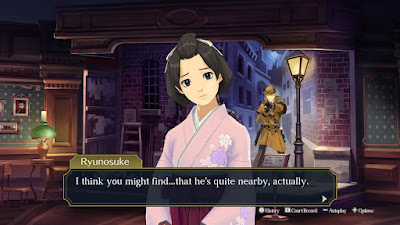
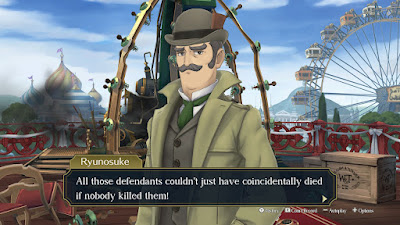
The Great Ace Attorney Chronicles manages to pull off an incredible feat, one which every game in a modern franchise can only dream of: it surpasses its predecessors. What's doubly impressive about this accomplishment is that the original trilogy can stand tall off of its unique premise alone, whereas The Great Ace Attorney doesn't really bring anything "new" to the series. Rather, where The Great Ace Attorney's excels is in its masterful craftsmanship, culminating in the best story Shu Takumi has penned yet. It's a roller coaster of bizarre twists, endearing characters, and mysteries so elaborately tangled up that even the great Sherlock Holmes would be left stupefied.


At first blush, this may all sound like a baseless boast, especially given how The Great Ace Attorney opens. You'll note early on that the narrative moves at a glacial pace, turning its first case—the intended tutorial—into an overwrought and verbose affair. This pervades the entire experience, as events, details, and motives are explained and then re-explained in elaborate detail, heedless of the player's understanding. Characters will belittle and infantilize you in court as you wait to present decisive evidence, drawing out conclusions that you've worked out several lectures ago. While this foible is present to some degree in every Ace Attorney game, it's arguably at its worst here—particularly because Shu Takumi should know better by now. The sole vice of The Great Ace Attorney's is that it's incorrigibly loquacious, like a college professor enamored by the sound of their own voice.

But as long as you don't mind being battered by wordy tidal waves, The Great Ace Attorney offers a fantastic ride from start to finish. Even its plodding first case contains several twists and turns, turning it into a struggle befitting of a penultimate case in an earlier game. The Great Ace Attorney doesn't let up either, repeatedly gobsmacking the player with baffling developments, wild conspiracy theories, and enough red herrings to make you suspect a nine-year-old of murder. So many mysteries underpin The Great Ace Attorney that by the end of the first game in the duology, you'll be left with more questions than answers. Fear not however, as by the end of the second every disparate piece of evidence will link together, like the cogs of a great machine.

And therein lies what makes The Great Ace Attorney so good: it's a competently told, standalone story. No character is invincible because they're a fan favorite, no ally inscrutable because they're on the "good" side, and no villain so deplorable as to commit a crime for the sake of it. The Great Ace Attorney's is an elaborate tale of nationalities and deep-seated hatreds, where conflicting ideologies mix with freak accidents to produce Machiavellian outcomes. At times the yarn it weaves is as fantastical as it is improbable, but glimmers of reality will bleed through, painting the world as a tragic place where good intentions frequently clash with carnal impulses—and often lose.


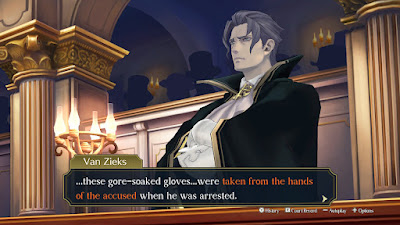
It's difficult to talk about the game without delving into full-on spoilers, so I'll just say that I was left very satisfied with how The Great Ace Attorney Chronicles resolves. While it's by no means perfect—expect some preposterous motives and incongruous details—the mystery surrounding the Professor case is utterly captivating. Even if you correctly guess the perpetrator lurking at its core, the way the final trial unfolds is spectacular, delivering some dark revelations that took me by surprise. Given how easy it is for a murder mystery to misstep in its final act (see Dual Destinies and Pretty Little Liars Season 7), The Great Ace Attorney deserves to be commended for not only delivering a convincing climax, but doing so with an unexpected, morally-gray gut punch.

Of The Great Ace Attorney's many delights (including its knock-out soundtrack), the way it plays with expectations is my favorite. Despite the franchise formula being well-trodden by this point, there are some genuine surprises to stumble upon in court—especially if you're expecting the game to mirror its predecessors. While I'm impressed most by the final case of the second game, it's the third case of the first game that left me smitten, as I pulled several 180° turns trying to guess its outcome. In fact, I don't think there's a bad case between either game; there are some laboriously long trials, yes, but every case is peppered with reveals both big and small that'll push you onwards. Be prepared for anything, from an innocent-yet-unexpected pet to a curious piece of evidence that can blow the case wide open. If you've grown weary of Phoenix Wright's 20-year-old tricks, I wholeheartedly recommend giving The Great Ace Attorney an try—there's bound to be something here that will impress you.

If you're a new player however, be forewarned that the game is long—very long. Like 80 hours long. The Great Ace Attorney is an exhaustive undertaking akin to Persona 5, where you'll have to chip away at it over the course of several months. I very much enjoyed the time I spent with it, but I'd be lying if I said I wasn't tempted to start another game after the conclusion of every other case. And like Persona 5, it's an absolute marvel of ambition... that you probably won't be touching again until a decade or two has passed. Still, a game's replayability isn't its sole defining factor; The Great Ace Attorney is worth the price of admission for the amount of "wait what?"s it elicits on the first time through.


While I contend that The Great Ace Attorney Chronicles would be improved with a firmer editor (you could probably cull 10% of the script without sacrificing anything of importance), everything else about it is spot on. If you're in the mood to read a tale as charming as it is impactful, and as puzzling as it is goofy, then The Great Ace Attorney will not disappoint. It really can't be overstated what an accomplishment it is for this duology to dethrone the OG trilogy. The Ace Attorney Trilogy might be the better introduction but The Great Ace Attorney is the more provocative package, in theme, style, story, substance—you name it. It is gaming's greatest whodunit, one that will leave you with a single question after its credits: how can Shu Takumi possibly outdo himself next?

Tuesday, November 30, 2021

Phoenix Wright: Ace Attorney - Dual Destinies - Thoughts


[contains minor spoilers]

Like Mega Man X6, Phoenix Wright: Ace Attorney - Dual Destinies is an unnecessary sequel to a finished storyline, failing to do a single thing better than its predecessors. Unlike X6 however, Dual Destinies remains a "fun" experience from start to finish... provided you can ignore its flagrant leaps in logic. The core Ace Attorney experience remains intact—quirky characters, queer mysteries, and plenty of manzai—so it's not like Dual Destinies is the untouchable black sheep of the series. It's just that the game is... sadly mediocre.


The big question that Dual Destinies struggles with is "who is the main character?" There's effectively three different protagonists (Athena, Apollo, and Phoenix) and they often bump shoulders to stay in the spotlight. By all accounts Dual Destinies is Athena's story and I quite like her cheery demeanor—but Phoenix Wright curiously receives the most screen time. Meanwhile Apollo flitters about, initially acting as a straight man to Athena's naïve goofery before transforming into this weird... aloof vigilante? It's hard to discuss him without veering into spoilers, but I can reveal that despite the series landing into his hands in Apollo Justice, he (and Trucy) have been wrongfully sidelined here. It's like Capcom wanted to return to the Phoenix Wright of old, as well as continue Apollo's journey, and introduce a brand new character. And then instead of making different franchises for each, the developers shrugged and mashed them all together, not realizing it would result in an unsatisfying and messy story.

Speaking of, Dual Destinies comes with plenty of fun twists and turns fans have come to expect from the franchise, but the central theme underpinning the game is extraordinarily weak. Dual Destinies hammers home the ominous "dark age of the law" at every opportunity it can get in its latter half, but it doesn't lead to any pointed remarks or nuanced insights. In fact, the story feels like the most uninspired shonen anime, where "truth = good, lies = bad" and your clients are hopelessly innocent while the killers are unapologetically evil. Even the game's central antagonist—the elusive "Phantom"—shows a lot of promise in the case they're involved in, but the trial inevitably devolves into slapstick, stretching the limits of plausibility as you cry out, "How the hell haven't you been arrested yet?!"


While I can forgive the storytelling of Dual Destinies somewhat—Ace Attorney games never aim to be literature—I remain disappointed in how simple the game's cases are. Dual Destinies is obsessed with guiding the player to its solutions, badgering them with unsubtle hints even after the answer couldn't be made more obvious. On one hand it's nice being able to play a Ace Attorney game without gambling on loosely-related evidence, but on the other your brain barely gets a workout. The only time you're forced to seriously ponder a case is right before the game makes a bizarre leap of logic—surely the killer didn't go to this length to cover their tracks, right? There's always a little bit of that in every Ace Attorney title, but I don't remember it being quite so egregious and cartoony.

Ironically, the oft-derided case 5-2 was my favorite of the lot. I found its theme charming and each stage of the trail was interesting and vaguely plausible—outside of one or two details. It might also be because it centered upon the Apollo & Athena duo, which felt more refreshing than playing as Phoenix Wright for the... 13th? 14th time? Besides that, no other trial stood out to me as notable; 5-1 was unconventional but weak, 5-3 took a nosedive towards its end, and the final two cases squandered too much of the Phantom's potential.

But I'm not all groans and gripes—Dual Destinies knocks its presentation out of the park. The new 3D models are smooth and lively, replacing the 2D sprites almost seamlessly. Likewise the soundtrack continues the franchise trend of implanting secret earworms in your head and being generally fitting overall. I also enjoyed the new mechanic Athena brings to the table (the Mood Matrix), as its more engaging and sensible than having the magatama magically detect lies, or using Apollo's bracelet to repeat a sentence over and over. Occasionally the Mood Matrix could be misleading based on how you think someone should be reacting to the situation, but as there's no penalty for wrong answers, it's really not too bad.


I suppose I was too hasty comparing Phoenix Wright: Ace Attorney - Dual Destinies to Mega Man X6, considering the latter is an irredeemable trash fire while the former is just... dull. But conversely it's hard not to see Dual Destinies as the low point of an otherwise fairly remarkable series. It's loyal to the franchise's roots and earnest in its efforts, but its passion fails to overcome just how bog standard the entire game is. If you've not tired of Ace Attorney's peculiar brew, Dual Destinies might be your cup of tea. But I personally feel that Capcom needs to spice up this blend before it gets too bland...


... Thankfully, The Great Ace Attorney Chronicles would be the answer to my problem.
---------------------

Images obtained from: nintendo.co.uk, amino.com, gsmarena.com, toucharcade.com

Tuesday, November 29, 2016

Always the Same Blue Sky... - Thoughts


[contains minor spoilers]

The worst part about Always the Same Blue Sky... is that it offers not but a taste of brilliance. There's a lot about it to like: approachability, colorful visuals, fantastic music, expressive writing... which makes it all the more tragic that the entire story wraps up in forty minutes. It's less of a visual novel and more like a visual short story, offering you a momentary glimpse into its cozy island setting before reaching one of its two endings. While I don't inherently dislike experiences that seek to be brief yet impactful, the amount of work and polish on display here practically beg for a longer runtime, especially in regard to the game's ulterior message.


This is not to say that I was disappointed by the experience; what I ultimately feel about the game is somewhat hard to describe. I think Always the Same Blue Sky... is good!—I definitely enjoyed my time with it. But narrative-centric visual novels can be finicky creatures to develop properly, since their emotional payoff depends on your fondness for their characters. There's nothing wrong with Kira (the sole heroine of the story) either, but familiarity forms the strongest of all bonds, and being able to say "hello" and "goodbye" to her in a single sitting doesn't provide the player with the emotional resonance the story seeks. Considering that the tale ends on a bittersweet note makes this issue all the more lamentable.


Always the Same Blue Sky... does try its best however, and the heartfelt effort is commendable on its authenticity alone. Though there are a handful of sections where the dialogue feels a bit forced (usually before a branching path centered around philosophical argument [e.g. "I have firm beliefs and I know what I'm doing is right. It may feel difficult superficially but I have a job to do for the greater good..."), the writing overall is splendid, featuring a wondrous amount of expressive phrases. There's a nostalgic, nearly saccharine feel to the game thanks to the portrait and description of the antique town ("The school is situated on the end of a peninsula and no matter where you are, you can hear the constant lapping of the docile waves on the beach not far below") and the ways in which the player character describes Kira's ethereal beauty ("Although untanned, the colours in her hair gave the impression she had spent a lifetime bathing in the sun. Full of depth, it appeared radiant in the bright light that flooded through the window behind her."). I suspect the writer Grant Wilde is somewhat of a hopeless romantic, as he naturally excels at filling the player's heart with an anxious whimsy that longs for love's sweet release. Granted, it's a naive, star-struck type of teenage love, but that doesn't detract from how soothing the relationship with Kira can be if you're able to transport yourself to those distant summer shoes.

Lastly, I need to congratulate the musician Jon Hayward for writing some absolutely amazing music. While I'm by and large a visually-oriented person, I find that the aspect of visual novels that hooks me the most is actually their soundtrack, as even titles that I deem not particularly good (*coughKanoncough*) can at least tug at my heartstrings with a melancholy tune or two. The short journey you find yourself on in Always the Same Blue Sky... is filled with breathy flutes and gentle marimbas, as evidenced by its phenomenal "Main Theme" or the curiously winding "Alleys and Side Roads". The work Hayward puts in to fit the music so perfectly to the style and setting of the game cannot be understated; where simple themes could've sufficed, Hayward truly brought out the beauty in this fleeting relationship.


My concluding thought on Always the Same Blue Sky... is that it serves as an amazing proof of concept for Wilde. I think it's strong enough to be played and enjoyed on its own, but it undoubtedly feels like a diamond caught in mid-transformation. The twist at the end is something I wish had more care delivered to it (as it's a bit jarring as is) but I really like the tone and outcome of both endings, finding them interesting concepts that would probably flourish better had the story spent more time building up to them. Always the Same Blue Sky... is like a precious sapling that only needed space to sprout into a mighty tale, yet in spite of that detriment there's still plenty to admire about it.