Showing posts with label Ace Attorney. Show all posts

Saturday, February 8, 2025

Phoenix Wright: Ace Attorney - Spirit of Justice - Thoughts


[contains minor spoilers—no case specifics, just general themes]

Something is rotten in the ancient state of Khurai'in—and if that statement doesn't spark an interest you, then Spirit of Justice likely won't either. The sixth mainline title in the Ace Attorney series sees a radical shift in setting, dropping Phoenix Wright & co. into a fanatical nation on the cusp of a revolution. It's a bold change to make, but arguably a necessary one, as the class and caste of old was growing stale. Note that this doesn't radicalize the structure of Ace Attorney in any way—everything you know and love is still here—but it brings to the table more unpredictability and intrigue, two key components to any good mystery story. I don't think Spirit of Justice gets to lay claim to being the best in the series, but it does its best to compete with the better titles, and in some ways, even transcends them.


Dual Destinies—the previous entry—tried to shake up the formula with the threat of corruption undergirding the judicial process, but it was a laughable dilemma that bore no weight on the story. Spirit of Justice counters this feeble punch with a hard right hook called the DC Act: a Khurainese law that ensures defense lawyers receive the same punishment as their clients should they fail. From the moment the game starts it keeps the pressure high for Phoenix Wright, who has to put his literal neck on the line to defend the innocent bystanders caught up in vile machinations greater than them. At times it can feel a little ridiculous how stacked the odds are (especially in the last case, where the governing body itself seeks your demise), but the stakes help to propel the story forward, frequently reminding you that the nation of Khurai'in is irredeemably broken.

Along with the vibrant new setting, Spirit of Justice also introduces the player to Insights: half-minute recollections (ie videos) of a victim's last moments, peppered with stray details from their five senses. It works similar to Athena's Mood Matrix in the previous game, where you're looking for a contradiction between the prosecution's argument and how the magical retelling unfolds. For a fictitious example, if the suspect is presumed to be a man, then spotting the word "perfume" in the victim's Insight could be the saving grace your case desperately needs. Although Insights were not used often, I found them to be an excellent addition that both enhanced and evolved the player's understanding of a case; they're perhaps the best mechanic the Ace Attorney series has ever produced (sorry jury system, but Insights allow for some clever twists!)

Speaking of twists, Spirit of Justice comes packing a decent number of them, even if (as is typical with the series) you may have to suspend your logic for a second. Nearly every case has a one or two twists that will be hard to see coming, with the third and fifth in particular having some especially brilliant, memorable, and dark outcomes. Sadly, the fifth case spins its wheels for a bit too long after its greatest rug pull, as its remaining mysteries make little sense or outright fail to convince the player ("that" character's reveal is one of the most nonsensical things I've seen in a series known for its serendipitous buffoonery). Thankfully, nothing here dips as low as the Phantom arc in Dual Destinies; from start to finish, I was constantly wondering, hypothesizing, and awaiting the many mysteries Spirit of Justice laid out for me.

And of course, no Ace Attorney game would be complete without a gaggle of curious characters and quirky music to accompany them. While the witness lineup doesn't quite hit the highs of the original trilogy, there are a decent number of memorable faces like Rayfa, Datz, Uendo, Soren, and my man Dhurke (arguably the best character in the whole game). Sahdmadhi as a prosecutor is... alright overal: he fulfills the "insufferable heel" trope pretty well without ever feeling cartoonishly evil or petty. I think his biggest problem is that he takes a backseat during his own character arc, allowing a larger character looming over him to take his stead (but hey, it fits in a way). The music is a bit less catchy this time around and more surprisingly moody, albeit still equal parts fantastic; the cream of the crop being the cross examination theme for being simultaneously unsettling and sinister.


Sadly, as with all the non-Shu Takumi titles, Spirit of Justice doesn't know how to handle its characters in a meaningful way. Trucy gets an emotional moment in the second case and then is promptly forgotten about for the rest of the game, the third case features some vile betrayals that no one shows any kind of guilt over, and Apollo gets yet another "never mentioned before but it's super important" backstory. But the worst for me was Maya: ignoring the fact that she's still a 17-year-old mentally with all the same old animations, she does very little in the main game besides being relegated to a damsel in distress. It's only in the DLC case that she gets to shine as an assistant once again, and even there her colorful commentary isn't nearly as bright as it once was. After being gone for so long, Maya's presence here is frankly a disgrace.

Likewise, I think the way Spirit of Justice ties up its tyrannical government plotline is deeply unfulfilling. The tumult of revolution can be felt in the background early on, but the game never takes it seriously as a potential outcome, treating it as beholden to—rather than in charge of—Khurai'in's destiny. Instead, it's our heroic cast of foreigners and their elaborate deductions that carve a path towards tyranny's end, with the final "aha!" being so farfetched that it could only work on a die-hard constitutionalist. For a narrative that was surprisingly grim and tragic up to this point, Spirit of Justice handles regime change with unwarranted, blinding optimism.

Now obviously I'm viewing this 2016 game through a more cynical 2025 lens (gee, it's that easy to topple an authoritarian government built on brainless zeal, huh?) but it's hard to restrain myself when Capcom deliberately chose this bold of a setting. And look—I get that this is the series where multiple villains have confessed to their crime when cornered with facts and logic; expecting a Pentiment-style portrayal of the common man's plight was never going to happen. But I refuse to believe Spirit of Justice couldn't have resolved its central conflict in a more thematically cohesive and valiant manner—I mean come on, Dhurke and Datz are right there! They could have done something more meaningful!


For fans of Ace Attorney, Spirit of Justice won't be a revolution; it plays its story straight and safely, doing little with most of its characters and even less with the established cast. But for someone looking for some lengthy cases with plenty of evidence to pore over, Spirit of Justice is a wedding-size buffet of intrigue, surprises, and subterfuge. The game takes over 50 hours to finish (DLC included) and is bound to stump you at least a handful of times, which I greatly appreciated after the relaxed ride of Dual Destinies. Even though I hope for the eventual Ace Attorney 7 to shake-up to the now-stable formula, Spirit of Justice has proven that for however long Capcom wants to crank out games of this quality, I will continue playing with glee, gripes notwithstanding.

---------------------

Images obtained from: Ace-Attorney.com

Friday, April 15, 2022

The Great Ace Attorney Chronicles - Thoughts


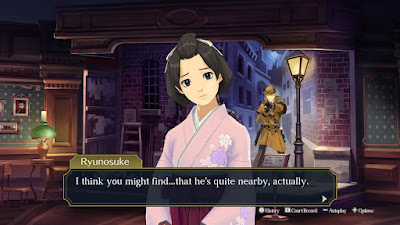
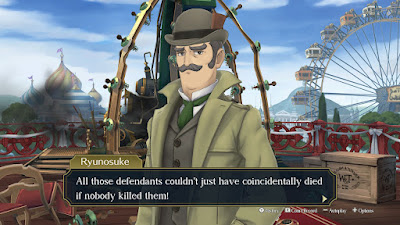
The Great Ace Attorney Chronicles manages to pull off an incredible feat, one which every game in a modern franchise can only dream of: it surpasses its predecessors. What's doubly impressive about this accomplishment is that the original trilogy can stand tall off of its unique premise alone, whereas The Great Ace Attorney doesn't really bring anything "new" to the series. Rather, where The Great Ace Attorney's excels is in its masterful craftsmanship, culminating in the best story Shu Takumi has penned yet. It's a roller coaster of bizarre twists, endearing characters, and mysteries so elaborately tangled up that even the great Sherlock Holmes would be left stupefied.


At first blush, this may all sound like a baseless boast, especially given how The Great Ace Attorney opens. You'll note early on that the narrative moves at a glacial pace, turning its first case—the intended tutorial—into an overwrought and verbose affair. This pervades the entire experience, as events, details, and motives are explained and then re-explained in elaborate detail, heedless of the player's understanding. Characters will belittle and infantilize you in court as you wait to present decisive evidence, drawing out conclusions that you've worked out several lectures ago. While this foible is present to some degree in every Ace Attorney game, it's arguably at its worst here—particularly because Shu Takumi should know better by now. The sole vice of The Great Ace Attorney's is that it's incorrigibly loquacious, like a college professor enamored by the sound of their own voice.

But as long as you don't mind being battered by wordy tidal waves, The Great Ace Attorney offers a fantastic ride from start to finish. Even its plodding first case contains several twists and turns, turning it into a struggle befitting of a penultimate case in an earlier game. The Great Ace Attorney doesn't let up either, repeatedly gobsmacking the player with baffling developments, wild conspiracy theories, and enough red herrings to make you suspect a nine-year-old of murder. So many mysteries underpin The Great Ace Attorney that by the end of the first game in the duology, you'll be left with more questions than answers. Fear not however, as by the end of the second every disparate piece of evidence will link together, like the cogs of a great machine.

And therein lies what makes The Great Ace Attorney so good: it's a competently told, standalone story. No character is invincible because they're a fan favorite, no ally inscrutable because they're on the "good" side, and no villain so deplorable as to commit a crime for the sake of it. The Great Ace Attorney's is an elaborate tale of nationalities and deep-seated hatreds, where conflicting ideologies mix with freak accidents to produce Machiavellian outcomes. At times the yarn it weaves is as fantastical as it is improbable, but glimmers of reality will bleed through, painting the world as a tragic place where good intentions frequently clash with carnal impulses—and often lose.


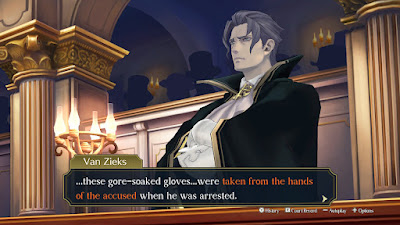
It's difficult to talk about the game without delving into full-on spoilers, so I'll just say that I was left very satisfied with how The Great Ace Attorney Chronicles resolves. While it's by no means perfect—expect some preposterous motives and incongruous details—the mystery surrounding the Professor case is utterly captivating. Even if you correctly guess the perpetrator lurking at its core, the way the final trial unfolds is spectacular, delivering some dark revelations that took me by surprise. Given how easy it is for a murder mystery to misstep in its final act (see Dual Destinies and Pretty Little Liars Season 7), The Great Ace Attorney deserves to be commended for not only delivering a convincing climax, but doing so with an unexpected, morally-gray gut punch.

Of The Great Ace Attorney's many delights (including its knock-out soundtrack), the way it plays with expectations is my favorite. Despite the franchise formula being well-trodden by this point, there are some genuine surprises to stumble upon in court—especially if you're expecting the game to mirror its predecessors. While I'm impressed most by the final case of the second game, it's the third case of the first game that left me smitten, as I pulled several 180° turns trying to guess its outcome. In fact, I don't think there's a bad case between either game; there are some laboriously long trials, yes, but every case is peppered with reveals both big and small that'll push you onwards. Be prepared for anything, from an innocent-yet-unexpected pet to a curious piece of evidence that can blow the case wide open. If you've grown weary of Phoenix Wright's 20-year-old tricks, I wholeheartedly recommend giving The Great Ace Attorney an try—there's bound to be something here that will impress you.

If you're a new player however, be forewarned that the game is long—very long. Like 80 hours long. The Great Ace Attorney is an exhaustive undertaking akin to Persona 5, where you'll have to chip away at it over the course of several months. I very much enjoyed the time I spent with it, but I'd be lying if I said I wasn't tempted to start another game after the conclusion of every other case. And like Persona 5, it's an absolute marvel of ambition... that you probably won't be touching again until a decade or two has passed. Still, a game's replayability isn't its sole defining factor; The Great Ace Attorney is worth the price of admission for the amount of "wait what?"s it elicits on the first time through.


While I contend that The Great Ace Attorney Chronicles would be improved with a firmer editor (you could probably cull 10% of the script without sacrificing anything of importance), everything else about it is spot on. If you're in the mood to read a tale as charming as it is impactful, and as puzzling as it is goofy, then The Great Ace Attorney will not disappoint. It really can't be overstated what an accomplishment it is for this duology to dethrone the OG trilogy. The Ace Attorney Trilogy might be the better introduction but The Great Ace Attorney is the more provocative package, in theme, style, story, substance—you name it. It is gaming's greatest whodunit, one that will leave you with a single question after its credits: how can Shu Takumi possibly outdo himself next?

Tuesday, November 30, 2021

Phoenix Wright: Ace Attorney - Dual Destinies - Thoughts


[contains minor spoilers]

Like Mega Man X6, Phoenix Wright: Ace Attorney - Dual Destinies is an unnecessary sequel to a finished storyline, failing to do a single thing better than its predecessors. Unlike X6 however, Dual Destinies remains a "fun" experience from start to finish... provided you can ignore its flagrant leaps in logic. The core Ace Attorney experience remains intact—quirky characters, queer mysteries, and plenty of manzai—so it's not like Dual Destinies is the untouchable black sheep of the series. It's just that the game is... sadly mediocre.


The big question that Dual Destinies struggles with is "who is the main character?" There's effectively three different protagonists (Athena, Apollo, and Phoenix) and they often bump shoulders to stay in the spotlight. By all accounts Dual Destinies is Athena's story and I quite like her cheery demeanor—but Phoenix Wright curiously receives the most screen time. Meanwhile Apollo flitters about, initially acting as a straight man to Athena's naïve goofery before transforming into this weird... aloof vigilante? It's hard to discuss him without veering into spoilers, but I can reveal that despite the series landing into his hands in Apollo Justice, he (and Trucy) have been wrongfully sidelined here. It's like Capcom wanted to return to the Phoenix Wright of old, as well as continue Apollo's journey, and introduce a brand new character. And then instead of making different franchises for each, the developers shrugged and mashed them all together, not realizing it would result in an unsatisfying and messy story.

Speaking of, Dual Destinies comes with plenty of fun twists and turns fans have come to expect from the franchise, but the central theme underpinning the game is extraordinarily weak. Dual Destinies hammers home the ominous "dark age of the law" at every opportunity it can get in its latter half, but it doesn't lead to any pointed remarks or nuanced insights. In fact, the story feels like the most uninspired shonen anime, where "truth = good, lies = bad" and your clients are hopelessly innocent while the killers are unapologetically evil. Even the game's central antagonist—the elusive "Phantom"—shows a lot of promise in the case they're involved in, but the trial inevitably devolves into slapstick, stretching the limits of plausibility as you cry out, "How the hell haven't you been arrested yet?!"


While I can forgive the storytelling of Dual Destinies somewhat—Ace Attorney games never aim to be literature—I remain disappointed in how simple the game's cases are. Dual Destinies is obsessed with guiding the player to its solutions, badgering them with unsubtle hints even after the answer couldn't be made more obvious. On one hand it's nice being able to play a Ace Attorney game without gambling on loosely-related evidence, but on the other your brain barely gets a workout. The only time you're forced to seriously ponder a case is right before the game makes a bizarre leap of logic—surely the killer didn't go to this length to cover their tracks, right? There's always a little bit of that in every Ace Attorney title, but I don't remember it being quite so egregious and cartoony.

Ironically, the oft-derided case 5-2 was my favorite of the lot. I found its theme charming and each stage of the trail was interesting and vaguely plausible—outside of one or two details. It might also be because it centered upon the Apollo & Athena duo, which felt more refreshing than playing as Phoenix Wright for the... 13th? 14th time? Besides that, no other trial stood out to me as notable; 5-1 was unconventional but weak, 5-3 took a nosedive towards its end, and the final two cases squandered too much of the Phantom's potential.

But I'm not all groans and gripes—Dual Destinies knocks its presentation out of the park. The new 3D models are smooth and lively, replacing the 2D sprites almost seamlessly. Likewise the soundtrack continues the franchise trend of implanting secret earworms in your head and being generally fitting overall. I also enjoyed the new mechanic Athena brings to the table (the Mood Matrix), as its more engaging and sensible than having the magatama magically detect lies, or using Apollo's bracelet to repeat a sentence over and over. Occasionally the Mood Matrix could be misleading based on how you think someone should be reacting to the situation, but as there's no penalty for wrong answers, it's really not too bad.


I suppose I was too hasty comparing Phoenix Wright: Ace Attorney - Dual Destinies to Mega Man X6, considering the latter is an irredeemable trash fire while the former is just... dull. But conversely it's hard not to see Dual Destinies as the low point of an otherwise fairly remarkable series. It's loyal to the franchise's roots and earnest in its efforts, but its passion fails to overcome just how bog standard the entire game is. If you've not tired of Ace Attorney's peculiar brew, Dual Destinies might be your cup of tea. But I personally feel that Capcom needs to spice up this blend before it gets too bland...


... Thankfully, The Great Ace Attorney Chronicles would be the answer to my problem.
---------------------

Images obtained from: nintendo.co.uk, amino.com, gsmarena.com, toucharcade.com