Friday, February 18, 2022

Mortal Shell - Thoughts


Whereas some games wear their Dark Souls inspiration on their sleeve, Mortal Shell fashions its entire suit out of From Software's fabric. Most of the series' staples are here: a grim fantasy world, trigger-focused control scheme, laborious combat, corpse runs, bosses with esoteric names, experience that doubles as currency, lore through item descriptions, et cetera, et cetera. But to Mortal Shell's credit, it applies some creative twists to the well-worn genre, generating new mechanics in the process. It's a neat and ambitious game... that unfortunately feels like an unbalanced tech demo in the end.


Surprisingly, Mortal Shell offers that rare introductory Souls experience that few games nowadays provide, where the opening hours feel like bullshit. You're given no direction, no estus flasks, and a forest littered with nasties that want you dead. As if that wasn't bad enough, Mortal Shell doesn't even offer a class, weapon, or item selection at its start—nor are you able to level your stats! It's like being dumped naked into 1-1 of Demon's Souls armed with only a longsword, and the best moon grass you can find is half as effective as the crescent variety. But you better learn to love that eighth moon grass because it's the best healing you'll find for the entire game.

You're not left entirely defenseless however, as Mortal Shell provides an new way to shield: hardening. By holding LT you can innately block any type of attack, transforming your flesh into an impenetrable statue à la the tanooki suit. This ability is also on an extremely generous cool down, allowing you to counter every other combo made by your opponent. It's a bit tricky learning to rely on it as a Souls vet, since it's best used in the middle of an attack animation to avoid interruption. Plus your impulse will likely be to mash roll or parry—both of which can be done here in addition to hardening. It's a cool mechanic though, and is super gratifying to pull off in the nick of time.

Another unique aspect about Mortal Shell I liked were the titular shells. While you can't choose what build you start as, there are three inhabitable bodies you can stumble upon out in the wild: one with high health, one with high stamina, and one that offers a compromise between the two. You may not be able to level these husks in a tradition sense but you can still dump your souls tar into their individualized skill trees wheels. Though I found the wheels to be underwhelming (a 5% resistance buff upon taking damage... hooray...), it was an interesting way to portray character growth beyond the trite "watch number go up."


The way Mortal Shell handles items is ingenious too—on paper. Every item you stumble across will have an unknown use until you consume it, incentivizing you to experiment with everything you pick up. The more you use an item the more familiar with it you'll become, eventually upgrading its potency to a second tier. I thought this was brilliant when I stumbled upon the tarspore—consuming the fungus can transform it from a poison edible to a poison-immunity treat once it hits familiarity. But every other item in the game is mundane by comparison; their effects become a tiny bit better once you cross the familiarity threshold. Considering how low-impact most of the items are already (I get health back for a single parry?), their evolved forms didn't do much to convince me they were even worth using in the midst of combat.

Early on, when your ass is being repeatedly handed to you, you'll probably stumble upon a mighty realization: dying is kind of... good? Not that being sent back to a checkpoint feels rewarding—it's frustrating as hell—but dying creates a statue of your shell you can reclaim for full health upon return. As you can already survive one ejection per life, your stone corpse serves as a second full heal waiting out on the field. Factor that together with the Eredrim shell's massive health pool (seriously, the dude's a tank), and you won't need consumables to win battles—as long as a copy of your corpse is nearby, any fight can be won through endurance alone. (Well except the last boss... you have to learn to roll for that obnoxious hopping dingbat.)

Combat is fun for the most part, as enemies run the gamut from slaughter-fodder to competent swordsman to "oh no not this guy!" But the problem with Mortal Shell's bestiary is that there's just not enough variety. The three arcs of your journey each feature a different—but small—set of enemies to clash swords with, but they're reused so many times that combat becomes stale and repetitive, your blade worn down to a nub. Given how sluggish and costly parrying can be, skipping encounters is often the safer option later on, especially during a gland run. Plus I didn't find much of a reason to fight foes once Eredrim was fully upgraded. Sure, I could funnel his tar into the other shells and try them out, but as soon as the going got tough I would revert back to the ol' dependable-Venerable. 

Amongst Mortal Shell's (many) shortcomings, the worst has to be its scarcity of locales. There are only four major zones in the game, each split up into three similar-looking subregions. The Seat of Infinity is the only zone of the four I'd readily call awe-inspiring: it's an expanse of pitch black stones carved into looming, brutalist architecture, bending even gravity to its will as you venture deeper inside the ominous Dim Gate. Unfortunately area drags on for forever, emulating the charred remains of Lost Izalith. Yet compared to the other areas it's the crowning jewel of Mortal Shell; the three remaining zones are a gigantic swamp, featureless cave, and some chilly catacombs. Each are comprised of muted, featureless corridors that often blend into one another, with the swamp being worst labyrinth of the lot—which is an egregious sin for a hub world to have! Toss in a washed out color palette, dearth of shortcuts, and the aforementioned enemy problem, and you'll be happy when the adventure is finally over.


While Nioh still retains the top spot as the premier 3D soulslike, Mortal Shell is a confident runner-up that's not without its flaws. Its merciless start offers no options other than "gitting gud", but as long as you can endure the initial beating you're bound to find something you enjoy. The combat has its foibles but is solid for the most part, and while its reuse of enemies was tiresome the placement of them was often devious, if not clever. I maintain that it's worth a playthrough for die-hard fans of the genre, as it's the closest a game has gotten to loyally copying Dark Souls. And hey, if that doesn't tickle your fancy—at least Mortal Shell can reveal all the things From Software does right by occasionally showing you what could go wrong.

Monday, February 7, 2022

Paper Mario: Color Splash - Thoughts


Never have I played a game so irresistibly charming that tries its damnedest to be mediocre. Paper Mario: Color Splash may be a better game than Sticker Star but it fails to learn nearly half of the lessons it should have. Every step forwards is proceeded by a baffling stumble backwards, punishing you every time you start to have fun. I don't fault anyone for being lured in by Color Splash's gorgeous visuals and toe-tappingly phenomenal music, but player beware: beneath the captivating aesthetic is the same exact crummy design document that sunk Sticker Star like a stone lobbed into a lake.

Or rather—a rock, eh? Eh?!!! Get it?!!!!!! 


Lord almighty do I loathe Paper Mario: Color Splash's obsession with rock paper scissors. Anyone that's played the game knows what I'm talking about—and likely feels the same. The best way to earn coins in Color Splash is to enter into one of the eight (!!!) rock paper scissors tournaments that pop up on the world map. Blatant hints are provided to assist you in the first two battles, but you're on your own for the third—and as the game progresses, the hints grow vaguer, culminating in a tournament that's entirely dependent on chance. Gone is any semblance of strategy; you either know the outcome of a match before it starts, or are helplessly beholden to a random roll. Does that sound fun?

Because it's not. The first tournament is entertaining in a kitschy way (given how seriously it's presented), but the novelty wears off quickly. I avoided the Roshambo temples after conquering the first two, but restocking my arsenal later on got so expensive that I'd be a fool not to do them—a single tournament can shower you in thousands of coins. Plus, seeing as a goddamn minigame quiz show was mandatory for progression, I assumed the Roshambo temples were as well. Only at the gates of final level did I say "screw it", ready to incur the wrath of an impossible boss fight as long as it meant I could maybe skip playing rock paper scissors for the 50th time.

For those familiar with Sticker Star, you're likely to notice two big red flags from that last paragraph: the need to restock and being unaware of what's mandatory for progression. Color Splash thankfully improves on its predecessor in both categories... but I wouldn't call either of those problems "fixed." Attacks continue to be consumable resources but they're cards now instead of stickers, meaning you won't have to deal with gigantic adhesives clogging up your inventory space. And in the main hub is a handy toad that'll clue you into what Thing you need next, avoiding the urge to keep a walkthrough open at all times. Buuut you'll continue to fiddle with deck management more than you should (largely from wanting to retain stronger cards for boss fights), as well as repeatedly backtracking to Port Prisma to check if you have the right Thing or not. Intelligent Systems keenly demonstrates that acknowledging a problem is not quite the same as addressing it.


In regard to boss fights, Color Splash likewise makes a minor improvement. What were once one-note fights (er, one-sticker fights) have transformed into actual battles that require proper healing and paint management. That is, until a specific event happens and you're forced to use the Thing that beats the boss—or face annihilation. Again the root problem is sidestepped, transforming "fights where a Thing trivializes a battle" into "fights where a Thing is mandatory for victory." And I mean mandatory—bosses are literally impossible to beat without their weakness! I would've readily taken reduced damage, or a penalizing status effect, or a difficult-to-dodge mega-attack over the brick wall that is invulnerability. It's a shame too because besides that prickly point, most of the boss fights are clever and fun (Wendy, Roy); the final boss in particular is a great duel, solely because no one particular card is required to beat it.

Another aspect Color Splash aims to improve but eventually bungles is its world map. Zones in Sticker Star were quarantined off like blobs of paint on a palette, locking you into exploring them one at a time. Color Splash mixes this up, adding multiple exits to every stage so that paths encircle the entire island. It starts off promising enough, feeling like a nonlinear adventure where you can solve things out of order, but the freedom is fleeting—you'll soon noticed that zones are still quarantined off, blocking you from making progress unless you tackle stages in the right order. This is especially apparently halfway through the game, where you're yet again traversing through stages in a boring linear fashion, with any secret exits tacked on in the most half-assed, shiftless way (Mossrock Theater).

Yet another problem Color Splash kicks further down the road is its random encounters—more specifically, making them meaningful. In Sticker Star, there's really no reason to fight enemies when you're armed with full health and stickers. However in Color Splash, battling will occasionally increase the maximum amount of paint you can hold, which is (sadly) as close to the concept of "levelling up" as the game gets. But after the first handful of expansions, upgrading your paint bucket hardly provides a benefit—the last few increases I got were a paltry 3% each. While paint is valuable early on, helping transform blank cards into better cards, powerful attacks eventually require so much paint that a single turn can deplete most of your chromatic stock. Therefore it's often better to stock up on paint-refilling green mushrooms and simply avoid battles—rendering the fights as superfluous as they were in Sticker Star.

But hey—at least Sticker Star gave numerical feedback for its battles!


Whoever thought it was a good idea to nix the damage numbers in Color Splash is a categorical fool. Depriving an RPG of such key information sends the player spiraling into an abyss of increasing uncertainty: does a hammer do as much damage as a jump? Does a fully painted jump do as much damage as an unpainted big jump? What about three half-painted hammers compared to a quarter-painted huge hurlhammer? A fire flower to an ice flower? A fire extinguisher to a lemon? Even when you manage to grasp one card's strength relative to another, you're still holding on to a formless adjudication that can never be tallied. Without a baseline of data to help determine the proper card for the situation, you'll just choose whatever card feels right.

But it's not like Color Splash requires a serious level of planning anyway. The gameplay here doesn't fare any better or worse than Sticker Star, as both suffer deeply from a simplified and recycled bestiary. Most of the fights boil down to "what attacks don't I want to waste," given that most of the enemies are a droll variation of one another. Maybe the shy guy will have a straw sticking out of his gob, or a crease across his middle, or a cardboard shield—all you really have to pay attention to is whether you should jump or hammer them. If that doesn't sound all that exciting, it's because it's not; the enemy gimmicks are mildly entertaining for the first encounter, but fail to distract from the fact that you're fighting the same overused archetypes over and over, attacks and health pools all vaguely blending together.

Color Splash's pathetic bestiary unfortunately extends over to its NPCs as well, seeing how Prism Island is home to a cabal of low-effort NFT Toads. Occasionally they'll wear a little hat, or a different colored vest, or maybe even some sunglasses—but they're all the same, bland, neutered creature in the end. Ironically a good chunk of them possess distinct personalities (the captain, the foreman, the bridge-loving toads), showing that Intelligent Systems (or at least the translation team) still yearn to tell stories. It's just a shame that the game has sterilized of any sort of visual whimsy—a problem which similarly plagued Sticker Star. But hey, at least the Koopa Kids are back this time!... again! A first for a Mario RPG Paper Mario game!

I do apologize for the unending comparisons to Sticker Star, but it's honestly hard to analyze Color Splash independent of the flawed ancestor it shares so much DNA with. I honestly feel that Color Splash is the better of the two, largely thanks to its crisp visuals, witty writing, and alarming creativity. Jokes land successfully more often than they don't, and there's a lot of fantastic paper-craft gags that reveal a stunning attention to detail. Plus I could gush about the music all day, about how it majestically evokes the chromatic tone of each colored star's episode perfectly, culminating in an energized boss theme which utilizes each episode's motif. I'd even go as far as to say that Color Splash is an aesthetic masterpiece, blowing the first three Paper Mario games out of the water...

... It's just that when it comes to the gameplay, everything comes tumbling down like a house of cards.

Just like Sticker Star.


Diehard Wii U fans may rightfully gush over Paper Mario: Color Splash's vibrant art style and charming script—but I'm unable to call it a good game, given the encyclopedic tome of annoyances and missteps. Every controllable aspect of the game is glaringly flawed—and I didn't even touch on how pointless the shy bandit is, or how annoying Kamek is, or the unforgivably stupid decision to make ally cards flee in boss fights! Those are the encounters where you need allies the most! If this blog post comes off as more negative than the one I wrote for Sticker Star, chalk it up to growing older, writing more honestly, or just a bur in my boot; the important takeaway is that neither game holds a candle to the Paper Marios of old. I mean, is there anyone that even prefers the rudderless direction the series is taking?

Worst of all is that Color Splash isn't just bad—it's bad in spite of its good parts, smothering whatever redeeming qualities it had in boneheaded decisions. It's a meticulously-crafted still life caked in dirt, a twinkling star strangled by needless smog.

---------------------

Images obtained from: nintendo.com, geekdad.com, theyoungfolks.com, expertreviews.co.uk, mariowiki.com

Friday, January 28, 2022

Snakebird - Thoughts


Snakebird
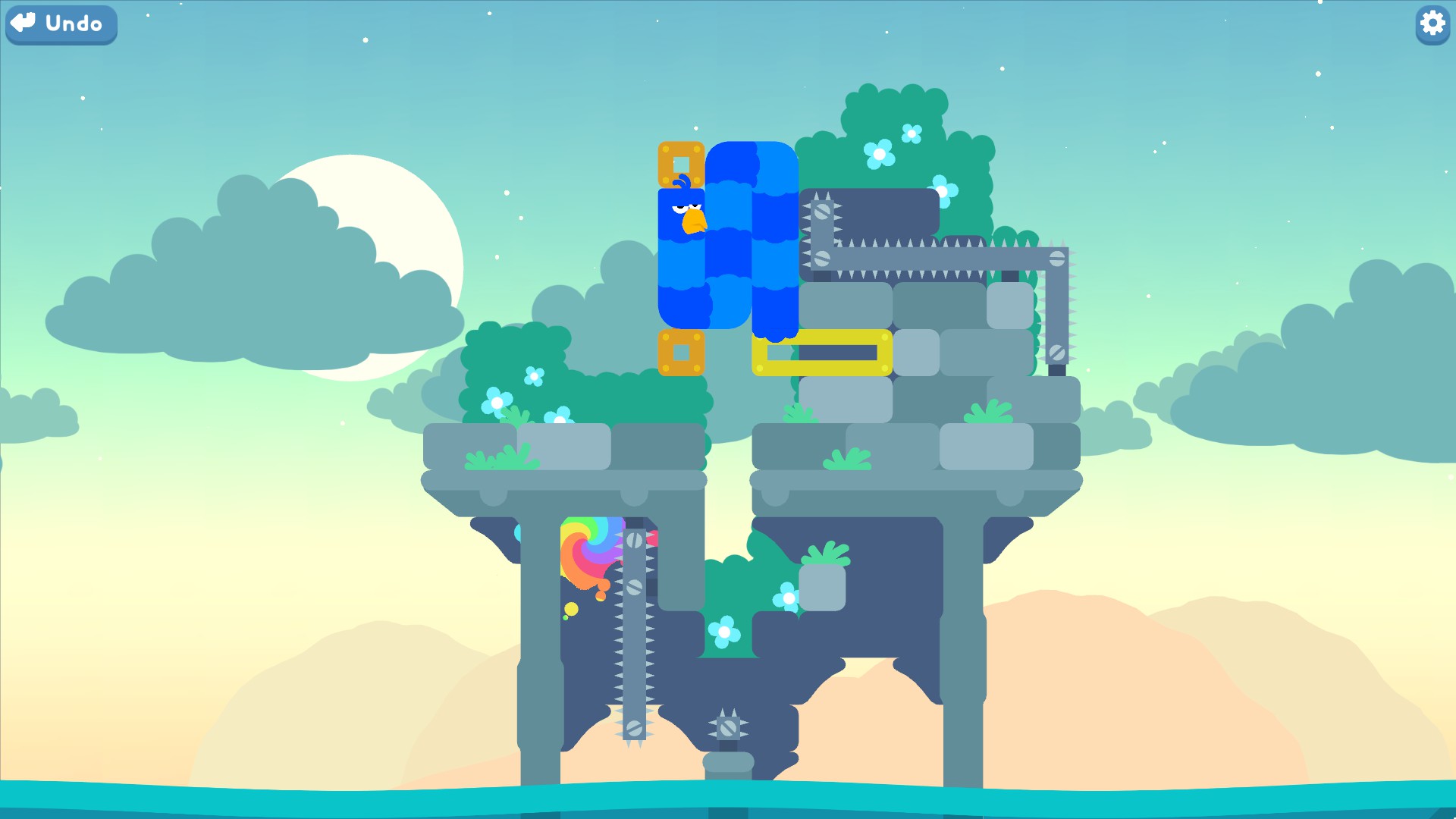
is a mischievous, downright evil game. Whereas most puzzlers try their best to ease the player into their mechanics (and occasionally struggle to live up to their potential), Snakebird deems all filler as fat, trimming itself down into a lean meal of pure muscle. Within minutes you'll be in the thick of it, left to your own devices to figure out the intricate mechanics of this cruel, blocky world. A creeping frustration will mark the start of your downward tumble into insanity as you bang your head against one "impossible" puzzle after another, exacerbated cries of "HOW DO I DO THIS?" leaking from your lips. Do not let the charming art style and cute birds fool you—Snakebird is forged from raw nightmare fuel.


On its surface, Snakebird is simple—deceptively simple. Your gluttonous snakebirds have only two objectives: eat all of the fruit on a level, and then escape through the rainbow portal. For each piece of fruit a snakebird consumes it will grow by one block, allowing it to reach new areas and bridge wide chasms. While this doesn't sound too bad, remember that gravity is an omnipresent menace, requiring your snakebirds to be anchored by at least one square or face plummeting to their doom. Like I said, it's an uncomplicated premise, but the way Noumenon Games designs their stages will wring every ounce of brainpower out of your feeble little mind.

Don't believe me? Out of its 50+ levels, it's Level 2 that's your first impasse—one of the game's introductory puzzles! And the experience doesn't get easier from there, oh no; expect to be stymied frequently, even multiple times within the same stage. You'll contort your snakebirds into painful configurations in order to reach sequestered fruits... and then realize you've gotten them permanently stuck (Level 11, 42). Or you'll spend half an hour reverse engineering how to reach every piece of fruit... but fail to plan an escape route back to the rainbow portal (Level 21, 45). Should you even chance upon the rare "easy" puzzle, expect Snakebird to throw a curveball soon after, leaving you more stumped than the remains of a lumberjack's rampage (Level... well, every level).


What truly catapults Snakebird into the lunatic stratosphere are three brain-bending mechanics that get slowly introduced. The first is the ability to control multiple snakebirds, dynamically changing how you move about the world (Level 19, 26) while also tacking on more ways you to get yourself stuck (Level 17, 20). The second is some good old fashion box pushing, which will rankle you beyond belief as you struggle to transport the stubborn squares from point A to point B (Level 23, 39, *1). And third is playing with position-swapping portals, which require as much terrifying foresight as you can imagine the mechanic implies (Level 38, 44).

While the odds may be stacked against you, at least you always have the "Undo" button in your back pocket, allowing you to backtrack all the way to your very first, naïve move. Without it the game would be hilariously unplayable, given how often your snakebirds worm their way off of cliffs or jam themselves into a corner. The only downside is that you have to mash the backwards key in order to return to "safe" point on the longer levels, forcing you to relive all of the turns you wasted putzing about. The "Undo" button is still a much appreciated, integral mechanic—I just wish it was a rewind function with a preview instead.

If it sounds like I reviled my torturous time with Snakebird, the opposite is actually true—I greatly adore and respect the game! It may have been unexpectedly brutal but it's never cruel for the sake of it; Snakebird treats you as an adult, letting you know early on that it's going to take your time with it seriously. To use a sour but effective phrase, Snakebird is the Dark Souls of puzzlers: you either adapt to its stubborn rules or scamper away with your tail between your legs. The stages themselves are truly impressive, often containing a singular solution with very little wasted space or structural red herrings. It's an utterly phenomenal video game from a design standpoint alone—and probably the best 2D puzzler I played since The Swapper—but heed the warning I've been echoing this entire entry: Snakebird is not welcoming, soft, nor remotely pitying. Some of the latter stages are so difficult (curse that final level!) that you may find it easier (and quicker!) to chew through an ingot of pure iron.


Snakebird is a brilliant puzzler but I was nevertheless relieved to finally be done with it. This goddamn game has haunted me for far too long—I've been trying to beat it since 2016! Well, not actively—more like once a year until I get overwhelmed—but its presence has weighed heavy on my prideful mind, holding me back from exploring games like Baba is You, Recursion, and Magnibox. "How are you going to bridge this gap?" It would jeer when I ran out of all feasible options, "Which snakebird should eat the fruit? How do you wriggle out of this spot? How are you going to move this box across the entire level?" Snakebird is deceptive and malicious, but like any good villain it's also exceedingly smart—so smart that I can think of few games as downright sinister as it. So congratulations Noumenon Games; I can only hope you're using those dastardly brains of yours nowadays for good and not ill—because lord help us if you aren't.

Wednesday, January 19, 2022

Super Mario Bros. 2 (US) - Thoughts


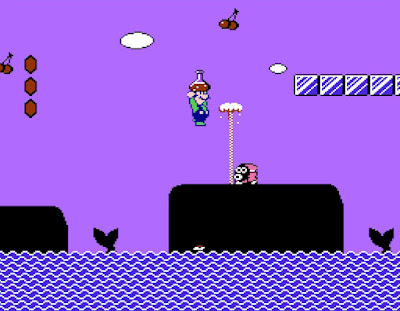
When it comes to Super Mario Bros. 2, opinions are usually split in one of two directions: either it's the black sheep of the series, or it's one of the most innovative titles in the 2D franchise. For me, I've always drifted towards the former—the Mario series is rooted in momentum based platforming, so why include all this turnip tossing? Doki Doki Panic's fingerprints were too large, too extraneous; the once-pristine waters of platforming had been muddied by root vegetables, key escorts, and dimensional doorways. As a sequel, Super Mario Bros. 2 may not have strayed as far as Link's Adventure, but it was similarly fated to live in the shadow of its younger siblings. Charitably, Super Mario Bros. 2 was an ambitious anomaly. Critically, it was a bizarre offshoot.

However, that kind of puritanical thinking is woefully outdated, especially given the smorgasbord of entries found across the (nearly) forty-year-old franchise. Super Mario Bros. 2 is actually more of a "loyal platformer" than Donkey Kong '94, Yoshi's IslandSuper Mario RPG, or even Super Mario Sunshine—hell, it's more like Super Mario Bros. than the arcade progenitor is! The eccentricity that made Super Mario Bros. 2 an outlier ironically works to its advantage, giving it a more colorful, charming, and memorable identity than that of its Japanese counterpart—or even the entirety of the New series! Super Mario Bros. 2 may not be the ideal sequel that 3 ended up being, but nor is it a mediocre outlier as I once narrowly thought in my youth.

It's simply a good game, all things considered.


As an adolescent, what I disliked the most about Super Mario Bros. 2 is that you no longer defeat enemies by stomping on their heads. This creates a noticeable change in rhythm, where the accuracy of your throw now takes priority over the momentum of your jump. The game feels less speedy, less urgent—and the lack of a time limit means you can scrounge for mushrooms or farm hearts at your leisure. While I no longer defensively correlate "different" with "bad", I still feel that Doki Doki Panic's framework makes for a poor Mario game.

That's not to discount everything Super Mario Bros. 2 brings to the table, however. Besides the vegetable pitching, there's distinct themes to each world, plenty of secrets to scavenge for, the aforementioned key caretaking, and a versatile bestiary that's sprinkled throughout the adventure. No longer must you wade through repetitive castles and topple marginally different psuedo-Bowsers—Super Mario Bros. 2 boasts a wide variety of bosses that require different approaches, an achievement the series wouldn't top until Yoshi's Island. Even the multitudinous Birdo duels are always exciting, thanks in no small part to the alterations made to her arena each fight.

But by far the best thing Super Mario Bros. 2 brings to the table—which the franchise foolishly leaves behind—is its quad of playable characters. I didn't find much value in the choice as a kid (Luigi was the only one I played), but bouncing between the protagonists really livens up the gameplay. They're a well-rounded cast that's distinct from one another without requiring that you learn a completely new playstyle. Plus you can tailor your choice on a per stage basis, effectively nullifying tricky sections. Can't quite jump on the fish in 5-1? Zoom across with the Princess! Want to easily reach the secret mushroom in 2-3? Jump sky-high with Luigi! Need to dispatch a boss quickly? Switch to Toad! Unsure what's ahead of you? Well-rounded Mario to the rescue! My only complaint is that I wish you could change characters after losing a life—something the All-Stars version wisely remedies.


Despite the vast number of changes Super Mario Bros. 2 introduces, one thing it maintains is its predecessor's knack for exploration. You won't be jumping down pipes and headbutting blocks for goodies however—instead you'll peek into jars and slip through doorways into the ephemeral Sub-space. There's not much to talk about with the former—most of the jars are copy-pasted bore-fests—but the door-conjuring potion is an excellent addition, letting you manually choose where to explore. Sniffing out mushrooms is an entertaining diversion, as even when you fail to unearth one, you can still harvest the nearby coins.

... Except the coins kind of suck this time around. In Super Mario Bros. they're the promise of a reward, scattered throughout stages to incentivize jumping while simultaneously building towards a 1-up. In Super Mario Bros. 2, they're the chance of a reward, easily farmed in Sub-space for the sole purpose of feeding them to a capricious slot machine. And unless you're rolling cherries, expect to walk away empty handed most of the time. I concede that gambling is a more... exciting alternative to fractionally collecting 1-ups, but I prefer the dependability of the old system—especially when you're in dire need of an extra guy.

Likewise, stars and hearts are useful powerups that have been rendered unfortunately unreliable. With no way to track when the next one will appear, you either have to make an educated guess or hope one will pop up when you need it. Similar to the slot machine, this isn't a massive foible; I just prefer openly predictable systems to (seemingly) random ones. In fact, there's not really anything I'd categorically claim as "bad" in Super Mario Bros. 2—the game just makes a lot of strange decisions is all. The level design is occasionally strange as well: 6-2 is so short that it feels unfinished, one path in 7-2 is notably harder than the other, and the precision required for 5-1 could make the Lost Levels blush.

Note that the worlds in Super Mario Bros. 2 still blow the first game out of the water. Whereas I had to rummage to find notable stages in Super Mario Bros., its successor won't leave you wanting. There's climbing sections, bomb puzzles, sandy excavations, magic carpet rides, ice rink races, and more platforming than you can shake a carrot at. While I find the base gameplay of the original more entertaining moment-to-moment—controlling classic Mario is like wrangling a wild beast—Super Mario Bros. 2 offers a hell of a lot more to the player on their first playthrough. Subsequent playthroughs are... less compelling, even with alternating characters, but not every game needs to endure a dozen replays to be considered worthwhile.


One of the few upsides of growing older is learning to appreciate the things you've previously dismissed. Although Super Mario Bros. 2 remains one of my least favorite Super Mario games, it's a lot better than I previously thought. I've learned to accept the change in gears, appreciating how it trades the frantic momentum of the first for a more relaxed, varied, and lob-heavy playstyle. Plus its four playable characters give it a depth that I can only hope the 2D series embraces again some day. I may not always be in the mood to return to Super Mario Bros. 2, but whenever I do, I never have a bad time.

Saturday, January 8, 2022

Hollow Knight - Thoughts


[contains minor spoilers]

In spite of its gloomy demeanor, Hollow Knight is a blindingly brilliant game. Name any aspect—music, visuals, gameplay, ambiance, boss fights—and Hollow Knight not only delivers on that front but does so with an enviable finesse. It's a carefully crafted experience that's breathtakingly massive, lasting longer than most Metroidvanias without ever slowing down or losing its grip on your curiosity. In spite of its monstrous size, Hollow Knight develops slowly, maturing from an exploration-focused platformer into a behemoth of buttery-smooth combat. What I appreciate most however, is that it rarely holds your hand—instead, it shoves you off of a steep cliff, hurtling into the dark unknown.


At first, it can be hard to acknowledge what makes Hollow Knight so damn special. Its intro is dusty and modest, calmly welcoming you to its kingdom and preventing you from getting lost or diving too deep. Within the first few hours you might feel that the color palette is lacking, that enemies are devoid of flavor, and that your moveset is disappointingly simple. Even after your first few bosses, you may remain vaguely unimpressed, skeptical how this little bug of a game could even challenge the gods of the metroidvania genre.

But gradually as you plumb its depths, Hollow Knight will start to click. You'll emerge onto the rain-soaked streets of the City of Tears, amazed at the game's quiet melancholy. You'll delve into the unnerving Deepnest, aghast at the size of the maze before you. And once you fell the Broken Vessel (or best the first arena challenge), you'll begin to understand how truly invigorating the combat feels. Time and time again, Hollow Knight will surprise you in miniscule ways, frequently eliciting an unexpected "wow that's cool!" or gasp of "oh I see!" Whereas some games suffer a death by one thousand cuts, Hollow Knight epitomizes the inverse, soaring high off one thousand plaudits.

Of these accolades, one of the most refreshing is how the game handles customization. Along with your standard energy & hp upgrades, you can uncover charms hidden throughout the Hollownest—ability-changing modifiers that range from minimal to revolutionary. You can only have a handful equipped however, with impactful charms taking up more space than simpler ones. At first this system appears unremarkable (one of the first charms you get is just a compass) but by the end you'll have a wealth of options. Should you make a magic build? Focus on melee? Defense? Minion spam? What about a glass cannon that can't heal? Charms allow for a variety of playstyles, and my favorite thing is that you'll always wish you had space for just one more.


Likewise, I adore the mapping system, although I understand the criticism against it. Hollow Knight treats mapping as a privilege, not a right—in order to receive even a bare-bones outline of the zone you're in, you have to sniff out the hiding spot of a particular vendor. While he's never too far off the beaten path, this adds to Hollow Knight's labyrinthine nature; you're better off memorizing room layouts as well as optimal routes, even with the map secured in your back pocket. I can see how this can be frustrating to the less-directionally inclined, but I absolutely adored etching this world onto my brain. Most of the rooms have at least one aspect that helps make them memorable (enemy, background, tricky section) and the pin system wisely reminds you which spots to return to in the future.

Capturing the magic of the world map best, in my opinion, is a late-game side mission where you have to run from one end of the Hollownest to the other—without taking damage. What's great is that the path isn't immediately obvious; there are several dozen rooms between you and your objective, and only by recalling what's in them can you plot the safest route. Should you risk fighting tougher foes for a shorter journey? Is the northern section of Queen's Gardens safer than the southern section? Are there any charms that can help you? It's an arduous journey that will reveal how much you know about the game's world, and it's one (among a myriad) of reasons why I enjoyed my playthrough so much.

Combat is another one of Hollow Knight's strong suits, and it's the aspect that evolves the most over the course of your journey. Like with the exploration, it's nothing remarkable at the start—all you're really doing is smacking foes with a single blade strike. But by end you'll feel like a subterranean samurai, dispatching foes with an awesome speed and grace. Seamlessly, you'll learn to blend spellcasting with charged techniques, figuring out how to dash in as well as dancing atop an enemy's head. Yet Hollow Knight's staggering bestiary will keep you humble—especially when it comes to the bosses. Anyone that has faced NKG and lived to tell the tale knows that this game has some of the hardest, frantic, white-knuckled boss battles the metroidvania genre has ever seen. Even though there's a few stinkers, the majority of them provide a delectable dance you'll be yearning to savor again.


Lastly, a cool ability unique to Hollow Knight is the Dream Nail: an ethereal blade that can peer into the mind of creatures both living and dead. Gameplay-wise it does very little—it physically lets you access a couple more boss fights and new areas—but it deepens the already-rich atmosphere of the world, enticing you to Dream Nail enemies and bosses just to see what they're thinking. Plus later on, it gets the ability to create custom checkpoints, which is a skill so useful that it practically feels essential for every large-scale metroidvania going forward.

For all of Hollow Knight's many, many achievements (I didn't even touch on how utterly majestic and passionate the soundtrack is) perhaps the biggest knock against it's clearly a child of the Souls school. There are plenty of parallels you can draw between the two: healing that leaves you vulnerable, corpse runs, a dying civilization, light vs dark, the final battle with a tragic figure, etc. Likewise, the Knight's agile abilities are reminiscent of Super Metroid, with Mantis Claw echoing Samus's infinite wall jump and the Crystal Heart working as a horizontal-only shinespark. Of course, Dark Souls and Metroid don't have a perpetual patent on these systems; I'm merely pointing out that Hollow Knight owes much to its spiritual forebearers.

If that sounds like a weak criticism to you—honestly, that's because it is. Hollow Knight brings enough personality and new concepts to the table that I think it's pretty easy to overlook its soulsian tropes. The detailed setting alone keeps the game from feeling like an uninspired knock-off; I can firmly remember more about the Hollownest than Metroid Dread's ZDR. Hollow Knight also features an extensive and lore-filled postgame centered around increasingly-difficult boss gauntlets, which I'm frankly not sure I'll ever beat (besting NKG was enough excitement for me.) Still, it's cool to see how Team Cherry has supported the title post-launch, and that they're as passionate about the game as its most ardent fans are.


I don't believe any piece of media is "perfect", but Hollow Knight is one of the blessed few to come shockingly close. It's an experience that you can't help but think back to, ruminating on all the cool things about it and the different ways it surprised you. You'll discover bizarre secrets, witness character deaths, rescue a maiden, get robbed, uncover a zone below the lowest point on the map, and much more; Hollow Knight is teeming with events humbly waiting to be stumbled upon. It's an experience that's centered around discovery, offering a seemingly dead world you'll realize is burdened by loss, regret, and broken dreams. Throw in a solid amount of customization and some of the fiercest boss battles ever made, and it's hard not to overstate the appeal of the game. Ultimately however, how much you end up getting out of Hollow Knight depends on how deeply you want to dig—and the greater the effort, the greater the spoils.

Tuesday, November 30, 2021

Phoenix Wright: Ace Attorney - Dual Destinies - Thoughts


[contains minor spoilers]

Like Mega Man X6, Phoenix Wright: Ace Attorney - Dual Destinies is an unnecessary sequel to a finished storyline, failing to do a single thing better than its predecessors. Unlike X6 however, Dual Destinies remains a "fun" experience from start to finish... provided you can ignore its flagrant leaps in logic. The core Ace Attorney experience remains intact—quirky characters, queer mysteries, and plenty of manzai—so it's not like Dual Destinies is the untouchable black sheep of the series. It's just that the game is... sadly mediocre.


The big question that Dual Destinies struggles with is "who is the main character?" There's effectively three different protagonists (Athena, Apollo, and Phoenix) and they often bump shoulders to stay in the spotlight. By all accounts Dual Destinies is Athena's story and I quite like her cheery demeanor—but Phoenix Wright curiously receives the most screen time. Meanwhile Apollo flitters about, initially acting as a straight man to Athena's naïve goofery before transforming into this weird... aloof vigilante? It's hard to discuss him without veering into spoilers, but I can reveal that despite the series landing into his hands in Apollo Justice, he (and Trucy) have been wrongfully sidelined here. It's like Capcom wanted to return to the Phoenix Wright of old, as well as continue Apollo's journey, and introduce a brand new character. And then instead of making different franchises for each, the developers shrugged and mashed them all together, not realizing it would result in an unsatisfying and messy story.

Speaking of, Dual Destinies comes with plenty of fun twists and turns fans have come to expect from the franchise, but the central theme underpinning the game is extraordinarily weak. Dual Destinies hammers home the ominous "dark age of the law" at every opportunity it can get in its latter half, but it doesn't lead to any pointed remarks or nuanced insights. In fact, the story feels like the most uninspired shonen anime, where "truth = good, lies = bad" and your clients are hopelessly innocent while the killers are unapologetically evil. Even the game's central antagonist—the elusive "Phantom"—shows a lot of promise in the case they're involved in, but the trial inevitably devolves into slapstick, stretching the limits of plausibility as you cry out, "How the hell haven't you been arrested yet?!"


While I can forgive the storytelling of Dual Destinies somewhat—Ace Attorney games never aim to be literature—I remain disappointed in how simple the game's cases are. Dual Destinies is obsessed with guiding the player to its solutions, badgering them with unsubtle hints even after the answer couldn't be made more obvious. On one hand it's nice being able to play a Ace Attorney game without gambling on loosely-related evidence, but on the other your brain barely gets a workout. The only time you're forced to seriously ponder a case is right before the game makes a bizarre leap of logic—surely the killer didn't go to this length to cover their tracks, right? There's always a little bit of that in every Ace Attorney title, but I don't remember it being quite so egregious and cartoony.

Ironically, the oft-derided case 5-2 was my favorite of the lot. I found its theme charming and each stage of the trail was interesting and vaguely plausible—outside of one or two details. It might also be because it centered upon the Apollo & Athena duo, which felt more refreshing than playing as Phoenix Wright for the... 13th? 14th time? Besides that, no other trial stood out to me as notable; 5-1 was unconventional but weak, 5-3 took a nosedive towards its end, and the final two cases squandered too much of the Phantom's potential.

But I'm not all groans and gripes—Dual Destinies knocks its presentation out of the park. The new 3D models are smooth and lively, replacing the 2D sprites almost seamlessly. Likewise the soundtrack continues the franchise trend of implanting secret earworms in your head and being generally fitting overall. I also enjoyed the new mechanic Athena brings to the table (the Mood Matrix), as its more engaging and sensible than having the magatama magically detect lies, or using Apollo's bracelet to repeat a sentence over and over. Occasionally the Mood Matrix could be misleading based on how you think someone should be reacting to the situation, but as there's no penalty for wrong answers, it's really not too bad.


I suppose I was too hasty comparing Phoenix Wright: Ace Attorney - Dual Destinies to Mega Man X6, considering the latter is an irredeemable trash fire while the former is just... dull. But conversely it's hard not to see Dual Destinies as the low point of an otherwise fairly remarkable series. It's loyal to the franchise's roots and earnest in its efforts, but its passion fails to overcome just how bog standard the entire game is. If you've not tired of Ace Attorney's peculiar brew, Dual Destinies might be your cup of tea. But I personally feel that Capcom needs to spice up this blend before it gets too bland...


... Thankfully, The Great Ace Attorney Chronicles would be the answer to my problem.
---------------------

Images obtained from: nintendo.co.uk, amino.com, gsmarena.com, toucharcade.com

Monday, November 29, 2021

BYE-BYE BOXBOY! - Thoughts


I leave the BOXBOY! 3DS trilogy more pleased than how I entered it, all thanks to its fabulous finale BYE-BYE BOXBOY! Despite failing to rid the series of its fiddliness, BYE-BYE BOXBOY! emerges well ahead of its predecessors by invoking their best aspects: BOXBOY!'s creativity and BOXBOXBOY's intensity. Gone are repetitive mechanics you've long-since learned, replaced by fresh ones like jump-boosting wind, box-buoyant water, weighted scales, and plenty more. On top of that are irritation-free escort quests (!) and four excellent new box powers that change how you traverse levels. Throw in some truly challenging bonus worlds, and BYE-BYE BOXBOY! becomes precisely the puzzle-platformer I wanted out of HAL.


However, I have to be honest—my brain's rotted a bit since I first played the series. I read my previous entries and nearly all of my criticisms still apply. The box limit sharply alternates between generous and cruel, mechanics can have unintuitive rules (eg no snaking in water), the front half of the game is too simple, and the performance-focused grading system remains an ill-fit for the experience. And yet... I wasn't really bothered by any of these... hence the rot. I've grown used to the roller coaster difficulty curve, the game's reliance on phantom boxes, and needing to restart a stage because I don't have enough boxes left to reach the final crown. While I recognize that these problems are no less prevalent in BYE-BYE BOXBOY!, they're somehow less irritating to me now, roughly as intrusive as an ant in my kitchen. Whether that's because I took a break between the games or I've just grown numb to the fiddliness, I'm unsure of—I'm just glad I didn't have to keep an ongoing list of mechanical eccentricities (besides the no snaking in water.)

Perhaps I owe my blind enjoyment to the bevy of new mechanics, each one keeping the gears in my brain turning. While there's still too many tutorial levels for my tastes, it's offset by the experimentation that comes with each strange new gimmick, pushing you to discover the ins and outs of how they operate. This is especially true for the new box abilities, which are easily my favorite part of the game. They're quick to understand but hide a lot of neat tricks, similar to what it was like getting the double box sets at the end of BOXBOY! Except instead of one game-changing power you have four, with each being better than the last. And as soon as you get a grasp on one it's time to move onto the next world—and the next mechanic.


I didn't truly appreciate BYE-BYE BOXBOY! until I reached the end, where the postgame worlds nearly doubled my playtime. I had multiple zen moments here as seemingly impossible puzzles gradually unfolded from "no way!" into "oh that's how!" Most of the stages took multiple attempts, lasting anywhere from three to thirteen minutes, with the worst offenders being 19-6, 20-5, 21-7, and 21-8. These stages were not only tricky to figure out but came saddled with painfully precise box limits, forcing me to develop new ways to cut corners. Although I managed to figure everything out on my own, I definitely wouldn't fault anyone for getting stuck here and dropping the game. For me though, it was puzzle nirvana.

Luckily, for the less intrepid there's the new challenge worlds: single-screen puzzles with a nifty restriction, like no throwing boxes, snaking, or even jumping. They're not as stupefying as the postgame worlds but they can occasionally throw out a solid stumper like C4-5 and C5-8. I like that these act as clever glimpses into more ways that HAL could play with the BOXBOY! formula, though I doubt a full game could be made from them like the dual box mechanic was. Still, the challenge worlds offer a diverse set of puzzles that play with your understanding of BOXBOY!'s usual mechanics—which is true of all of BYE-BYE BOXBOY! and is likely why I enjoyed it so much.


Overall, the BOXBOY! trilogy is an entertaining and cute set of games, although I'm unsure if I'd call them "essential." They're worthwhile puzzlers for the 3DS in any case, rivaled in my mind only by the Pushmo titles (which I remember being far more delightful and less confounding, but it's been a while). I also have to give kudos to BYE-BYE BOXBOY for achieving the rare feat of ending a trilogy on its highest note, closing out not with a whimper but a planet-sized bang. I've not played BOXBOY + BOXGIRL yet, but BYE-BYE BOXBOY has ensured that I'll go into it with a smile on my face...

... Likely because I'm finally immunized to its befuddling quirks.

---------------------

Images obtained from: nintendo.co.uk, michibiku.com, darkstation.com, 2dradar.com